

Child support payments aren’t deductible for the parent who pays them, and they aren’t taxable income for the parent who receives them.
If you’re staring at tax software, a divorce judgment, or a string of texts from an ex and wondering whether child support belongs anywhere on your return, you’re asking one of the most common post-separation tax questions. The confusion makes sense. Support payments, custody schedules, dependency claims, and changing IRS rules often get mashed together, especially during the first tax season after a divorce or breakup.
For Florida parents, the practical problem usually isn’t just understanding the federal rule. It’s making sure your parenting plan, marital settlement agreement, and tax documents all line up so nobody claims something they shouldn’t. That’s where avoidable disputes start. One parent assumes paying support means they get a tax break. The other assumes receiving support means they need to report it. Neither assumption is right.
The better approach is simple. Separate the questions. First, understand how the IRS treats child support. Then look at the separate issue of who may claim the child as a dependent. After that, make sure your Florida family law documents clearly spell out the tax terms so you don’t end up arguing with your ex, or explaining a messy record to the IRS.
Introduction Navigating Taxes After Divorce or Separation
The first tax season after a separation can feel oddly personal. You’re not just entering numbers. You’re revisiting the same issues that probably caused arguments before. Who paid what. Who had the child more often. Who gets to claim the child. Whether support counts as income.
A lot of parents type the same question into Google: can you claim child support payments on taxes? The answer is still no, but the reason matters because it affects how you organize your paperwork and how you talk about taxes with your ex-spouse or co-parent.
Think of child support and tax benefits as two different lanes. One lane is the payment itself. The other lane is the tax treatment tied to the child. People often merge those lanes and create trouble. A parent may believe, “I pay support, so I should get the deduction.” Another may think, “I receive support, so maybe I owe taxes on it.” Those are both common mistakes.
When parents confuse support with dependency rights, they often negotiate the wrong issue and document it badly.
For Florida families, this confusion shows up in settlement agreements, final judgments, and informal side agreements that were never written clearly. That’s where a federal tax rule collides with family law practice. The IRS has its own standards. Your court order has its own language. If the two don’t match, you’re left with a preventable mess.
The good news is that the basic rule is straightforward. The harder part is the follow-through. You need the right labels in the right places, and you need documents that say exactly who may claim what and when.
The Core Rule Child Support Is Tax-Neutral
A parent can pay child support every month for years and still get no federal tax deduction for it. A parent can receive that same money and still not report it as taxable income. That result feels counterintuitive until you separate family budgeting from tax classification.
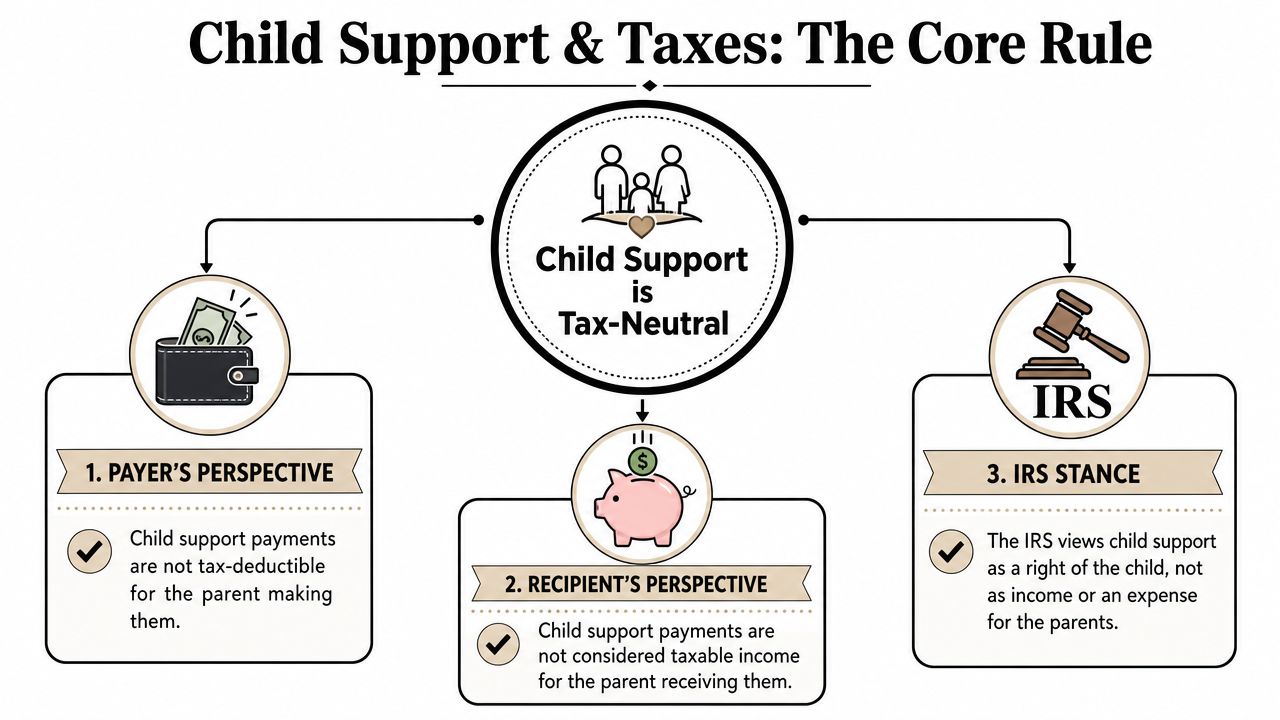
Child support is tax-neutral. In plain terms, the payment does not lower the paying parent’s taxable income, and it does not raise the receiving parent’s taxable income.
Why the IRS doesn’t treat child support like income
The IRS views child support as money one parent is required to provide for the child’s benefit. It is not treated like wages paid to the receiving parent, and it is not treated like a deductible personal expense for the paying parent.
That distinction helps clear up a common point of confusion. In everyday life, child support absolutely affects cash flow. If you pay it, you feel the expense. If you receive it, you rely on it to help cover housing, food, school costs, and other needs. But federal tax law uses different labels than a household budget does. The tax question is narrower: does this payment fit a category the Internal Revenue Code taxes or allows as a deduction? Child support does not.
Practical rule: Do not report child support as income, and do not claim child support payments as a deduction on a federal return.
For Florida parents, this rule matters most when support terms are written into a marital settlement agreement, final judgment, or later modification. If an order mixes child support language with other payment obligations, confusion starts fast. Clear drafting helps prevent two separate problems. One is a dispute with your ex-spouse about what a payment was meant to cover. The other is a tax filing mistake that creates trouble later.
What tax-neutral means when you file
For the parent who pays, child support generally stays off the deduction side of the return.
Here is the quick reference version:
| Parent’s role | Federal tax treatment of child support |
|---|---|
| Paying parent | Not deductible |
| Receiving parent | Not taxable income |
That is the core answer to “can you claim child support payments on taxes.” You usually cannot claim the payments themselves.
The better question is often whether your court order clearly separates child support from other obligations. That is especially important if your case also involves spousal support. If your paperwork uses broad words like “family support” or combines amounts without labeling them carefully, review a Florida alimony tax overview and compare it against your order before you file.
Good records help here. Keep the signed order, any modification, and a payment log that matches what was paid. In Florida cases, those documents often matter just as much as the tax return itself if a disagreement comes up later.
Child Support vs Alimony A Critical Tax Distinction
A common Florida divorce problem looks like this: the final judgment says one parent will pay a monthly amount for “support,” the parties read that word differently, and tax season turns a drafting problem into an argument. One parent treats the payment like child support. The other assumes part of it was meant for a former spouse. The IRS and the family court will not sort that out based on guesses. They start with the written order.
Parents use the word “support” as a catchall. Tax law does not. Child support and alimony are separate categories, and the wording in your decree, settlement agreement, or modification order matters for both tax filing and future enforcement.
Why the distinction causes so much confusion
The mix-up is easy to understand. Both payments may appear in the same divorce papers. Both may be due on the first of the month. Both may be paid by the same person to the same household.
But they serve different purposes. Child support is meant for the child’s benefit. Alimony is meant to support a former spouse. That difference is the tax starting point, and in Florida cases it should also be clear on the face of the order.
If your case includes spousal support, a Florida alimony tax overview can help you compare the categories against the wording in your own documents.
Why the date of the alimony order still matters
Alimony has an extra layer that child support does not. The tax treatment of alimony changed for many divorce or separation instruments executed after December 31, 2018. Older instruments can follow different rules, depending on the date and any later modification language.
That timing issue trips people up. They hear that “support” is no longer deductible and assume every payment works the same way. Or they remember the old alimony rule and apply it to child support. Both shortcuts cause filing mistakes.
A simple comparison helps:
| Payment type | General tax treatment |
|---|---|
| Child support | Not deductible to payer, not taxable to recipient |
| Alimony under instruments executed after December 31, 2018 | Generally not deductible to payer, not taxable to recipient |
| Older alimony arrangements | May follow different tax treatment depending on the instrument and later changes |
One practical way to think about it is this: child support has stayed in its own lane, while alimony rules depend more heavily on the date of the paperwork. If your Florida order blends the two into one monthly figure, you lose that clear lane marking. That is where later disputes begin.
If your order combines child support and alimony carelessly, the problem often surfaces months later, when one parent files based on memory and the other points to a different interpretation of the decree.
For Florida families, careful drafting is not just tidy paperwork. It is evidence. A well-written order should separate child support from alimony, state the amount for each, and match the labels used in any later modification. That gives you something concrete to show your ex-spouse, your accountant, or the IRS if questions come up later.
Related reading:
Not Getting Child Support Payments? Here’s What Actually Works in 2026
How to Get Back Child Support in Florida
Child Support
Claiming Dependents and Tax Credits: Where the Savings Are
Filing season often exposes a problem that had been sitting unaddressed in the background. One Florida parent has been paying support all year and assumes that means a tax break follows. The other parent has the child most overnights and assumes the return is straightforward. Then both returns go in, and the IRS treats the issue as a rule-and-paperwork question, not a fairness question.
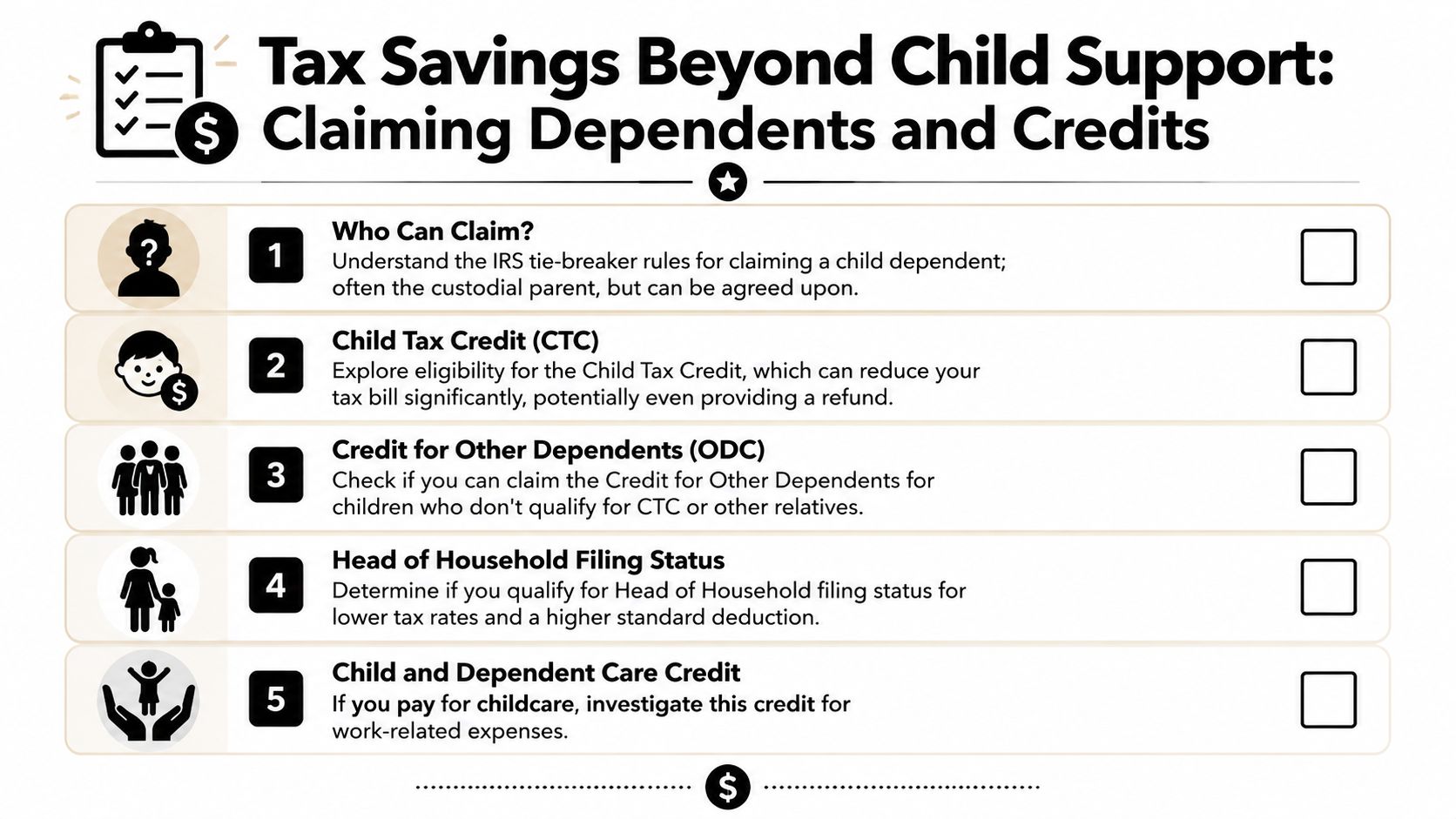
That is why the tax value in many family cases comes from the dependency claim and the credits connected to it, not from child support payments themselves.
Claiming a child is a separate tax issue
Paying support and claiming a child on your tax return are related in real life, but they are not the same rule under federal tax law. A parent may pay substantial support and still not be the parent entitled to claim the child. A parent may receive support and still need to meet the IRS rules for child-related tax benefits.
As noted earlier in Texas Law Help’s explanation of child support and taxes, the support payment itself is not the deduction. The tax question is who may claim the child under IRS rules.
A good way to view it is as two different files. One file is the Florida support case. The other is the federal tax return. They affect each other, but they do not answer each other automatically.
That distinction causes many disputes. One parent focuses on money paid. The other focuses on where the child lived. The IRS usually starts with residency, custodial status, and whether the required form was signed.
What a noncustodial parent usually needs
For a noncustodial parent, the right to claim a child usually depends on meeting the IRS requirements and having the right documentation. In many cases, that includes a signed Form 8332 from the custodial parent. Without that form, an informal side agreement often falls apart at filing time.
A text saying, “You can claim him this year,” may settle things emotionally between co-parents. It often does not settle things with the IRS.
If you are the parent planning to claim the child, check these points before you file:
- Confirm the family status for the tax year. The parents generally must be divorced, legally separated, or living apart under the IRS rules that apply to separated parents.
- Review where the child resided. Overnight counts and the governing parenting schedule matter more than assumptions.
- Check whether the child was supported by the parents. The IRS looks at support rules separately from the child support label in your court order.
- Get Form 8332 if required. A signed release is often the document that makes the noncustodial parent’s claim work.
- Match your return to your records. Your tax filing should line up with the final judgment, settlement agreement, parenting schedule, and signed forms.
For Florida parents, this is where careful drafting matters. If your settlement says you alternate tax years, the tax language should also say who signs Form 8332, by what date, and what happens if a parent refuses. A vague promise to “share tax benefits” is like a house key that only opens half the lock.
Which tax benefits are usually tied to the child
Parents often say they want to “claim the child,” but what they usually mean is that they want the tax benefits attached to that claim. Depending on the facts, those benefits may include the Child Tax Credit, the Credit for Other Dependents, Head of Household filing status, or the Child and Dependent Care Credit.
Each of those benefits has its own rules. Some follow the dependency claim more closely than others. That is one reason tax disputes after divorce can get confusing fast. A court order may say one parent can claim the child for one purpose, while federal tax law still applies separate rules to a different credit or filing status.
Florida parents should also remember that child support calculations and tax planning often interact in practice, even though they are not the same legal question. If you want background on that connection, this guide on how child support is calculated in Florida helps explain the support side of the equation.
The practical lesson is simple. Do not ask only, “Who paid support?” Ask, “Who meets the IRS rule, and what documents prove it?” That question prevents more trouble, both with an ex-spouse and with the IRS, than almost anything else in this area.
Practical Steps for Florida Parents Documenting Your Agreement
In Florida family cases, tax disputes usually don’t start with tax law. They start with vague drafting. A final judgment says the parties will “share tax benefits.” A settlement agreement says the parents will “work it out each year.” An email says they will “alternate if support is current.” None of that is clear enough when filing season arrives.
Write tax terms clearly in your Florida paperwork
If you’re negotiating a marital settlement agreement or parenting-related order, spell out the tax terms in plain language. Identify which parent claims which child, in which tax year, under what conditions, and what documents must be signed.
That means naming the form when needed, setting deadlines for signatures, and stating what happens if one parent fails to cooperate. If parents intend to alternate years, say that directly. If one parent’s right to claim a child depends on compliance with the agreement, define the compliance standard clearly instead of leaving it implied.
Florida child support and timesharing issues often overlap in practice, so it helps to understand how support is determined in the first place. This overview of how child support is calculated in Florida gives useful context for how these issues can connect, even though the tax treatment of support is separate.
Keep records that answer questions fast
Good records reduce arguments. They also make it easier if a tax preparer, accountant, or attorney has to step in later.
Keep these documents together in one folder, digital or paper:
- Your final judgment or settlement agreement: Use the signed version, not a draft.
- Parenting plan and timesharing records: Calendars, school records, and shared schedule logs can matter if custody facts are disputed.
- Support payment records: Bank statements, payment portal records, and receipts help show what was paid, even though the payments themselves aren’t deductible.
- Signed tax forms: If Form 8332 applies, keep the signed copy where you can find it immediately.
- Written parent communications: Save messages that confirm tax-year agreements, but don’t rely on them as a substitute for the required form.
In Florida cases, the strongest tax clause is the one a third party can read years later without asking either parent what they meant.
One more drafting point matters. Avoid vague labels that blend child support and spousal support into one combined amount if clarity is important. When money is not allocated cleanly, confusion grows. Clear categories make compliance easier for both parents and simpler for professionals reviewing the file later.
When to Consult a Family Law Attorney
Some tax questions are simple. Many post-divorce tax disputes are not. If you’re dealing with mixed support obligations, a noncooperative ex, or unclear settlement language, self-help often stops working quickly.
Situations where self-help often breaks down
Consider getting legal advice if any of these apply:
- Your order is vague: If it doesn’t clearly say who claims the child, when, and under what conditions, conflict is likely.
- Your ex won’t sign required documents: This is common with dependency-release forms and year-to-year tax cooperation.
- You have both child support and alimony issues: Mixed obligations create labeling and interpretation problems.
- Your parenting schedule changed in practice: Actual custody patterns can drift away from the written plan.
- You suspect the other parent already claimed the child: That can trigger filing problems and require a documented response.
A family law attorney can also help when an informal arrangement has worked for years, until it suddenly doesn’t. Those cases are tricky because both parents may be convinced they are following the deal.
Why legal help can prevent a bigger fight
An attorney doesn’t just answer a tax question. A good attorney helps match your tax position to your family law documents, your payment history, and your parenting facts. That reduces the chance of one bad filing decision turning into a larger dispute over contempt, modification, or enforcement.
If you’re looking at a Florida divorce, post-judgment dispute, or support issue with tax consequences, it’s also worth learning what to expect from a first meeting with counsel. This guide to a family law attorney consultation can help you prepare.
For many parents, the smartest time to ask for legal help is before filing, not after a return has already been submitted. It’s easier to prevent a dispute than to unwind one.