

You post a photo from a weekend trip. Your spouse’s attorney prints it out and hands it to the judge two weeks later. What felt like a harmless Instagram story becomes exhibit A in an argument that you cannot afford the alimony you claimed, or that you are not as present in your children’s lives as you testified. This is not hypothetical. It happens in Florida family law courtrooms regularly, and Miami-Dade County is no exception.
The reality of modern divorce is that your digital life is not separate from your legal case. Every post, check-in, tagged photo, and private message exists in a form that can eventually be used by opposing counsel, used to challenge your credibility, and placed in front of a judge at the worst possible moment. If you are not sure where to begin when it comes to protecting yourself legally, understanding what is the first thing I should do if I want a divorce can help you get oriented before the details of your case become more complex.
This article covers both sides of the equation: what not to post, why each type of post creates a specific legal risk, and what you can share safely during a Florida divorce.
Why Social Media Evidence Is Now Standard in Florida Divorce Cases
• Florida courts accept screenshots, posts, and metadata as legal evidence when properly authenticated
• Opposing attorneys search social media at the start of every contested divorce. It is standard practice, not a surprise tactic
• Nothing online is truly private. Even friends-only posts can be screenshot or forwarded by mutual contacts
• Deleted posts do not necessarily disappear for good, and deleting content after proceedings begin can be treated by the court as destruction of evidence, regardless of whether opposing counsel ever recovers the original post
Before you post anything else, consider this, you may already have content online that could be used against you in your proceedings. A qualified family law attorney Miami residents trust can help you evaluate what exists, what the risks are, and how to protect yourself going forward. That conversation is far more valuable before something becomes an exhibit than after.
A quick note on terminology, Florida law technically no longer uses the word “custody.” Since a 2008 revision to Florida Statutes Section 61.13, the legal terms are “time-sharing,” which is the physical schedule a child spends with each parent, and “parental responsibility,” which is the authority to make major decisions in a child’s life. This article uses “custody” throughout because it is the term most people search for and use in everyday conversation, but do not be surprised if your attorney and your paperwork use time-sharing and parental responsibility instead.
How Florida Courts Use Social Media as Evidence in Divorce
Social media evidence enters a Florida divorce case through three main channels.
- The first is direct review, opposing counsel looks at your public profiles at the outset of any contested case.
- The second is personal disclosure, your spouse, or someone in their social circle, provides screenshots directly to their attorney.
- The third is formal discovery, a request for production or court order directed at you, requiring you to produce your own account data, including message archives and content you may have deleted.
That third channel is worth understanding correctly, because it works differently than most people assume. Federal law, specifically the Stored Communications Act, generally prevents platforms like Meta from handing over the contents of private messages directly to an opposing party’s attorney, even in response to a subpoena. Platforms typically object and refuse to comply when asked to do this. What Florida courts do instead, and what opposing counsel relies on, is ordering the account holder themselves, meaning you or your spouse, to produce their own social media data through the discovery process. If that person refuses, deletes relevant content, or is not truthful about what exists, the court can impose real consequences, including sanctions for destruction of evidence and negative inferences about credibility.
Florida courts apply standard evidentiary rules on authenticity, meaning a post must be shown to have originated from you and must be relevant to a disputed issue in your case. In practice, these requirements are easy to meet. A public post on your profile, featuring your face, timestamped on a verifiable date, is admissible.
Florida is a no-fault divorce state under Florida Statutes Section 61.052. You do not need to prove your spouse did anything wrong to obtain a divorce. But social media evidence does not need to prove fault to damage your case. It can affect alimony calculations, parenting arrangements, and asset division arguments. Here is how each evidence type maps to the issues that matter most in your proceedings:
Social Media Evidence Type Which Divorce Issue It Affects
- Vacation and luxury purchase photos contradicts financial hardship claims. Directly impacts alimony and asset division arguments
- New relationship posts can affect alimony if it suggests a supportive, cohabiting relationship under Florida Statutes Section 61.14. Damages your custody position if a new partner appears with your children
- Party, drinking, or substance-related photos used directly to challenge parenting fitness in custody hearings
- Negative posts about your spouse demonstrate inability to co-parent. Damages custody position and may constitute contempt if a court order is already in place
- Location check-ins can contradict testimony about where you were, who you were with, or how you spend your time
- Financial wins such as bonuses, promotions, or new purchases contradict claims of limited income or inability to pay support
- Posts about the divorce, court proceedings, or settlement show bad faith, may violate confidentiality orders, and give opposing counsel ready-made material to challenge your credibility
7 Types of Posts That Can Hurt Your Florida Divorce Case
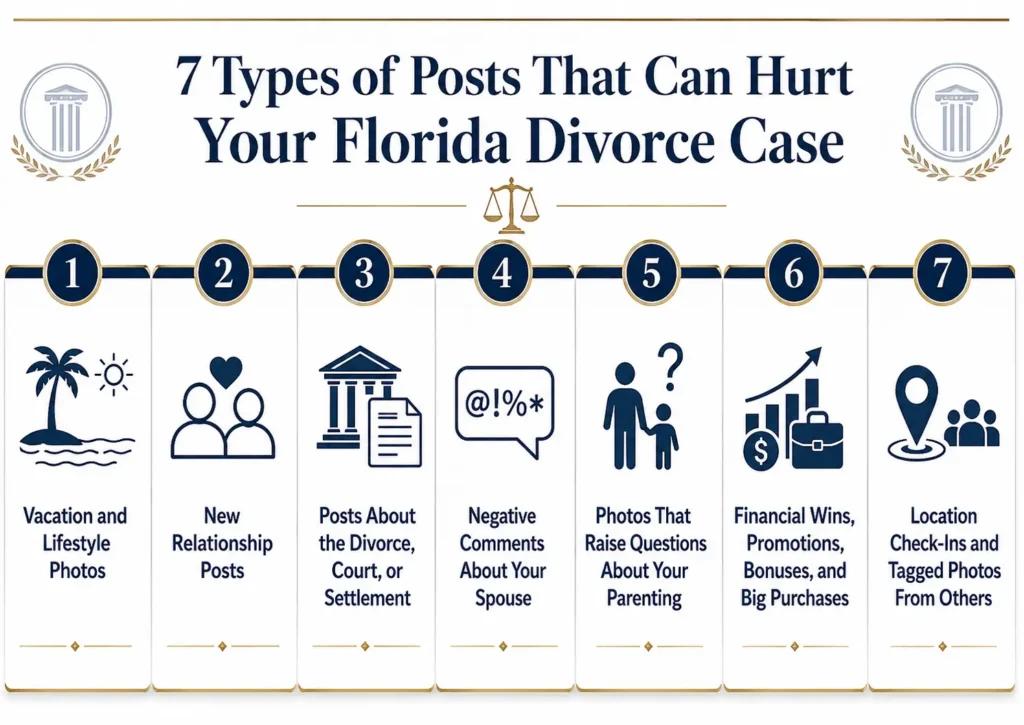
1.Vacation and Lifestyle Photos While Claiming Financial Hardship
Florida courts evaluate lifestyle evidence when assessing alimony and support claims. If you are arguing that you cannot afford higher payments while simultaneously posting resort photos from a weekend in the Keys or a tagged dinner at a Brickell steakhouse, you are giving opposing counsel exactly what they need to challenge your financial narrative. It does not matter that the trip was planned before the divorce or paid for by someone else. What matters is how it looks in a courtroom where your financial affidavit is already on the record.
2. New Relationship Posts Before the Divorce Is Final
Florida does not require proof of adultery to grant a divorce, and a new relationship alone does not automatically affect asset division. However, the downstream effects on your case can be significant. Under Florida Statutes Section 61.14, if your spouse argues that you are in a supportive relationship that resembles a marriage, including factors like living together and pooling finances, it can directly affect alimony calculations. Understanding the full legal implications of dating while going through a divorce in Florida is something most people underestimate. More importantly, posting photographs of a new partner with your children before the divorce is finalized signals to a judge that you are prioritizing your personal life over the stability of your children’s environment during a difficult transition.
3. Anything About the Divorce, Court Proceedings, or Settlement
Venting about your case online feels natural when you are under pressure. It is also one of the fastest ways to damage your legal position. Posting about what happened in a hearing, discussing terms of a marital settlement agreement, criticizing the process, or making comments about the judge or your attorney can be used as evidence of bad faith, may violate court-ordered confidentiality, and creates a written record that opposing counsel can use to challenge anything you say under oath.
4. Negative or Inflammatory Comments About Your Spouse
Florida family law judges evaluate co-parenting capacity in every contested custody case, including which parent is more likely to foster a healthy, ongoing relationship between the child and the other parent, one of the statutory best-interest factors under Section 61.13. Public attacks on your spouse, whether in a caption, a comment section, or a shared post, send exactly the opposite message. Courts take parental alienation seriously as a factor in these evaluations, and repeated negative online commentary about your spouse can be cited as evidence of conduct that undermines the parent-child relationship. If your children are old enough to access social media themselves, the damage extends well beyond the courtroom.
5. Photos That Raise Questions About Your Parenting
This category is broader than most people expect. A photo taken late on a school night. An event where alcohol or substances are visible in the background. A tagged location that contradicts your account of where you were on a specific evening. None of these need to be dramatic to create a problem. Opposing counsel builds credibility challenges from patterns, and a pattern of small inconsistencies between your social media activity and your courtroom account can be more damaging than a single compromising photograph. A solid child custody agreement Florida courts will respect starts with demonstrating consistent, responsible parenting, and that demonstration begins on social media.
6. Financial Wins, Promotions, Bonuses, and Big Purchases
Florida requires both parties in a divorce to file a mandatory financial affidavit disclosing income, assets, and liabilities in full, under Florida Family Law Rule of Procedure 12.285. Understanding exactly how to handle mandatory disclosure Florida requires, and what that document commits you to, is essential before you post anything financial online. When you celebrate a bonus on LinkedIn, announce a business win on Instagram, or post a photo with a new vehicle while your financial affidavit tells a different story, you have created a direct contradiction that opposing counsel will find and use. Financial posts are also regularly cross-referenced with hidden assets in divorce investigations, particularly in cases where one spouse suspects the other of underreporting income.
7. Location Check-Ins and Tagged Photos From Others
This is the category that catches the most people off guard, because it requires you to manage not just your own behavior but the behavior of the people around you. Even if you stop posting entirely, a friend who tags you at an expensive restaurant on an evening you said you were home with your children creates a credibility problem you did not cause but still have to answer for. Managing this risk means having a direct, honest conversation with your inner circle about what they post, share, and tag during your divorce proceedings.
Related reading:
Miami Divorce Trial Experience: How to Prepare Your Case
Why is Moving Out the Biggest Mistake in a Divorce?
Divorce & Separation
The One Rule That Prevents Every Social Media Mistake During Divorce
Every scenario above, from the vacation photo to the tagged check-in, fails the same simple test. Before posting anything during your divorce, ask yourself one question: “Would I be comfortable if the judge assigned to my case saw this?” If the answer is anything other than a clear yes, do not post it.
This question does not require you to understand family law or memorize evidentiary rules. It simply asks you to apply the same filter your attorney uses before any filing, any statement, and any courtroom appearance. If the post passes that test, it is probably safe. If you hesitate for even a second, it is not.
What you have already posted before the divorce started can also become an issue. Opposing counsel does not limit their review to content created after the filing date. If you are concerned about existing content on your profiles, a qualified family law attorney Miami can help you understand what the risks are and what, if anything, can be done about it without creating additional legal exposure.
What You CAN Safely Post During a Florida Divorce
Going completely silent on social media for six to twelve months is not realistic for most people, and it is not necessary. The goal is not to disappear. The goal is to post with intention and avoid specific categories of risk. The following types of content are generally low-risk during Florida divorce proceedings:
- Positive, neutral content with no financial, relationship, or parenting subtext. A book you read, a recipe you tried, a sports opinion, a comment on local news.
- Professional accomplishments that are consistent with the financial disclosures you have made in your case. There is a meaningful difference between posting that you completed a professional certification and announcing a significant salary increase while your financial affidavit states otherwise.
- Community or charitable involvement that demonstrates positive character without raising financial or parenting questions. Volunteer work, neighborhood participation, charitable contributions of time.
- Any content you have specifically discussed with your attorney and received clearance to post. When in doubt, ask first.
The thread connecting all of these is simple: nothing that touches finances, personal relationships, parenting situations, or the divorce itself belongs on your social media during your case.
What to Do Right Now If You Are Going Through a Divorce in Florida
• Step 1. Do not delete existing posts without speaking with your attorney first. Courts can treat post-filing deletions as destruction of evidence. Discuss what you have with your attorney before making any changes to your accounts.
• Step 2. Tighten privacy settings on every platform you use. This does not make content legally unreachable, but it reduces casual exposure and limits who can see new content going forward.
• Step 3. Have a direct conversation with close friends and family. Ask them not to tag you in posts, share photos of you, or create any content that places you in a specific location or situation during the proceedings.
• Step 4. Stop posting anything that touches the four high-risk categories: finances, relationships, parenting, and the divorce itself. The benefit of any single post is never worth the risk of what it could become in a courtroom.
• Step 5. Get legal guidance on your specific situation. Every divorce involves different disputed issues, and the content that creates risk in one case may be irrelevant in another. Only a qualified attorney who knows your case can tell you precisely where your vulnerabilities are.
Social media strategy during a Florida divorce is not something to figure out on your own. One misstep can undo months of careful legal work. The Law Office of John P. Sherman has helped many Miami-area families navigate the legal and practical complexities of divorce, including the digital side of the process that most people do not think about until it is too late. The consultation is free, confidential, and covers your specific situation.
Frequently Asked Questions
Can social media posts be used against me in a Florida divorce? Yes. Florida courts regularly admit social media content as evidence in divorce proceedings, including photos, check-ins, and, in some cases, messages and metadata. Public posts, content lawfully obtained through the discovery process, and screenshots shared by mutual contacts can all become exhibits in court.
Should I delete my social media accounts during a divorce in Florida? Do not delete posts after your divorce case has begun. Courts may treat this as destruction of evidence. You can deactivate or pause accounts, but consult your attorney before making any changes. The safest approach is to stop posting new content rather than deleting existing posts.
Does Florida’s no-fault divorce law mean social media posts don’t matter? Not entirely. While Florida does not require proof of fault to grant a divorce, social media evidence can still impact alimony, especially claims involving a new supportive relationship, custody and time-sharing decisions, and asset division arguments. Courts can use posts to challenge credibility and contradict sworn statements.
Can my spouse’s attorney get access to my social media accounts? Generally, yes, but not by simply subpoenaing the platform for your private messages. Federal law limits what companies like Meta can hand over directly to a civil litigant, and platforms typically refuse to produce message content even under a subpoena.
What happens in a contested Florida divorce is that the court can order you directly, through formal discovery, to produce your own account data, including content you may have deleted. Refusing to comply, or deleting relevant content after your case has begun, can lead to serious consequences, including sanctions from the court.