
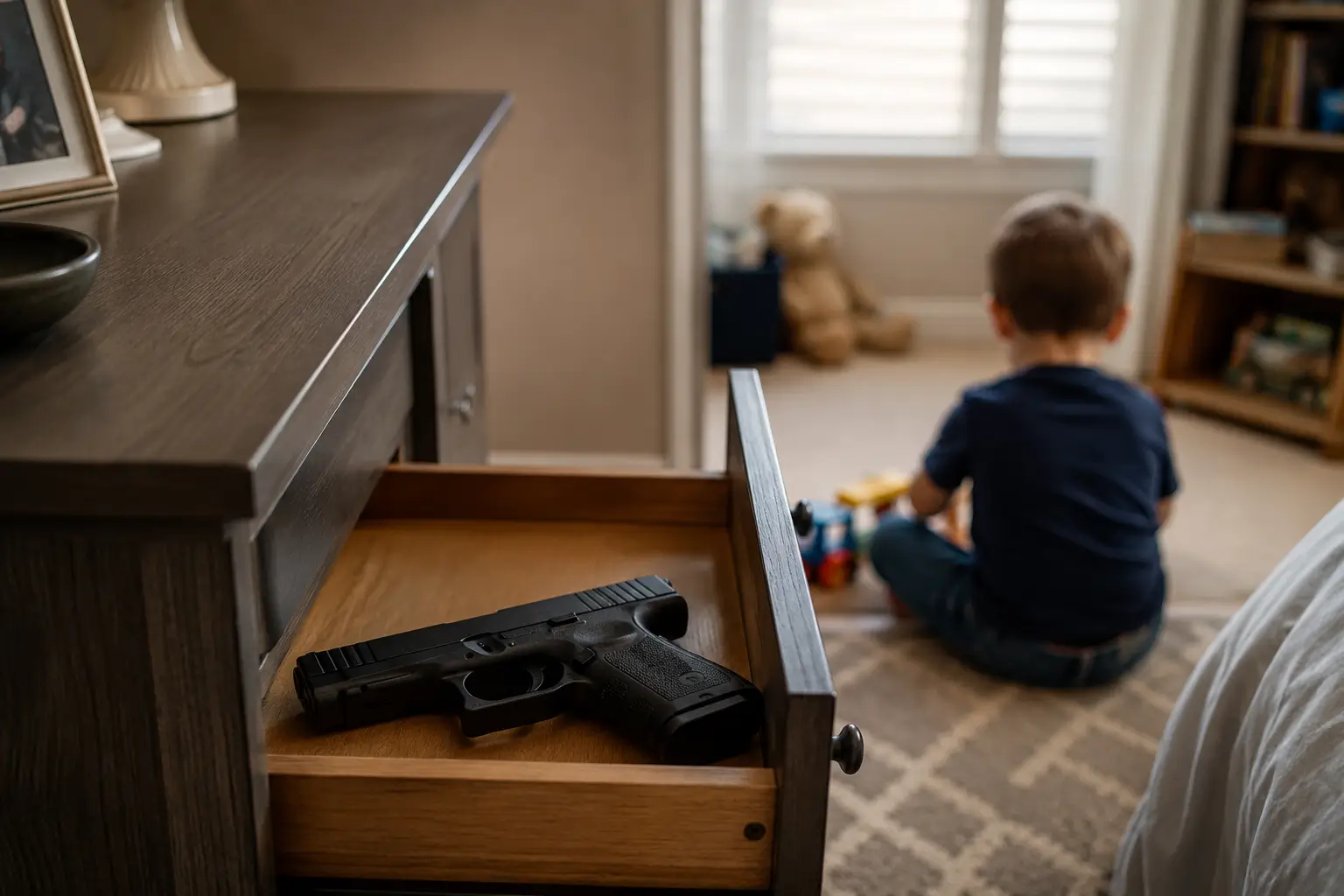
Every year, children across Florida are injured or killed because a firearm was left within their reach. These tragedies are preventable, and under Florida law, the adults responsible for securing those weapons can be held legally accountable. Whether the shooting occurs at a friend’s home, in a family’s living room, or during a supervised playdate, civil liability follows the negligence. If your child was harmed by an unsecured firearm, you have the right to pursue justice and full financial compensation.
What Families Need to Know When a Child Is Injured by an Unsecured Firearm in Florida
• Florida Statute § 790.174 (the Child Access Prevention, or CAP, law) requires gun owners to secure loaded firearms from minors under 16. A violation is strong evidence of civil negligence
• Multiple parties can be liable: the gun owner, parents, hosts, caregivers, and landlords depending on the circumstances
• A civil lawsuit is entirely independent of criminal proceedings. You can file a civil claim even if no charges were filed or the defendant was acquitted
• The civil standard of proof is significantly lower than in criminal court. “More likely than not” is all that is required
• Florida’s deadline to file a personal injury claim is 2 years from the date of the incident
• Evidence disappears fast. Acting immediately protects your family’s ability to build the strongest possible case
When a gun owner violates Florida’s Child Access Prevention Law, they do not simply make a mistake. They breach a statutory duty that Florida’s legislature created specifically to prevent exactly what happened to your child. Under the legal doctrine of negligence per se, a violation of a statute like this one, written to protect a specific group of people (children under 16) from a specific type of harm (unauthorized access to a firearm), creates a strong presumption of negligence in a civil claim. It does not decide the case by itself. The family still has to show that the violation caused the injury and what that injury cost, and the defendant can try to show the violation was excusable. But starting a case with that kind of presumption already in place is one of the strongest positions an injured family can be in. For families pursuing civil accountability after a child firearm injury, that matters enormously. The Law Office of John P. Sherman represents families in exactly these situations throughout Florida, and your first consultation is completely free.
Florida’s Child Access Prevention Law: What Gun Owners Must Know
Florida’s Child Access Prevention (CAP) law is codified under Florida Statute § 790.174. It establishes a clear legal obligation for firearm owners: if you store a loaded firearm in a location where a minor under the age of 16 can access it, you are required by law to secure it with a trigger lock, in a locked container, or in a location a reasonable person would consider secure.
Failure to comply with this statute can result in criminal charges, and it is important to understand that Florida actually addresses this conduct through two separate statutes depending on what happens next. Beyond the criminal system, this law also forms the backbone of many civil lawsuits filed on behalf of injured children and grieving families.
Key elements of Florida’s firearm storage laws for minors:
| Element | Details |
| Applies to | All firearms stored in locations accessible to minors under 16 |
| Requirement | Trigger lock, locked container, or similarly secured location |
| Base criminal penalty | Misdemeanor of the second degree under Florida Statute § 790.174(2) if a minor gains unauthorized access and possesses or exhibits the firearm in public, or in a rude, careless, angry, or threatening manner |
| If the minor causes injury or death | Felony of the third degree under Florida Statute § 784.05(3) if the minor obtains the firearm and uses it to injure or kill themselves or someone else. This provision does not apply if the firearm was properly secured, if the minor gained access through an unlawful entry, in sport shooting or hunting accidents, or to military and law enforcement personnel acting in their official duties |
| Civil relevance | A violation of either statute serves as strong evidence of negligence in a civil claim |
It is critical to understand that the criminal threshold under these statutes covers children under 16. However, civil liability can extend to situations involving older minors, depending on the circumstances and the applicable negligence standard. Consulting with a qualified personal injury attorney is strongly recommended to evaluate the specific facts of your case and determine the full scope of liability.
The CAP statute represents a legislative acknowledgment that firearms are uniquely dangerous, particularly for children who cannot fully understand or anticipate the consequences of handling them. When a gun owner disregards this legal obligation, the harm that follows is not a random accident. It is the foreseeable result of a conscious failure to act responsibly.
Criminal Charges vs. Civil Claims When a Child Is Shot by an Unsecured Gun
Many families assume that because law enforcement is involved, the legal process is handled. This is a common and costly misconception. The criminal justice system and the civil court system operate independently of each other, and the outcomes in one do not determine what happens in the other.
Criminal proceedings focus on punishing the offender. The goal is a conviction, probation, fines, or incarceration. The victim’s family receives no direct financial compensation through this process.
Civil claims, by contrast, are filed by the injured victim or their family directly against the responsible party. The purpose is to recover monetary damages for medical expenses, pain and suffering, long-term care needs, and other losses.
Here is how the two systems differ:
| Factor | Criminal Case | Civil Case |
| Who brings the case | State of Florida (prosecutor) | Injured victim or family |
| Burden of proof | Beyond a reasonable doubt | Preponderance of the evidence |
| Outcome | Conviction, jail, fines | Monetary damages awarded to victim |
| Family’s financial recovery | None | Yes, through civil judgment or settlement |
| Can proceed if charges are dropped | Not applicable | Yes, civil case can still move forward |
One of the most important distinctions is the burden of proof. Because the civil standard, often described as “more likely than not,” is significantly lower than the criminal standard, a gun owner may be found civilly liable even if they are not criminally convicted, or even if no charges are ever filed. This means families have far more legal options than they may initially realize.
In practice, this distinction is enormously important. A prosecutor may decline to file criminal charges for any number of reasons: insufficient evidence for a criminal conviction, resource constraints, or prosecutorial discretion. None of those factors prevent a family from filing a civil lawsuit and recovering compensation. The civil system exists precisely to fill that gap.
Who Is Liable: Gun Owners, Parents, Hosts, and Caregivers
Civil liability for a child’s gunshot injury does not fall exclusively on the person who pulled the trigger. Florida law recognizes that multiple parties can share responsibility depending on how the shooting occurred and who had control over the firearm.
- Gun owners who failed to secure their firearms. If a homeowner, tenant, or any individual stored a weapon in an unsecured location accessible to a child, they can face civil liability for the resulting harm. This applies regardless of whether the gun belonged to a parent of the injured child or to someone else entirely.
- Parents of the child who accessed the gun. If a child obtained a firearm and injured another person, that child’s parents may be liable for negligent supervision or for failing to secure the weapon in their household. Florida courts have consistently recognized parental responsibility in these contexts.
- Hosts and social visitors. If a shooting occurs at a friend’s home during a playdate, birthday party, or informal gathering, the homeowner or resident who controlled the property may be held accountable. Florida’s premises liability principles apply when a guest child is injured due to hazardous conditions on a property, including unsecured weapons. Because a child invited onto a property for a playdate or party is a legal invitee, not a trespasser, the homeowner owes that child the heightened duty of care Florida law recognizes for invitees, one that specifically accounts for a child’s limited ability to appreciate danger.
- Caregivers and babysitters. Any adult entrusted with supervising a child has a duty to protect that child from foreseeable harm. If a caregiver knew or should have known that a firearm was accessible on the premises and failed to act, they may share in civil liability.
- Landlords in certain circumstances. If a landlord had knowledge of dangerous conditions on a rental property, including improperly stored weapons, and failed to address them, liability questions may extend to them depending on the facts and the nature of their control over the premises.
Each situation is unique. A thorough legal investigation is often necessary to identify every party whose negligence contributed to a child’s injury. An experienced attorney can conduct that investigation, review all available evidence, and build a comprehensive case on your family’s behalf.
The Devastating Reality: Childhood Gunshot Injury Statistics
Understanding the scope of this problem underscores why Florida’s laws exist and why civil accountability matters. The numbers are sobering.
Public health research from the CDC and organizations that track firearm injury data point to several consistent patterns nationally:
• Unintentional shootings account for a significant and preventable portion of pediatric gunshot wounds nationwide
• Children between the ages of 5 and 14 are particularly vulnerable to unintentional shootings that occur inside the home
• A majority of unintentional childhood firearm deaths involve a weapon belonging to the child’s own family or a family member of a friend
• Research on safe storage laws like Florida’s CAP statute has found a correlation with reduced child firearm fatalities in states that enforce them consistently
• Households that store firearms loaded and unlocked show substantially higher rates of unintentional child shooting deaths than households that practice secure storage
These statistics reflect a painful truth: most of these incidents are entirely preventable. When adults fail to secure firearms, children pay the price with their lives or their long-term physical and psychological health. Civil litigation serves not only as a means of compensating victims but also as a powerful deterrent that encourages responsible firearm ownership across entire communities.
Every civil case filed on behalf of an injured child sends a message to gun owners, homeowners, and caregivers that negligence carries real financial consequences. That message, repeated across many cases, contributes to a culture of greater responsibility.
Damages in Child Gunshot Injury Cases: Medical Costs, Trauma, and Long-Term Impact
The financial and emotional toll of a child gunshot injury extends far beyond the emergency room. Florida law allows injured victims and their families to pursue a wide range of compensatory damages designed to address both current and future needs.
Economic damages, tangible financial losses:
• Emergency medical treatment and surgery costs
• Hospital stays, intensive care, and rehabilitation
• Ongoing physical therapy and occupational therapy
• Future surgeries or medical procedures related to the injury
• Costs of long-term care if the child suffers permanent disability
• Home modifications required due to mobility limitations
• Lost future earning capacity if the injury affects the child’s ability to work as an adult
• Educational support, tutoring, or special accommodations due to cognitive or physical impairments resulting from the injury
• Transportation costs related to ongoing medical appointments
Non-economic damages, intangible losses:
• Physical pain and suffering endured by the child
• Psychological trauma, including post-traumatic stress disorder, nightmares, anxiety, and significant behavioral changes
• Permanent scarring or disfigurement
• Loss of enjoyment of life and inability to participate in activities the child previously loved
• Emotional distress suffered by a parent or sibling who directly witnessed the shooting, if it resulted in a discernible physical manifestation of that trauma. Florida’s “impact rule” limits this kind of claim to close family members who were present for the traumatic event itself, not every relative affected by the child’s injury
• A parent’s claim for loss of a child’s companionship and support under Florida Statute § 768.0415, available only when the child’s injury results in permanent total disability
Regarding punitive damages, in cases where the defendant’s conduct was particularly reckless or egregious, Florida courts may award punitive damages. These go beyond compensation and are intended to punish the defendant and deter similar conduct in the future. Cases involving willful disregard for a child’s safety, repeated violations of firearm storage obligations, or other aggravated circumstances may qualify under Florida Statute § 768.72, which requires clear and convincing evidence of intentional misconduct or gross negligence. Punitive damages are not unlimited: under Florida Statute § 768.73, they are generally capped at the greater of three times compensatory damages or $500,000, rising to four times compensatory damages or $2 million when the conduct was motivated solely by unreasonable financial gain, and uncapped only where the defendant acted with a specific intent to harm.
Every family’s situation is different, and the total value of a claim depends on the specific facts, the severity of the injury, and the applicable insurance coverage or assets of the responsible parties. A detailed case evaluation with a qualified attorney is the most reliable way to understand what your family may be entitled to recover.
The full financial scope of a child gunshot injury, particularly the costs of future care, lost earning capacity, and long-term psychological treatment, is almost always significantly larger than families initially realize. Insurance companies and defense attorneys work to minimize these numbers from the very first day. A personal injury attorney experienced in childhood injury cases understands how to document every future cost, retain the right medical and economic experts, and ensure that no element of what your child will need goes unaddressed in the claim. Getting that full analysis before any settlement discussions begin changes the outcome of a case.
How Playdate and Social Visit Shootings Create Premises Liability Claims
A significant number of child gunshot incidents in Florida occur not in the child’s own home but in the home of a friend, classmate, or family acquaintance. These situations give rise to premises liability claims, a distinct but closely related area of personal injury law.
Under Florida premises liability principles, property owners and residents have a duty to maintain their property in a reasonably safe condition for lawful visitors. Children who are invited onto a property, whether explicitly or implicitly, are legal invitees, and Florida law recognizes that they are owed a heightened duty of care because of their diminished ability to recognize and respond to danger.
Why child visitors receive enhanced legal protection: Florida law recognizes that children are less capable of appreciating danger than adults. When a firearm is left accessible to a child visitor, the property owner cannot claim that the child assumed the risk or should have known better. The responsibility lies with the adult who controlled the property and the weapon.
What families in this situation should document:
• The identity of the property owner and all adults present at the time of the incident
• The location where the firearm was stored and whether any safety device was in place
• Any prior incidents or known presence of firearms on the property
• Statements made by the property owner or other witnesses at the scene
• All medical records, emergency response documentation, and law enforcement reports
• Photographs of the property, the storage location, and any relevant physical evidence
These cases can be complex because they involve both negligent storage of a firearm and the broader question of premises liability. Having an attorney who understands both areas of law is essential to building the strongest possible case and identifying the full range of parties who may be held accountable.
Protecting Your Family’s Rights After a Child Is Injured by a Firearm
The moments and days after a child is injured by a firearm are overwhelming. Families are managing medical emergencies, emotional shock, and practical chaos simultaneously. However, the steps taken in the early stages of a case can have a significant impact on the outcome of any future legal claim.
Steps families should take as soon as it is safe and possible to do so:
• Seek immediate medical attention. The child’s health is the absolute priority. Ensure all injuries are fully documented by medical professionals, including injuries that initially appear minor, as some complications emerge over time.
• Preserve the scene if possible. Do not move or handle the firearm or surrounding objects. If law enforcement has not yet been notified, contact them immediately.
• Request copies of all official reports. This includes police incident reports, emergency medical service records, and any child protective services documentation generated as a result of the incident.
• Identify witnesses. Obtain the names and contact information of any individuals who witnessed the incident or have direct knowledge of how the firearm was stored on the premises.
• Avoid giving recorded statements to insurance companies. Insurance adjusters representing the homeowner or gun owner may contact you quickly after the incident. Do not provide a recorded statement or sign any documents before consulting with an attorney.
• Document all expenses and impacts. Keep meticulous records of every medical bill, prescription cost, therapy session, and out-of-pocket expense. Maintain a written journal documenting the child’s recovery progress, reported pain levels, behavioral changes, sleep disruptions, and emotional state over time.
• Consult a personal injury attorney promptly. Florida’s statute of limitations for personal injury claims is generally two years from the date of the incident under Florida Statute § 95.11. Acting quickly preserves your ability to file a claim and gives your legal team the time needed to conduct a thorough investigation, gather evidence, and build the most complete case possible.
Time is a critical factor in these cases. Evidence can disappear, witnesses’ memories fade, and security footage is often overwritten within days. The earlier an attorney becomes involved, the stronger the foundation for your family’s legal claim.
What to Expect During the Civil Claims Process
Many families who have never been involved in litigation feel uncertain about what pursuing a civil claim actually looks like in practice. Understanding the general process can help reduce anxiety and allow families to focus on their child’s recovery.
- Initial case evaluation. An attorney will review the facts of the incident, the applicable Florida statutes, and the evidence available to determine the strength of the case and the potential parties who may be held liable.
- Investigation and evidence gathering. This phase includes collecting medical records, obtaining law enforcement reports, interviewing witnesses, visiting the scene, and potentially retaining expert witnesses, such as firearms safety experts or medical professionals, to support the claim.
- Demand and negotiation. In many cases, a formal demand is sent to the responsible party’s insurance carrier outlining the injuries, the evidence of negligence, and the damages sought. Many cases resolve at this stage through negotiated settlement.
- Litigation if necessary. If a fair settlement cannot be reached, the case proceeds to formal litigation in Florida civil court. This involves filing a complaint, conducting discovery, and ultimately presenting the case before a judge or jury.
- Resolution. Whether through settlement or trial verdict, the goal is to obtain the maximum possible compensation for your child’s injuries and your family’s losses.
Throughout this process, your attorney should keep you fully informed of every development and every decision that must be made. You should never feel left in the dark about the status of your family’s case.
Final Thoughts
Children should never pay the price for an adult’s failure to secure a deadly weapon. Florida law makes clear that gun owners, parents, hosts, and caregivers who allow a child to access a firearm can be held legally and financially responsible for the consequences. These are not random accidents in the legal sense. They are the foreseeable result of negligence, and the law provides a defined pathway for justice.
The road to recovery for a child who has suffered a gunshot injury is long, expensive, and deeply painful for the entire family. Compensation through the civil courts cannot undo the harm, but it can relieve the financial burden, provide access to the best available medical care and rehabilitation, and send a clear message to the broader community that negligent gun storage carries real consequences.
You do not have to face this fight alone. JP Sherman Law is dedicated to representing families who have suffered unthinkable harm because someone failed to take basic, legally required precautions with a firearm. Our attorneys will investigate the facts, identify every responsible party, and fight relentlessly for the full compensation your child deserves. Call us today or submit your case online for a free, no-obligation consultation. Time matters, and so does your family’s future.