
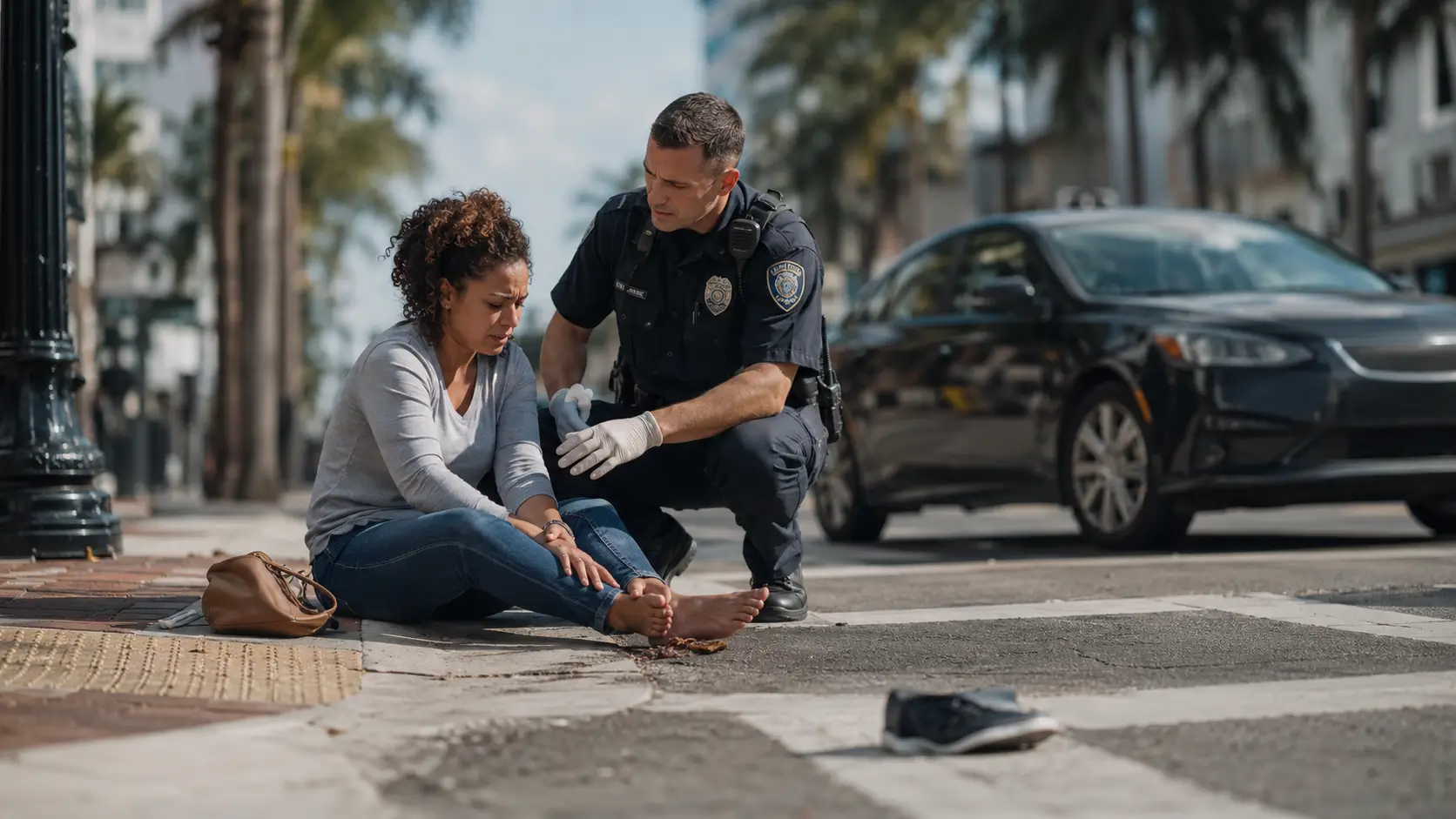
Florida has a well-earned and deeply concerning reputation as one of the most dangerous states in the country for people on foot. According to Florida crash data, 706 pedestrians lost their lives on Florida roads in 2024, representing about 22 percent of all traffic fatalities in the state. Miami-Dade County accounted for 1,883 pedestrian crashes, with 83 resulting in fatalities. These are not abstract statistics for the families and individuals affected by them.
A pedestrian struck by a vehicle faces physical injuries that tend to be among the most severe in any traffic accident category. Without the structural protection of a vehicle surrounding them, pedestrians absorb the full impact of the collision and are often thrown, dragged, or run over. Recovery from these injuries can take months or years, carry enormous medical costs, and in many cases result in permanent disability. During that recovery, injured pedestrians and their families are also trying to understand their legal rights in a system that can be difficult to navigate without guidance.
This guide explains what Florida law says about pedestrian rights and driver obligations, how fault is determined when a pedestrian is hit, what compensation may be available, and what happens in the increasingly common scenario where the driver flees the scene. It also explains why the timing of legal action matters as much as the substance of the claim.
Being hit by a car while walking is a traumatic experience, and understanding your legal options should not be something you have to figure out alone while recovering. Schedule a free consultation. There is no cost and no commitment to get clarity on where you stand.
Florida’s Pedestrian Safety Laws and Right-of-Way Rules
Florida law places specific obligations on both drivers and pedestrians. Understanding these obligations matters because they form the legal framework for determining who is at fault when a collision occurs, and by how much each party’s conduct contributed to the outcome.
The primary statute governing pedestrian rights in Florida is Section 316.130 of the Florida Statutes, which covers pedestrian obedience to traffic signals, rights of way at crosswalks, and the duties of pedestrians who must cross roadways where no crosswalk exists. The key principles from this statute include:
- Right of way at crosswalks. Drivers must yield the right of way to pedestrians crossing the roadway within a marked crosswalk, and at any intersection where a crosswalk is implied even without pavement markings. The obligation to yield applies whether or not the pedestrian is crossing with a signal.
- Pedestrian signals. Where pedestrian signals are present, pedestrians must obey them. A pedestrian who enters a crosswalk against a “Don’t Walk” signal may be found partially at fault for any resulting collision, particularly if the driver had a green light and no reason to anticipate a pedestrian in the roadway.
- Crossing outside of a crosswalk. Pedestrians crossing at any point other than a marked crosswalk must yield the right of way to vehicles. However, drivers still have a duty to exercise due care to avoid striking a pedestrian, even one who is crossing outside a designated area.
- Walking along roadways. Where sidewalks are available, pedestrians must use them. Where no sidewalk is available, pedestrians should walk on the shoulder of the road facing oncoming traffic. Walking in the roadway itself when a sidewalk is accessible can be considered contributory negligence.
- Duty of all drivers to exercise due care. Regardless of right of way, Florida law requires every driver to exercise due care to avoid colliding with any pedestrian and to give warning when necessary. A driver who hits a pedestrian cannot simply point to the pedestrian’s technical fault to escape liability if the driver had time and distance to avoid the collision.
The interaction between these rules is important for understanding how fault gets allocated after a pedestrian accident. A pedestrian crossing outside a crosswalk who is struck by a speeding driver may share some fault for the collision, but the speeding driver still bears primary responsibility. Florida’s comparative negligence framework requires that the conduct of both parties be weighed to arrive at each party’s percentage of fault.
Common Causes of Pedestrian Accidents in Miami and Coral Gables
The specific geography, traffic patterns, and demographics of Miami and Coral Gables create a pedestrian accident risk profile that differs from other parts of the state. A dense urban core with high tourist traffic, wide arterial roads designed for vehicle speed rather than pedestrian safety, and a significant number of drivers unfamiliar with local roads all contribute to the frequency and severity of pedestrian crashes in this area.
- Distracted driving. In Miami’s congested traffic, the temptation to check a phone, use navigation, or engage with in-car systems while stopped at a light or moving slowly through traffic is significant. A driver who looks down for even two or three seconds can miss a pedestrian who has stepped into the crosswalk on a walk signal. This is the leading cause of pedestrian crashes in urban environments nationally.
- Failure to yield at crosswalks. Florida law requires drivers to yield to pedestrians in crosswalks, but enforcement is inconsistent and many drivers treat crosswalks as suggestions rather than legal requirements. Biscayne Boulevard, Miracle Mile in Coral Gables, and the intersection-heavy streets of Downtown Miami are all areas where failure-to-yield crashes are repeatedly documented.
- Left-turn collisions at intersections. A driver turning left must yield not only to oncoming vehicles but also to pedestrians in the crosswalk on the street being crossed. Many drivers focus on gaps in oncoming traffic and do not check for pedestrians before completing the turn. These collisions often occur at higher speeds than right-turn crashes and produce more serious injuries.
- Speeding in residential and commercial areas. The relationship between vehicle speed and pedestrian injury severity is direct and steep. At 23 mph, the average fatality risk for a struck pedestrian is approximately 10 percent. At 42 mph, it rises to around 50 percent, and at 58 mph, it approaches 90 percent. Speeding on residential streets near schools, parks, and shopping areas in Miami-Dade is a persistent contributing factor to severe pedestrian injuries.
- Driving under the influence. Impaired drivers have reduced reaction times, compromised judgment about distance and speed, and a higher likelihood of drifting out of lanes or failing to notice pedestrians at crossings. DUI crashes involving pedestrians are disproportionately represented in fatality statistics, particularly in nighttime and weekend crash data.
- Poor lighting and infrastructure. Some areas of Miami-Dade have inadequate lighting at crosswalks, faded crosswalk paint, missing pedestrian signal equipment, or road designs that create unsafe crossing conditions. When a government entity’s failure to maintain safe infrastructure contributes to a pedestrian crash, there may be an additional or alternative avenue for compensation through a government liability claim.
How Fault Is Determined in Florida Pedestrian Accident Cases
When it comes to initial medical coverage, Florida’s No-Fault PIP system actually does apply to pedestrians, creating a unique hybrid framework. Under Florida Statute Section 627.736, if you are a pedestrian struck by a motor vehicle, your initial $10,000 in medical bills and lost wages is covered on a no-fault basis. If you own a vehicle, your own auto PIP policy pays first; if you do not own a vehicle, you are covered by the PIP policy of the driver who struck you. However, for any medical expenses exceeding that $10,000 limit, or to pursue non-economic damages like pain and suffering, Florida switches to a strict fault-based negligence framework where you must prove the driver was careless.
The key complication in pedestrian accident cases is that fault is rarely assigned entirely to one party. Florida’s modified comparative negligence system, which took effect under House Bill 837 in 2023, requires that the conduct of all parties be evaluated and that each party’s percentage of fault be assigned. A pedestrian who was crossing outside of a designated crosswalk, crossing against a signal, or walking in the roadway where a sidewalk was available may be assigned some portion of fault for the collision.
| Scenario | Likely Fault Allocation |
| Driver runs a red light and strikes pedestrian in crosswalk on a walk signal | Driver bears primary fault. Pedestrian likely bears little or no comparative fault. |
| Driver fails to yield on left turn; pedestrian is crossing legally in crosswalk | Driver bears primary fault. Pedestrian likely bears little or no comparative fault. |
| Pedestrian crosses mid-block outside a crosswalk; driver is at posted speed limit | Fault is shared. Pedestrian may be assigned 20-40% depending on visibility and road conditions. |
| Pedestrian crosses against a red signal; driver has green light | Fault may be substantially with pedestrian. Driver still has duty to exercise due care but may have limited liability. |
| Driver strikes pedestrian on sidewalk (vehicle leaves road) | Driver bears full or nearly full fault. Pedestrians on sidewalks have reasonable expectation of safety. |
| Driver is speeding; pedestrian crossing mid-block | Fault is shared, but driver’s speeding is a significant factor that likely increases their share. |
| DUI driver strikes pedestrian in crosswalk | Driver bears primary fault. Impairment may support punitive damages in addition to compensatory. |
The critical threshold under HB 837 is the 50 percent mark. A pedestrian who is found to bear more than 50 percent of the fault for the collision cannot recover any compensation from the driver, regardless of the severity of their injuries. This threshold, which is more restrictive than the pre-2023 pure comparative negligence standard, means that how fault is argued and documented in a pedestrian case has significant financial consequences. Insurance adjusters are aware of this threshold and will seek to characterize pedestrian behavior in ways that push the fault percentage above 50.
Hit-and-run pedestrian accidents require immediate action. Evidence disappears, witnesses move on, and specific legal steps must be taken to protect your right to compensation even when the driver is never found.
Compensation Available to Pedestrian Accident Victims
Pedestrian accident victims in Florida are entitled to pursue compensation that reflects the full impact of the collision on their lives. Because pedestrian injuries tend to be severe, the categories of compensation available are often broad, and the amounts can be substantial when the injuries are significant.
| Category | What It Covers | Examples |
| Medical expenses (past) | All reasonable and necessary medical costs incurred from the accident to the date of settlement or judgment | Emergency room, surgery, hospitalization, imaging, medications, follow-up appointments |
| Medical expenses (future) | Estimated costs of ongoing and future medical care necessitated by the injuries | Long-term rehabilitation, future surgery, assistive devices, home healthcare |
| Lost wages | Income lost during the recovery period when the victim was unable to work | Salary, hourly pay, tips, commissions, self-employment income missed during recovery |
| Lost earning capacity | Reduction in the victim’s ability to earn income in the future due to permanent disability | Career change required by injury, reduced hours, inability to perform prior job functions |
| Pain and suffering | Physical pain experienced as a result of the injuries, past and projected into the future | Chronic pain, ongoing discomfort, physical limitations affecting daily life |
| Emotional distress | Psychological consequences of the accident and recovery | Anxiety, depression, PTSD, sleep disorders, fear of walking near traffic |
| Permanent disability and disfigurement | Compensation for lasting physical changes and limitations | Paralysis, amputation, permanent scarring, loss of limb function |
| Wrongful death | Compensation for families when a pedestrian accident is fatal | Funeral expenses, loss of financial support, loss of companionship and guidance |
Florida does not cap compensatory damages in most pedestrian accident cases. The amount available depends on the specific facts: the severity of the injuries, the cost of past and projected medical care, the victim’s age and income, and the degree of fault assigned to each party. For cases involving serious permanent injuries or death, the total value of the claim can be substantial, which is precisely why insurance companies invest resources in minimizing the payout.
Related reading:
Uber and Lyft Accident Claims in Florida: What Victims Need to Know
Motorcycle Accident Claims in Florida: Legal Rights and Compensation
Auto & Rideshare Accidents
Hit-and-Run Pedestrian Accidents: What Are Your Legal Options
Hit-and-run crashes are a serious and growing problem in Florida. According to FLHSMV data, there were more than 85,000 hit-and-run crashes in Florida in 2024, and 76 percent of hit-and-run pedestrian and cyclist fatalities occurred in those incidents. Miami-Dade County alone recorded more than 19,000 hit-and-run crashes in 2024, with 32 fatalities and more than 3,000 injuries.
For a pedestrian struck by a driver who flees the scene, the situation can feel hopeless. The driver is unknown, there is no at-fault insurance to file against, and the physical evidence at the scene is disappearing by the minute. But hit-and-run victims have more legal options than they may realize.
- Uninsured Motorist coverage. Florida law under Section 627.727 provides that a pedestrian who is struck by a hit-and-run driver and suffers bodily injury may make a claim under their own Uninsured Motorist coverage, even though the pedestrian was on foot and not inside a vehicle at the time of the crash, as long as the pedestrian has UM coverage on their own auto insurance policy. Florida Statute §627.727 does not require the insured to be an occupant of a vehicle to access UM benefits, coverage follows the person, not the vehicle they were in.
- Household member’s UM coverage. If the pedestrian does not have their own auto policy but lives with a family member who does, that household member’s UM coverage may be available to cover the claim, depending on the policy terms.
- Investigation and driver identification. Law enforcement investigations, traffic camera footage, business surveillance systems, and witness statements can sometimes identify a hit-and-run driver, even when it is not immediately apparent who was responsible. An attorney can work with investigators to pursue identification and, if the driver is found, a direct liability claim against them and their insurer.
- Physical reporting requirement. Florida requires that any accident resulting in injury or death be reported to law enforcement immediately. Calling 911 at the scene is essential both for your safety and to create the official record that a UM claim will require. Without a police report documenting the hit-and-run, the UM claim process becomes significantly more complicated.
The time window for preserving hit-and-run evidence is very short. Surveillance camera footage is typically overwritten within 24 to 72 hours. Physical evidence at the scene fades or is disturbed. Witnesses scatter. The earlier an attorney is involved in a hit-and-run pedestrian case, the more of this critical evidence can be preserved before it is gone.
The Role of Comparative Negligence in Pedestrian Claims
Florida’s comparative negligence framework is relevant in virtually every pedestrian accident case, and its post-2023 structure under HB 837 makes it more consequential than the prior pure comparative negligence system. Understanding how it actually functions helps pedestrian accident victims anticipate the arguments they are likely to face and prepare for them.
Under pure comparative negligence, which Florida used before March 24, 2023, a pedestrian who was 90 percent at fault for a collision could still recover 10 percent of their damages from the driver. The modified system eliminates that possibility. If a court or jury finds that the pedestrian was more than 50 percent at fault, the recovery is zero.
Insurance companies are aware of this change and have adjusted their claims strategies accordingly. In pedestrian cases where the facts are at all ambiguous, adjusters will work to push the pedestrian’s fault percentage as high as possible. Common arguments used to assign fault to pedestrians include:
- Jaywalking or crossing outside a crosswalk. If the pedestrian was not crossing at a designated crosswalk or intersection, this will be raised as evidence of comparative fault. The strength of this argument depends on whether the driver had reasonable time and distance to avoid the collision.
- Crossing against a signal. If pedestrian signals were present and the pedestrian crossed against a don’t walk indication, this will be used to assign fault. It does not eliminate the driver’s independent duty of care, but it reduces the pedestrian’s relative claim.
- Walking distracted. Insurers increasingly argue that pedestrians who were using a phone, wearing headphones, or otherwise not paying attention to traffic share fault for failing to notice an approaching vehicle in time to avoid the collision.
- Walking in or near the roadway in low-light conditions. Pedestrians wearing dark clothing or walking on poorly lit roads at night may be assigned partial fault in cases where visibility was a contributing factor.
None of these arguments, if they apply to your case, is necessarily fatal to a claim. They affect the percentage of fault assigned to the pedestrian and thus the amount of recoverable compensation. An attorney can counter these arguments by presenting evidence that the driver had time to avoid the collision regardless of the pedestrian’s conduct, that the pedestrian’s actions were foreseeable, or that the driver’s own negligence, whether speeding, distraction, or impairment, was the primary cause of the accident.
Why Acting Fast After a Pedestrian Accident Is Critical
The decisions made in the hours and days immediately after a pedestrian accident have a direct effect on the viability and value of the resulting claim. Unlike some legal disputes where time is a consideration in the abstract, pedestrian accident cases involve evidence that begins disappearing almost immediately after the collision.
Physical evidence at the scene, including skid marks, debris, vehicle fluids, and point-of-impact markings, fades or is cleaned up quickly. Surveillance footage from nearby businesses, traffic cameras, and residential systems is typically overwritten within 24 to 72 hours unless a preservation request is made. Witnesses who stopped at the scene may move on and become difficult to locate. The vehicle involved in a hit-and-run may be repaired or disposed of before investigators can examine it.
Beyond evidence, Florida’s legal framework creates additional time-sensitive obligations. The statute of limitations for personal injury claims, including pedestrian accidents, is two years from the date of the accident under the post-2023 reform framework. Two years is not as long as it sounds when factored against the time needed to complete medical treatment, reach maximum medical improvement, gather records, and prepare a demand. For claims involving a government entity, such as cases where a poorly designed or maintained roadway contributed to the accident, additional notice requirements with shorter windows may apply.
Florida also has a 14-day rule for PIP (Personal Injury Protection) coverage that applies when the injured pedestrian has their own auto insurance. A pedestrian who does not begin medical treatment within 14 days of the accident may lose eligibility for PIP benefits under their own policy, reducing an available source of early medical coverage.
For all of these reasons, the earlier an attorney is involved after a pedestrian accident, the more effectively they can protect the claim. Evidence preservation requests can be sent immediately. Medical documentation can be guided from the start. Insurance companies can be put on notice before they have had time to conduct their own one-sided investigation. And the pedestrian can focus on recovery rather than on managing a legal process they did not anticipate.
Personal injury law is fact-specific, and no article can evaluate whether the specific circumstances of a pedestrian accident create a viable claim or what that claim may be worth. Those questions depend on details that require professional legal analysis. If you or someone you love was struck by a vehicle while walking in Florida, speaking with a qualified personal injury attorney promptly is the most important step toward protecting your rights.
Attorney John P. Sherman handles personal injury cases throughout Florida. If you have questions about your legal options following a pedestrian accident, a conversation with an experienced attorney is where to begin.
Final Thoughts
Florida’s pedestrian safety statistics are sobering, and the legal framework that governs compensation for pedestrian accident victims is more demanding than many people expect. The 2023 tort reform changed the comparative fault rules in ways that make it easier for insurers to eliminate or dramatically reduce a pedestrian’s recovery by pushing fault percentages above the 50 percent threshold. Hit-and-run incidents, which account for a disproportionate share of pedestrian fatalities, require immediate and specific legal steps to preserve the right to compensation.
None of this means that pedestrian accident victims in Florida are without recourse. The law does provide rights and remedies, and those remedies can be substantial when the injuries are serious and the legal process is handled correctly. But handling it correctly requires acting quickly, preserving evidence, and engaging legal representation before the insurer has already shaped the narrative of what happened.
If you were struck by a vehicle while walking in Florida, your rights exist regardless of whether the driver stopped or fled, regardless of where exactly the collision occurred, and regardless of what the insurer says in its first communication. The question is not whether you have rights. The question is whether you act on them before the window to do so effectively closes.
Frequently Asked Questions
Does a pedestrian always have the right of way in Florida?
Not in every circumstance. Florida Statute Section 316.130 grants pedestrians the right of way at marked and unmarked crosswalks, and drivers must yield to pedestrians lawfully crossing at intersections. However, pedestrians who cross outside of crosswalks must yield to vehicles, and pedestrians who cross against a pedestrian signal may share fault for a resulting collision. Both drivers and pedestrians have duties under Florida law, and the fault allocation after a pedestrian accident depends on the specific conduct of both parties.
What if the driver who hit me left the scene?
Florida pedestrian accident victims struck by hit-and-run drivers may be able to make a claim under their own Uninsured Motorist coverage, even though they were not in a vehicle at the time of the crash. UM coverage under Florida Statute Section 627.727 can cover bodily injury caused by a hit-and-run driver. It is critical to call 911 immediately, obtain any witness information, and contact an attorney as quickly as possible to preserve surveillance footage and other evidence before it is overwritten or lost.
How does Florida’s comparative negligence rule affect pedestrian accident claims?
Under Florida’s modified comparative negligence standard, introduced by House Bill 837 in 2023, a pedestrian who is found to be more than 50 percent at fault for the collision cannot recover any compensation. If the pedestrian is found partially at fault but below 50 percent, their compensation is reduced proportionally. Insurance companies use this threshold strategically and will argue for the highest possible pedestrian fault percentage. An attorney can counter these arguments with evidence of the driver’s independent negligence and the causation analysis specific to the crash.
How long do I have to file a pedestrian accident claim in Florida?
The statute of limitations for personal injury claims in Florida, including pedestrian accident claims, is two years from the date of the accident under the tort reform framework that took effect March 24, 2023. For incidents that occurred before that date, the prior four-year limit may apply. Claims against government entities may have additional notice requirements and shorter windows. Missing these deadlines will result in the case being dismissed regardless of the merits. Acting promptly and consulting an attorney early in the process is the best protection against missing a critical deadline.