
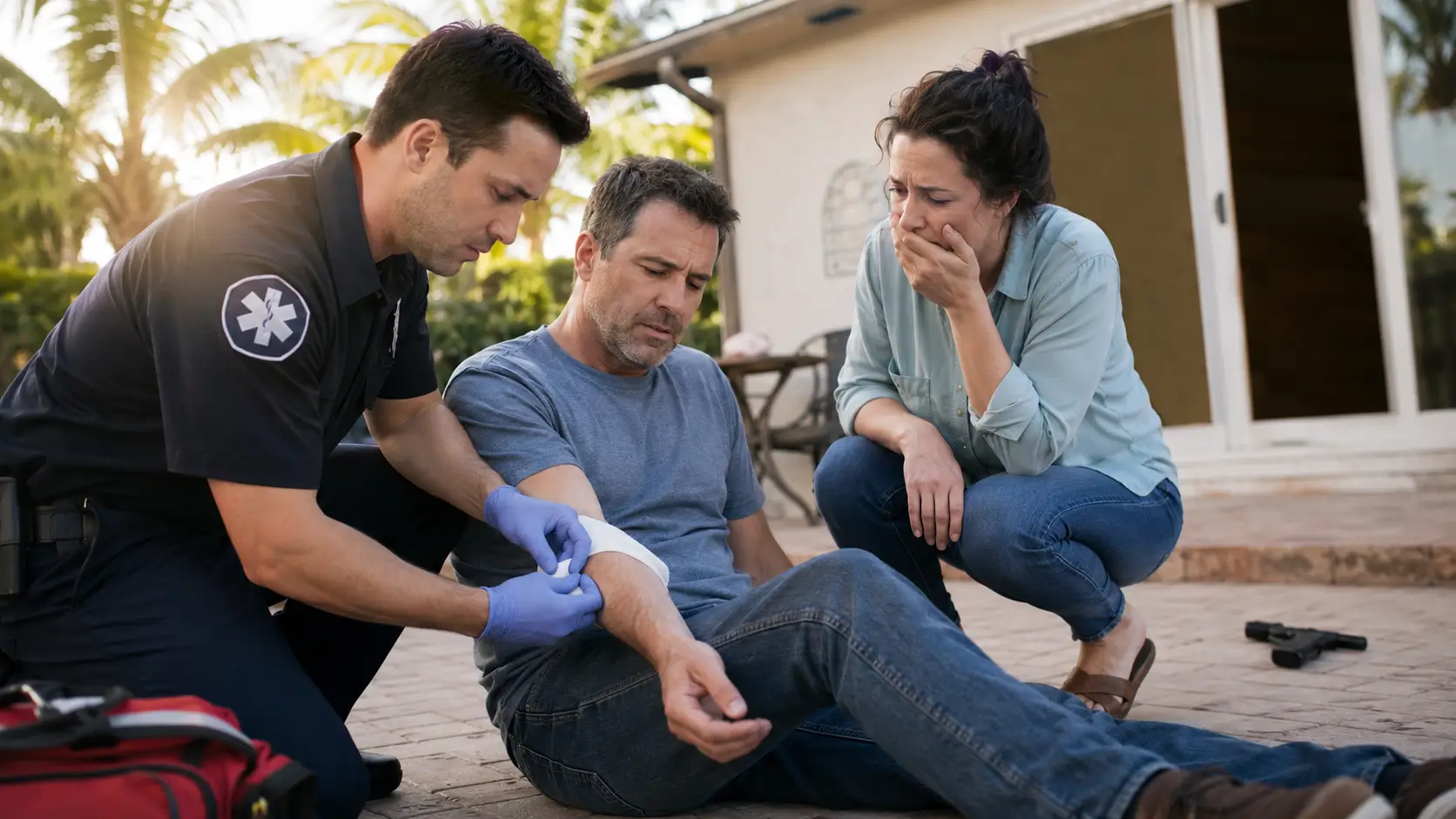
Every year, hundreds of Floridians suffer serious injuries as the result of firearms being mishandled, improperly stored, or negligently discharged. These incidents are frequently labeled “accidents,” a word that carries an unfortunate implication: that no one is at fault and that victims simply have no recourse. Under Florida law, that assumption is wrong. When a firearm is discharged carelessly and someone is hurt, the legal system provides injured victims with a clear path to hold responsible parties accountable and recover meaningful compensation.
If you or a loved one has been injured in an accidental shooting, the consequences can be devastating: emergency surgeries, prolonged rehabilitation, permanent disability, lost wages, and profound emotional trauma. The physical and financial burden should not fall on the person who did nothing wrong. A civil claim may allow you to recover what you need to rebuild your life.
What Accidental Shooting Victims in Florida Need to Know
- “Accidental” does not mean no one is liable. Florida negligence law does not require intent to cause harm
- Multiple parties can be held responsible: the gun handler, a property owner, a supervising adult, or the firearm manufacturer
- Florida Statute 790.174 creates specific gun storage obligations for households where minors under 16 are present. Violations strengthen a civil claim significantly
- A civil case runs independently from any criminal investigation. You can sue even if no charges were filed
- Florida’s deadline to file a personal injury claim is 2 years from the date of the injury
- Evidence disappears fast. The firearm, the scene, and witness recollections must be documented immediately
Most accidental shooting victims are told by someone, a neighbor, a family member, or even law enforcement, that because it was an accident, there is nothing to pursue legally. That is incorrect, and acting on that assumption is one of the most costly mistakes a victim can make. The civil standard for negligence is not intent. It is carelessness. If the firearm was handled, stored, or supervised in a way that no reasonable person would consider safe, a civil claim exists. The Law Office of John P. Sherman offers free, confidential consultations for accidental shooting victims across Florida. Understanding your rights costs you nothing.
“Accidental” Does Not Mean “No One Is Responsible” Under Florida Law
The word “accidental” is often used loosely after a shooting incident to suggest that the event was unforeseeable and blameless. In everyday conversation, that framing might seem reasonable. In a court of law, however, the analysis is far more nuanced.
Florida personal injury law operates under a negligence standard. To establish negligence, a plaintiff must demonstrate four essential elements:
| Element | What It Means in a Shooting Case |
| Duty | The defendant had a legal obligation to handle, store, or supervise the firearm responsibly |
| Breach | The defendant failed to meet that obligation through careless or reckless conduct |
| Causation | That failure directly caused the discharge of the firearm and the resulting injury |
| Damages | The victim suffered real, measurable harm as a result |
The critical point is this: negligence does not require intent. A person does not have to mean to pull the trigger, or even mean to pick up the gun, to be held civilly liable for the consequences of their careless behavior. If a gun owner leaves a loaded firearm on a kitchen counter and a guest accidentally fires it, the gun owner may well be liable. If a shooter handles a weapon without understanding its safety mechanisms and it discharges, they can be held responsible.
Florida civil courts regularly distinguish between criminal intent, which is irrelevant to a civil negligence claim, and unreasonably dangerous conduct, which forms the foundation of one. This is precisely why victims of accidental shootings have legal rights even when the person who fired the weapon never intended any harm.
It is also worth noting that the standard for civil liability is intentionally lower than the standard required for a criminal conviction. In criminal proceedings, guilt must be established beyond a reasonable doubt. In a civil negligence case, the plaintiff need only show that the defendant’s careless conduct was more likely than not the cause of the injury. This distinction is enormously important for shooting victims who may have been told that because law enforcement did not pursue charges, no legal action is possible. That conclusion is incorrect. A civil claim exists independently of any criminal investigation or prosecution.
Common Causes of Accidental Shootings and Who Can Be Held Liable
Accidental shootings arise from a surprisingly wide range of circumstances. Understanding the most common causes helps identify who the responsible parties are and what legal theories may apply.
- Improper Handling and Unsafe Firearm Practices
Many accidental discharges occur when someone handles a gun without proper training or ignores basic firearm safety rules. Failing to treat every weapon as if it is loaded, pointing a gun in an unsafe direction, or placing a finger on the trigger before intending to fire are classic examples of conduct that courts recognize as negligent.
Potentially liable parties in these situations include:
- The individual who was physically handling the weapon
- A supervising adult who allowed an inexperienced person to handle a firearm without proper oversight
- A shooting range or firearms instructor who failed to enforce safety protocols
In cases involving minors, the liability of supervising adults becomes especially significant. Florida law imposes a heightened duty of care when children are present around firearms, and an adult who permits a child to access or handle a weapon without adequate supervision may face serious civil consequences.
- Negligent Storage at Home or on Private Property
Firearms left accessible in homes, vehicles, or other private properties are a persistent source of accidental injuries. This is especially true when children are present, but adults are also harmed when loaded weapons are left unsecured in common areas.
Liable parties may include the property owner, a tenant, or any adult who maintained control over the weapon and failed to store it safely. Importantly, liability in storage cases is not limited to the moment of the discharge itself. Courts examine the entire chain of decisions that made the weapon accessible in the first place, including where the firearm was kept, whether it was loaded, and whether any safety mechanisms were engaged.
- Discharges During Cleaning or Maintenance
Guns that are improperly handled during cleaning, maintenance, or inspection cause a significant number of injuries each year. These cases often involve a firearm owner who believed the weapon was unloaded or who failed to engage the safety mechanism before beginning work on the gun. In some instances, a second person is present during the cleaning and is struck when the weapon unexpectedly discharges. The person performing the maintenance owes a duty of care to anyone in the immediate vicinity.
- Third-Party Negligence at Events or Gatherings
Social gatherings, hunting trips, and outdoor recreational activities where firearms are present create situations where third-party negligence can lead to accidental discharges. A host who permits guests to handle firearms carelessly, or who fails to ensure weapons are safely secured during an event, may face civil liability. Similarly, organized events such as gun shows or outdoor shooting activities can give rise to negligence claims when organizers or participants fail to enforce adequate safety measures.
- Defective Firearms and Manufacturing Flaws
In some cases, the gun itself is the problem. A firearm that discharges without the trigger being pulled, that fails to engage its safety mechanism correctly, or that malfunctions due to design or manufacturing defects may give rise to a product liability claim against the manufacturer, distributor, or retailer. These cases are addressed in greater detail in the section below.
Florida’s Gun Storage Laws and How Violations Create Civil Liability
Florida has enacted specific legislation addressing the safe storage of firearms, and violations of these statutes can play a significant role in civil liability claims.
Florida Statute Section 790.174 establishes requirements for storing loaded firearms in households where a minor under 16 is present or likely to be present. Under this law, gun owners must keep loaded firearms secured in a locked container, a gun box, a firearms safe, or must have the weapon secured with a trigger lock when the gun is not in their immediate possession or control.
When a gun owner violates this statute and a resulting injury occurs, that violation can serve as evidence of negligence per se, a legal doctrine under which the breach of a statute written to protect a specific class of people from a specific type of harm creates a strong presumption of negligence. This significantly strengthens a civil claim on behalf of the injured party. It is important to understand what this presumption does and does not do. Under Florida law, it is rebuttable, not automatic or conclusive. The defendant can still present evidence that the violation was excusable or justified under the circumstances, and the plaintiff must still prove that the violation caused the injury and what that injury cost. What the presumption does is remove the need to separately argue, from scratch, that storing a loaded gun where a child could reach it fell below a reasonable standard of care. The statute has already made that judgment for the court.
Beyond the statute, Florida courts also apply common law negligence principles to gun storage cases. Even in situations where a statutory violation cannot be established, a property owner who stores firearms carelessly in an environment where others are present may still be found negligent under general duty-of-care standards. This means that even gun owners who technically comply with the minimum requirements of Section 790.174 can still face liability if their overall conduct is found to be unreasonably dangerous.
It is worth noting that Florida’s gun storage requirements exist in a broader legislative context. Courts interpreting these cases look to the overall framework of Florida firearms law, found in Chapter 790 of the Florida Statutes, to assess whether a defendant’s conduct fell below the expected standard of care. Attorneys handling these cases must be thoroughly familiar with both the statutory scheme and the case law that has developed around it.
Firearm Defects and Product Liability Claims Against Manufacturers
Not every accidental shooting stems from human error. A meaningful number of incidents each year are caused by defective firearms, components, or ammunition. When a gun malfunctions in a way that causes injury, the manufacturer, the distributor, or even the retail seller may be liable under Florida’s product liability laws.
Product liability claims in firearm cases typically fall into one of three categories:
- Design defects: The firearm’s basic design is inherently unsafe, meaning every unit produced carries the same dangerous flaw. A classic example is a firearm designed without adequate drop-safety protection, causing it to discharge when struck or dropped even without the trigger being engaged.
- Manufacturing defects: A specific unit was improperly assembled or produced in a way that deviates from the manufacturer’s own design standards, resulting in a dangerous malfunction. These defects affect individual weapons rather than an entire product line.
- Failure to warn: The manufacturer did not provide adequate instructions or warnings about the risks associated with the firearm’s use, maintenance, or storage. If a gun has known characteristics that could cause injury under foreseeable conditions, the manufacturer has a legal duty to communicate those risks to consumers.
These claims can be pursued independently or alongside a negligence claim against the person who was handling the weapon. In complex cases, multiple defendants may share liability, including the gun owner, a third party, and the manufacturer. Apportioning liability among multiple defendants is one of the most technically demanding aspects of these cases and requires careful investigation and expert analysis.
Building a product liability case requires detailed technical investigation, expert testimony, and a thorough understanding of both tort law and firearm mechanics. Speaking with a qualified personal injury attorney as early as possible ensures that critical evidence, including the firearm itself, is preserved and properly documented before it is altered, lost, or claimed by another party.
How Comparative Negligence Affects Accidental Shooting Cases
Florida follows a modified comparative negligence system, which was updated by the Florida legislature through HB 837, signed into law in 2023. Under this framework, a plaintiff who is found to be more than 50 percent at fault for their own injury is barred from recovering any compensation. If the plaintiff is found to be 50 percent or less at fault, their damages are reduced in proportion to their degree of responsibility.
For example, if a jury determines that a victim suffered $200,000 in total damages but assigns 20 percent of the fault to the victim, the victim would recover $160,000. If fault is assigned at 51 percent or greater to the victim, recovery is entirely barred under the 2023 reform.
In accidental shooting cases, defendants and their insurers frequently attempt to shift blame onto the victim. Common arguments include:
- The victim was also handling the weapon carelessly
- The victim was aware of the risk and chose to participate in an unsafe activity
- The victim’s own conduct contributed to the circumstances that led to the discharge
These arguments must be confronted head-on with strong evidence and effective legal advocacy. The way a claim is investigated, documented, and presented can have a direct impact on how fault is allocated and how much compensation a victim ultimately recovers.
It is also important to understand that comparative fault is a defense tool, not an objective truth. Its use does not mean the victim is actually responsible. An experienced attorney can challenge fault attributions that are inaccurate or exaggerated and work to ensure the defendant is held to the full extent of their liability.
Insurance companies representing gun owners, property managers, and other defendants use comparative fault aggressively in accidental shooting cases. Their goal is to push enough blame onto the victim to reduce or eliminate the payout entirely. The way your case is investigated, documented, and presented from day one determines how that fault argument lands. A personal injury attorney experienced in firearm negligence claims knows exactly how to challenge inaccurate fault attributions and ensure the full weight of the defendant’s liability is put on the record. Do not let the insurer shape the narrative before you have representation.
Compensation for Accidental Shooting Victims in Florida
The financial and personal toll of a gunshot wound can be overwhelming. Florida civil law recognizes a broad range of recoverable damages in accidental shooting cases, reflecting the full scope of what victims endure.
Economic Damages: These are quantifiable financial losses directly tied to the injury:
| Category | Examples |
| Medical expenses | Emergency care, surgeries, hospitalization, rehabilitation, physical therapy, ongoing treatment |
| Future medical costs | Anticipated procedures, long-term care needs, assistive devices |
| Lost wages | Income missed during recovery |
| Loss of earning capacity | Reduced ability to work due to permanent injury or disability |
| Property damage | Any personal property damaged as a result of the incident |
Non-Economic Damages: These damages address the human cost of the injury beyond financial loss:
- Physical pain and suffering, both past and future
- Emotional distress and psychological trauma
- Loss of enjoyment of life
- Disfigurement or permanent scarring
- A spouse’s claim for loss of consortium, meaning the documented impact on their relationship with the injured victim, and in narrower circumstances a parent’s claim tied to a child’s permanent disability
In cases where the defendant’s conduct was particularly reckless or egregious, punitive damages may also be available under Florida Statutes Section 768.72, which requires clear and convincing evidence of intentional misconduct or gross negligence. These are designed not to compensate the victim directly but to penalize especially dangerous behavior and deter similar conduct in the future. Florida courts have awarded punitive damages in shooting cases where a defendant demonstrated a conscious disregard for the safety of others, such as repeatedly storing firearms in an accessible location despite prior warnings or incidents. These damages are not unlimited: Florida Statutes Section 768.73 generally caps punitive damages at the greater of three times compensatory damages or $500,000, rising to four times compensatory damages or $2 million when the conduct was motivated solely by unreasonable financial gain, and removing the cap entirely only where the defendant acted with a specific intent to harm.
Quantifying the full value of a claim, particularly the non-economic components, requires skill and experience. Insurance companies routinely undervalue these categories of harm. Having legal representation from the outset helps ensure that every category of damage is identified, documented, and presented effectively.
Steps to Take After an Accidental Shooting to Protect Your Claim
The actions taken in the hours, days, and weeks following an accidental shooting can significantly affect the strength and value of a civil claim. If you or someone close to you has been injured, the following steps are critical.
1. Seek Immediate Medical Attention Your health and safety are the first priority. Even if injuries appear minor, a prompt and thorough medical evaluation documents your condition and creates an official record linking the injury to the incident. Gaps in medical treatment can be used by insurance companies to argue that your injuries were not serious or were caused by something other than the shooting.
2. Report the Incident Contact law enforcement immediately. An official police report establishes a formal record of the event, including how it occurred and who was involved. This documentation can be invaluable in a civil case, even if no criminal charges are ultimately filed.
3. Preserve Evidence If it is safe to do so, preserve as much evidence as possible from the scene. This may include:
- Photographs of the scene, the firearm, and any injuries
- The firearm and any accessories, ammunition, or packaging
- Clothing worn at the time of the incident
- Witness contact information
- Any text messages, emails, or communications related to the firearm or the incident
4. Avoid Making Statements to Insurance Companies Insurance adjusters representing the responsible party may contact you quickly after the incident. These conversations are not in your interest. Statements made without legal guidance can be used to minimize or deny your claim. Politely decline to provide recorded statements or sign any documents until you have spoken with an attorney.
5. Consult a Qualified Attorney as Soon as Possible Florida’s statute of limitations for personal injury claims is generally two years from the date of the injury, following the 2023 tort reform changes to Florida Statute Section 95.11. Acting promptly protects your right to file a claim and gives your legal team the maximum time to gather evidence, identify liable parties, retain expert witnesses, and build a compelling case. Waiting too long can result in lost evidence and forfeited rights.
The Long-Term Impact of Accidental Shooting Injuries
It is easy to focus on the immediate crisis following a shooting, but the long-term consequences often define the true scope of a victim’s losses. Gunshot wounds frequently cause lasting damage to bones, nerves, organs, and soft tissue. Many victims require multiple surgeries over months or years. Some sustain permanent nerve damage that results in chronic pain or loss of function. Others are left with mobility limitations that prevent them from returning to their previous employment or engaging in activities they once enjoyed.
The psychological impact can be equally severe. Post-traumatic stress disorder, anxiety disorders, and depression are common among shooting survivors. These conditions may require ongoing psychiatric treatment and can affect every dimension of a person’s life, from their relationships to their ability to work and function independently.
Florida civil law is designed to account for all of these long-term consequences. A claim that accurately reflects the full extent of a victim’s future needs, not just immediate expenses, is far more valuable than one that focuses only on past costs. This is one of the most important reasons why professional legal guidance is essential in these cases. An attorney experienced in catastrophic injury claims understands how to project future medical needs, work with life care planners and vocational experts, and present a complete picture of the victim’s losses to a jury or in settlement negotiations.
Final Thoughts
An accidental shooting is a life-altering event, and the label “accidental” should never be allowed to erase the legal accountability of those whose negligence caused it. Florida law provides injured victims with meaningful legal tools to seek justice, recover financial compensation, and hold careless gun owners, negligent property managers, and firearm manufacturers responsible for the harm they caused.
You do not have to navigate this process alone. The road to recovery, both physical and financial, is difficult enough without also managing a complex legal claim on your own. If you have been injured in an accidental shooting, speaking with a qualified personal injury attorney is the most important step you can take to understand and protect your rights.
At The Law Office of John P. Sherman, we represent accidental shooting victims with the dedication, skill, and resources their cases demand. We work on a contingency fee basis, which means you pay nothing unless we win. Reach out today to schedule your free consultation and take the first step toward the justice and compensation you deserve.