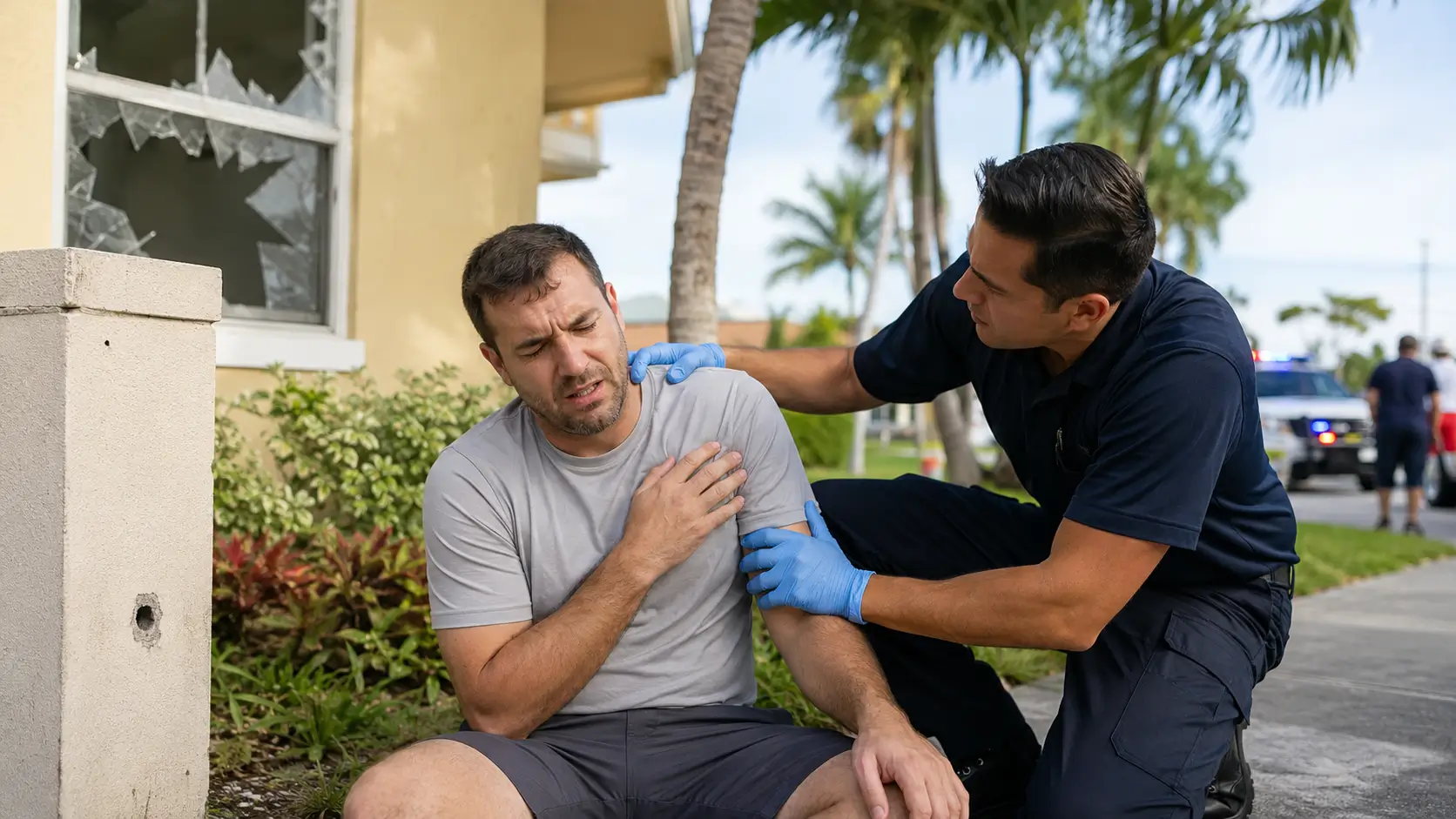
Every year in Florida, people going about their daily lives, attending a neighborhood cookout, sitting on their front porch, driving to work, or watching their children play in the yard, are suddenly struck by bullets they never saw coming. Stray bullet injuries represent one of the most devastating and unpredictable forms of gun violence, because the victim has absolutely no connection to the original conflict.
They are simply in the wrong place at the wrong time. Yet under Florida law, being an innocent bystander does not mean being without legal recourse. If you or someone you love has been struck by a stray bullet in Florida, you may have powerful legal options available to pursue compensation from multiple responsible parties.
What Stray Bullet Victims in Florida Need to Know
- Innocent bystanders have full legal rights even when they had no connection to the original shooting
- The shooter is rarely the only liable party. Property owners, venue operators, employers, and alcohol vendors can all share responsibility
- A civil claim runs completely independently from the criminal case. You can sue even if the shooter is unknown, acquitted, or judgment-proof
- Florida’s Crime Victim Compensation Fund provides limited interim financial assistance while a civil case is pending, but it has its own strict, shorter deadline
- Florida’s deadline to file a personal injury claim is 2 years from the date of injury
- Surveillance footage disappears within 24 to 72 hours. Acting quickly is not just advisable. It is essential
Most stray bullet victims assume that if the shooter is unknown, uninsured, or has no financial resources, their legal options are limited or nonexistent. That assumption is wrong, and acting on it is one of the costliest mistakes an innocent victim can make. Florida law provides multiple paths to recovery that go far beyond the individual who fired the weapon, from property owners who ignored documented crime patterns to event organizers who failed to screen for weapons. The Law Office of John P. Sherman offers free, confidential consultations for stray bullet victims across Florida. There is no cost unless we win your case.
How Innocent Bystanders Get Caught in Gunfire in Miami and Across Florida
Stray bullet incidents are a documented and serious problem in Florida’s larger cities. In places like Miami, Orlando, Jacksonville, and Tampa, they occur with real frequency and affect individuals who have no involvement in any dispute or criminal activity whatsoever, even though Florida’s overall rate of gun violence sits in the middle of the national pack rather than at the top of it.
Innocent bystanders are struck by stray bullets in a wide variety of circumstances, including:
| Scenario | Common Locations |
| Gang-related shootings or drive-bys | Residential neighborhoods, parking lots |
| Arguments escalating to gunfire | Streets, convenience stores, gas stations |
| Celebratory gunfire on New Year’s Eve or July 4th | Residential yards, outdoor events |
| Bar fights turning into shootings | Nightclub parking lots, entertainment districts |
| Road rage incidents | Highways, intersections |
| Apartment complex disputes | Shared walkways, pools, parking areas |
| Accidental discharges | Homes, vehicles, gun ranges |
In Miami-Dade County alone, law enforcement responds to hundreds of shooting incidents annually, and a significant portion involve victims with no connection to the original altercation. Children playing outside, elderly residents on their porches, and workers walking to their vehicles have all been victims of stray gunfire in Florida communities.
What makes these cases particularly complex from a legal standpoint is identifying who bears financial and legal responsibility. The shooter may be unknown, arrested, deceased, or judgment-proof. That is precisely why understanding the full spectrum of potentially liable parties is essential to recovering meaningful compensation. A thorough legal investigation can reveal sources of recovery that victims and families would never identify on their own.
Beyond the immediate physical harm, stray bullet injuries leave lasting psychological damage on victims and their families. Survivors frequently develop post-traumatic stress disorder, anxiety, depression, and a pervasive fear of public spaces. Children who witness or survive stray bullet incidents may suffer developmental and emotional consequences that require years of professional treatment. These non-physical harms are real, legally compensable, and deserve to be taken seriously in any civil claim.
Who Is Liable When a Stray Bullet Hits an Innocent Person
Many stray bullet victims and their families assume that if police do not catch the shooter, or if the shooter has no financial resources, there is nothing to be done legally. This assumption is incorrect and can be extremely costly. Florida law recognizes multiple avenues of liability beyond just the individual who pulled the trigger.
The Shooter
The most direct source of liability is the person who fired the weapon. Even if that person is facing criminal prosecution, a separate civil lawsuit can be filed against them for compensatory and punitive damages. Criminal conviction is not required to succeed in a civil claim. Florida courts apply a lower standard of proof in civil cases. Preponderance of the evidence, rather than beyond a reasonable doubt, is all that is required, meaning a defendant can be found civilly liable even if acquitted in criminal court, or even if charges were never filed.
Third Parties Who Created Dangerous Conditions
Florida’s premises liability and negligent security laws allow victims to hold property owners, landlords, business operators, and management companies accountable when their failure to maintain safe premises contributed to the shooting. If a stray bullet originated from a known high-crime property where the owner had done nothing to address ongoing dangers, that owner may bear significant civil liability. Since 2023, Florida law also requires that when these claims go to a jury, fault is divided among everyone who contributed to the injury, including the shooter, under Florida Statutes Section 768.0701.
Employers of the Shooter
In cases where the shooter was acting within the scope of their employment at the time of the incident, an employer can be held vicariously liable under Florida law. This legal theory is less common in stray bullet cases but is entirely valid and should be explored in every case where any employment connection exists.
Event Organizers and Venue Operators
If the shooting occurred at a concert, festival, sporting event, or other organized gathering, the entity responsible for security at that event may be held accountable for failing to implement reasonable safety measures such as metal detectors, bag checks, or adequate security personnel. Large public events that attract significant crowds carry an elevated duty of care under Florida law.
Firearm Owners Who Failed to Secure Their Weapons
When a stray bullet originates from a firearm that was illegally obtained or improperly stored, the original owner of the weapon may face civil liability, particularly if they were negligent in how they stored or transferred the firearm. If a gun was stolen from an unsecured location and later used in a shooting, the original owner’s failure to secure that weapon may form the basis for a civil negligence claim.
Alcohol Vendors and Dram Shop Liability
Florida’s dram shop law, codified in Florida Statutes Section 768.125, provides a limited basis for holding alcohol vendors liable when they knowingly serve a person who is habitually addicted to alcohol and that person subsequently causes harm. In shooting cases where alcohol contributed to the escalation of a confrontation, this theory may provide an additional avenue of recovery worth examining.
Self-Defense Shootings Gone Wrong: When the Defender Becomes Liable
One of the most legally nuanced situations in stray bullet cases involves self-defense scenarios. Florida is a Stand Your Ground state, and while that law provides significant legal protections to individuals defending themselves, those protections are not absolute, and they do not automatically shield a shooter from civil liability when an innocent third party is injured or killed by a missed shot or a bullet that passed through its intended target.
Under Florida Statutes Section 776.032, a person who uses force in self-defense may be immune from criminal prosecution and civil action. However, this immunity applies only when the force was used lawfully and meets the statutory requirements. When a stray bullet strikes an innocent bystander, several critical legal questions arise:
- Was the use of force justified under the specific circumstances present at the time?
- Did the shooter exercise reasonable care to avoid endangering bystanders before firing?
- Was the self-defense claim legitimate, or was it asserted as a post-incident justification after the fact?
- Did the shooter fire multiple rounds when a single shot or no shot was required?
- Was the location so densely populated that firing a weapon was inherently reckless regardless of any threat?
If a court finds that the self-defense claim does not meet the legal threshold, or that the shooter acted recklessly in discharging a weapon in a crowded or populated area, the shooter can be held civilly liable for all injuries suffered by the innocent bystander. Even in cases where Stand Your Ground immunity is granted in criminal court proceedings, the civil liability analysis is conducted separately and is not automatically resolved in the shooter’s favor. The Florida Supreme Court confirmed exactly this principle in Kumar v. Patel, holding that a criminal court’s immunity finding does not automatically bind a civil court, and that a defendant sued for damages must plead and prove immunity again in the civil case.
Stray bullet cases are among the most legally complex shooting claims in Florida because liability often involves multiple defendants under completely different legal theories at the same time. The owner of the property faces a negligent security claim. A Stand Your Ground shooter faces a civil battery claim. An event organizer faces premises liability. Each defendant has a separate legal team, a separate insurance carrier, and a separate strategy for minimizing their exposure. Building a case that pursues all of them simultaneously, with the right evidence and legal theory for each, is not something a victim can effectively manage without experienced legal representation.
Negligent Security Claims When Stray Bullets Come from Known Problem Properties
When a stray bullet originates from or travels through a property with a documented history of violence, the property owner or manager may be held liable under Florida’s negligent security doctrine. This legal theory holds that property owners owe a duty of reasonable care to the public, which includes protecting foreseeable victims from violent crime on or around their premises.
Foreseeability is the central legal concept. If a property owner knew, or reasonably should have known, that criminal activity and gun violence were occurring on or near their premises, they had a legal obligation to take meaningful, concrete steps to prevent further harm. Failure to act on that knowledge can constitute actionable negligence.
Evidence used to establish foreseeability in these cases includes:
- Police incident reports documenting prior shootings at or near the location
- 911 call logs reflecting repeated complaints about violence or criminal activity
- Prior civil lawsuits or code enforcement complaints against the property
- Security audit reports that were commissioned but ignored
- Lack of functioning surveillance cameras in common areas
- Absence of security personnel or adequate lighting in high-risk areas
- Violations of local building, fire, or safety codes
- Records of prior tenant or visitor complaints about criminal activity
Apartment complexes, public housing developments, strip malls, parking garages, and convenience stores are among the most common locations where negligent security claims arise in Florida stray bullet cases. Property owners who collect rental income or business revenue while deliberately ignoring dangerous conditions on their premises bear a moral and legal responsibility when innocent people suffer the consequences of that inaction.
The legal process for a negligent security claim involves several distinct phases: gathering all available incident reports and crime data for the property, retaining qualified expert witnesses in security assessment and premises safety, documenting the full scope of the victim’s injuries and economic losses, establishing a direct causal link between the property’s security failures and the shooting incident, and filing suit against all responsible parties within the applicable statute of limitations.
In Florida, property owners sometimes argue that criminal acts by third parties are unforeseeable superseding causes that break the chain of liability. An experienced attorney knows how to defeat these arguments by demonstrating through documented evidence that the criminal activity at the property was not only foreseeable but had been occurring repeatedly and without meaningful intervention.
Florida Crime Victim Compensation Fund: An Additional Resource for Shooting Victims
In addition to civil litigation, innocent bystanders struck by stray bullets in Florida may be eligible to receive financial assistance through the Florida Crime Victim Compensation Program, administered by the Bureau of Victim Compensation within the Florida Office of Attorney General. This state-funded program provides benefits to victims of violent crime who meet specific eligibility criteria and can serve as a supplemental source of financial relief during the period before a civil case resolves, but it operates on a much smaller scale and a much shorter deadline than a civil lawsuit.
Covered expenses, per the Bureau’s current schedule of benefits, may include:
| Type of Benefit | Maximum Available |
| Medical and dental treatment | Up to $10,000, paid at 50% of cost |
| Mental health treatment for an injured adult victim | Up to $5,000, paid at 50% of cost |
| Wage loss | Up to $15,000 total, paid at 50% of lost wages or the state’s average weekly wage |
| Funeral and burial expenses | Up to $7,500 |
| Loss of support (for dependents of a deceased victim) | Up to $25,000 |
These category limits are also capped by an overall per-claim maximum: total benefits cannot exceed $15,000 when the victim was injured but not catastrophically, $25,000 when the victim died, or $50,000 when the victim suffered a catastrophic injury as defined by Florida law.
To qualify for the program, victims generally must meet the following requirements:
- Report the crime to law enforcement within 72 hours of the incident, absent good cause for a delay
- Cooperate with law enforcement throughout the ongoing investigation
- File a compensation application within 1 year of the incident date, which may be extended to 2 years only if good cause is shown for the delay
- Not have been engaged in criminal activity at the time of the injury
It is important to understand that the Crime Victim Compensation Fund is not a substitute for civil litigation. The amounts available through the fund are limited by statutory caps and will rarely cover the full extent of a serious gunshot injury. Emergency surgery, intensive care hospitalization, follow-up procedures, and long-term rehabilitation for a traumatic shooting injury can easily reach hundreds of thousands of dollars or more. A personal injury lawsuit is almost always the most effective and complete path to recovering compensation that reflects the true cost of what a victim has suffered.
Victims should also be aware that accepting compensation from the fund does not necessarily prevent them from also pursuing a civil lawsuit. However, coordination of benefits rules may apply, and it is advisable to consult with a qualified personal injury attorney before making any decisions about the fund that could affect a pending or potential civil claim.
Damages and Compensation for Innocent Bystander Shooting Victims
Stray bullet injuries are often catastrophic and life-altering. A single bullet can cause permanent organ damage, spinal cord injury, traumatic brain injury, loss of a limb, severe vascular damage, or death. The physical, emotional, and financial toll on victims and their families is immense and frequently extends for years or decades beyond the initial incident.
Florida law allows innocent bystander shooting victims to pursue a comprehensive range of damages in a civil lawsuit, including the following:
Economic Damages:
- Emergency room costs and surgical expenses
- Hospitalization, intensive care, and step-down care
- Follow-up medical treatments and specialist consultations
- Physical therapy, occupational therapy, and speech therapy
- Prescription medications and durable medical equipment
- In-home nursing or attendant care
- Future medical costs for ongoing care or permanent impairment
- Lost income and wages during the recovery period
- Diminished future earning capacity if the victim cannot return to their previous occupation or any comparable employment
- Vocational rehabilitation costs
Non-Economic Damages:
- Physical pain and suffering, both past and future
- Emotional distress and post-traumatic stress disorder
- Loss of enjoyment of life and inability to participate in previous activities
- Disfigurement or permanent visible scarring
- A spouse’s claim for loss of consortium, covering the documented loss of companionship and support, and in narrower circumstances a parent’s claim tied to a child’s permanent disability
- Mental anguish and psychological harm from the traumatic experience
Punitive Damages:
In cases involving especially reckless, willful, or egregious conduct, Florida courts may award punitive damages under Florida Statutes Section 768.72. These damages are designed to punish the responsible party and deter similar conduct in the future. They are separate from and in addition to compensatory damages, and in the right case, they can significantly increase the total recovery obtained for the victim. Punitive damages are not unlimited, however. Florida Statutes Section 768.73 generally caps them at the greater of three times compensatory damages or $500,000, rising to four times compensatory damages or $2 million when the conduct was motivated solely by unreasonable financial gain, and removing the cap entirely only where the defendant acted with a specific intent to harm.
In wrongful death cases where a stray bullet proves fatal, surviving family members may bring a claim under the Florida Wrongful Death Act, Florida Statutes Sections 768.16 through 768.26, seeking compensation for the loss of their loved one’s financial support, companionship, parental guidance, and the mental pain and suffering caused by the loss.
Stray bullet cases are among the most time-sensitive personal injury claims in Florida. Property owners document incidents in their favor immediately after a shooting. Surveillance footage is overwritten within 24 to 72 hours. Witnesses scatter. And in cases involving multiple defendants such as property owners, venue operators, or security companies, the window preserves evidence against each party closes at different rates. Every day without legal representation in a case like this is a day the other side is building their defense. A personal injury attorney can step in immediately to preserve what matters most and ensure every liable party is identified before the trail goes cold.
What to Do If You or a Loved One Is Hit by a Stray Bullet in Florida
The moments and days following a stray bullet injury are critical, not only for immediate medical reasons but also for preserving your legal rights and building the strongest possible civil claim. Taking the right steps early can make a significant and lasting difference in the outcome of your case.
Immediate Steps:
- Seek emergency medical care without delay, even if the wound appears minor at first glance. Internal injuries from gunshot wounds are frequently life-threatening and may not present obvious external symptoms immediately after impact.
- Call 911 and report the incident to law enforcement. A police report is a foundational document in any civil shooting case and is also required for the Crime Victim Compensation Fund application.
- Remain at the scene if it is safe to do so. Your presence, your account of events, and your ability to identify witnesses and evidence are all important to the investigation.
- Document everything possible. If you or someone with you is physically able to do so safely, take photographs or video of the scene, the location, any visible evidence, bullet casings, property damage, or bystanders who witnessed the incident.
- Collect witness contact information. Full names, phone numbers, and addresses of anyone who saw what happened can be invaluable evidence in a civil proceeding.
- Preserve physical evidence, including clothing and personal items, if instructed to do so by medical or legal professionals.
In the Days and Weeks That Follow:
- Follow all medical instructions precisely and attend every scheduled follow-up appointment. Gaps in medical treatment are routinely used by opposing insurance carriers and defense attorneys to argue that your injuries are less severe than claimed.
- Request a certified copy of the police report as soon as it becomes available from the investigating agency.
- Keep detailed and organized records of all medical expenses, out-of-pocket costs, lost wages, and documents related to your injury.
- Avoid making any statements to insurance company representatives, property management staff, or any other party about the incident before speaking with an attorney. Even well-intentioned statements can be misused to undermine your claim.
- Contact a qualified personal injury attorney as early as possible. Under Florida Statutes Section 95.11, most personal injury claims are subject to a two-year statute of limitations from the date of injury. Waiting too long can permanently forfeit your right to seek compensation, regardless of how strong your case might otherwise be.
Speaking with an experienced attorney early in the process ensures that critical evidence is preserved before it disappears, that all potentially liable parties are identified promptly, and that you fully understand your rights before making any decisions that could affect your case.
Protecting Your Rights After a Stray Bullet Injury
Being struck by a stray bullet is a trauma no one should have to endure, and no one should have to face the legal and financial aftermath alone. Florida law provides meaningful and well-established pathways to justice for innocent bystanders, from direct civil claims against the shooter to negligent security lawsuits against property owners who failed their duty to protect the public. The key is acting quickly, gathering the right evidence, and working with a legal team that understands the full complexity of shooting injury claims in Florida.
At The Law Office of John P. Sherman, we handle stray bullet and shooting injury cases on a contingency fee basis, meaning you pay nothing upfront and nothing at all unless we recover compensation on your behalf. We conduct thorough independent investigations, work with respected expert witnesses in security, medicine, and economics, and pursue every available legal avenue for our clients. If you or someone you love was hit by a stray bullet in Florida, do not wait. Contact us today for free, confidential consultation. Your time to act is limited, and the evidence that builds your case disappears fast.