
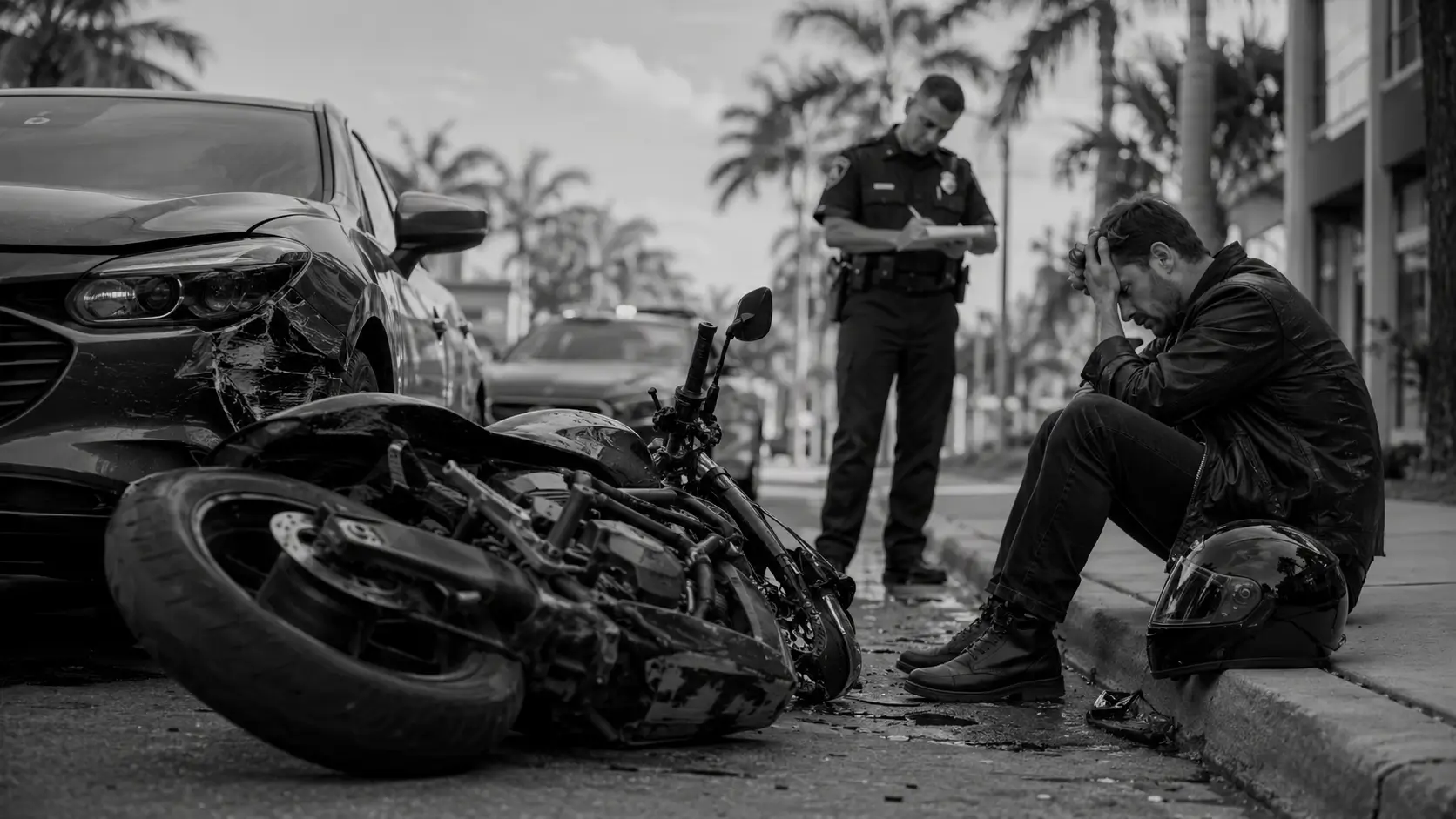
Riding a motorcycle in Florida is legal, common, and for many people an essential part of daily life. Florida’s year-round warm weather, its sprawling highways, and its coastal roads make the state one of the most active motorcycle markets in the country. It is also, consistently, one of the most dangerous. According to the Florida Department of Highway Safety and Motor Vehicles, there were 9,453 motorcycle crashes statewide in 2024, resulting in 591 fatalities and more than 8,000 injuries. In Miami-Dade County alone, there were 1,398 motorcycle crashes and 66 fatalities in the same year.
What most people outside the legal system do not realize is that motorcycle accident claims are governed by a fundamentally different set of rules than regular car accident claims in Florida. The no-fault Personal Injury Protection system that provides immediate medical coverage to injured car drivers does not apply to motorcyclists. The helmet law creates a comparative fault argument that insurers deploy aggressively to reduce payouts. And the bias against motorcycle riders, in the minds of some adjusters and juries, is a real obstacle that requires a deliberate litigation strategy to overcome.
If you were injured in a motorcycle crash in Florida, understanding these distinctions is not academic. It is the difference between knowing your options and unknowingly accepting far less than your case is worth.
A motorcycle crash leaves you without the automatic insurance safety net that car drivers have in Florida. The decisions made in the first days after the accident can significantly affect your ability to recover fully.
Why Motorcycle Accident Claims Differ from Regular Car Accident Cases
The most important thing to understand about a motorcycle accident claim in Florida is that the rules that apply to car accidents do not automatically apply to you. Florida has structured its motor vehicle insurance laws around a no-fault system designed to provide immediate medical coverage to injured drivers regardless of who caused the accident. Motorcycles are explicitly excluded from that system, and that exclusion has significant practical consequences.
When a car driver is injured in a crash, their own Personal Injury Protection coverage kicks in immediately, paying 80 percent of medical expenses and 60 percent of lost wages up to a combined limit of $10,000, regardless of fault. That payment comes from their own insurance, quickly and without the need to prove who caused the accident. The injured car driver can focus on getting treatment while the insurance system handles the initial costs.
When a motorcyclist is injured in a crash, Florida’s no-fault system does not apply. Motorcycles are excluded from Personal Injury Protection (PIP), which means there is no automatic first-party coverage for medical expenses or lost wages. Instead, the motorcyclist must rely on a combination of their own health insurance, optional first-party coverages such as Medical Payments (MedPay), uninsured/underinsured motorist (UM/UIM) coverage if purchased, or a fault-based claim against the at-fault driver.
If the at-fault driver is uninsured or underinsured, which is a significant risk in Florida, the motorcyclist’s recovery may be limited without UM/UIM coverage. While health insurance may cover medical treatment, it does not compensate for non-economic damages like pain and suffering, and the at-fault driver may lack sufficient personal assets to cover losses. For that reason, UM/UIM coverage is one of the most important protections available to motorcyclists, even though it is not required by law.
In addition to the lack of PIP coverage, motorcycle accident cases often involve more severe injuries than car accidents. The absence of a protective enclosure, airbags, and crumple zones means that even moderate-speed collisions can result in significant harm. Injuries such as road rash, traumatic brain injuries, spinal cord damage, and fractures occur more frequently and tend to be more severe than in comparable car crashes, increasing the financial and legal stakes of each claim.
Florida’s No-Fault Insurance Exception for Motorcycles
The exclusion of motorcycles from Florida’s no-fault system is established by Florida Statute Section 627.736. The statute defines “motor vehicles” for PIP purposes in a way that does not include motorcycles. This exclusion is intentional and has remained in place for decades, leaving motorcyclists outside the automatic benefit structure that applies to most passenger vehicles.
| Car Accident Victim | Motorcycle Accident Victim | |
| First-party medical coverage | PIP covers 80% of medical expenses up to $10,000, regardless of fault | No PIP; may rely on health insurance or optional MedPay if purchased |
| Is coverage automatic? | Yes. Applies to any licensed vehicle registered in Florida | No. Motorcyclist must prove fault against at-fault driver to recover from their insurance |
| What if the other driver is uninsured? | PIP still pays; can then make UM/UIM claim | Without UM/UIM, recovery may be limited to health insurance or the at-fault driver’s personal resources |
| Time to access benefits | Immediate, no fault determination required | May require fault investigation and claims process unless first-party coverage is in place |
| Insurance required by law? | Yes, including $10,000 PIP coverage | $10,000 Property Damage Liability (PDL); Bodily Injury Liability is not generally required but may be recommended or required in certain circumstances |
| Direct lawsuit option | Only after exceeding serious injury threshold | Available immediately without a serious injury threshold |
Because motorcyclists do not have access to PIP, their insurance decisions carry greater financial consequences. While not legally required, UM/UIM coverage provides critical protection when another driver lacks sufficient insurance. Given Florida’s high rate of uninsured motorists, relying solely on the minimum required coverage can leave a rider exposed to substantial out-of-pocket losses after a serious crash.
Common Causes of Motorcycle Accidents in Miami-Dade County
Miami-Dade County’s combination of dense urban traffic, high tourist volume, unfamiliar drivers, and year-round riding conditions creates a specific risk profile for motorcyclists. Understanding the most common causes of crashes in this environment matters both for prevention and for building a strong legal claim, because the cause of the crash determines where fault lies and what evidence needs to be gathered.
- Left-turn collisions. Left-turn crashes are statistically the single most dangerous scenario for motorcyclists. A driver turning left at an intersection misjudges the distance or speed of an oncoming motorcycle, or simply fails to see it, and turns directly into the rider’s path. These collisions often occur at high relative speeds and are among the most serious crashes motorcyclists face. The turning driver is almost always at fault.
- Failure to check blind spots during lane changes. Motorcycles occupy a smaller visual footprint than cars, making them easier to miss in mirror checks and shoulder checks. Drivers who change lanes without fully checking for motorcycles in adjacent lanes cause a significant percentage of serious injuries on Florida’s highways, particularly on I-95 and the Palmetto Expressway.
- Distracted driving. A driver who is texting, using navigation, or looking away from the road for even a few seconds can miss a motorcycle entirely. At highway speeds, a two-second distraction covers the length of a football field. This type of negligence is increasingly documented through cellphone records and in-car data systems, both of which can be obtained through the discovery process.
- Impaired driving. DUI crashes involving motorcycles are disproportionately represented in fatality statistics. Impaired drivers have reduced reaction times, impaired judgment about speed and distance, and are less likely to notice motorcycles in traffic. Blood alcohol records, toxicology reports, and police incident reports are critical evidence in these cases.
- Road hazards. Potholes, gravel, sand, wet paint, loose asphalt, and other road surface defects that pose minimal risk to a four-wheeled vehicle can be catastrophic for a motorcyclist. When a road defect caused or contributed to a crash, the responsible government entity or property owner may bear liability in addition to or instead of the other driver.
- Rear-end collisions. A following driver who underestimates the distance or braking ability of a motorcycle ahead may rear-end the rider. These collisions often produce serious spinal and head injuries even at moderate speeds.
Proving Fault and Overcoming Bias Against Motorcycle Riders
Proving fault in a motorcycle accident case in Florida involves the same basic legal framework as any negligence claim: duty of care, breach of that duty, causation, and damages. But motorcycle cases carry an additional challenge that car accident cases generally do not: a cultural bias against riders that appears in the assumptions insurance adjusters make, the arguments defense attorneys raise, and sometimes in the minds of jurors.
The most common version of this bias is the assumption that a motorcycle rider was riding recklessly, speeding, weaving in traffic, or otherwise behaving dangerously regardless of what the evidence actually shows. Insurers know this assumption exists and use it strategically. A driver who strikes a motorcycle will often claim they simply did not see the rider, which is not a legal defense but can function as one if the injured motorcyclist does not have evidence to counter it.
Under Florida’s modified comparative negligence standard, introduced by House Bill 837 in 2023, a motorcyclist who is found to be more than 50 percent at fault for the crash cannot recover any compensation. That threshold makes fault attribution a high-stakes question in every motorcycle case. Insurers routinely attempt to push the rider’s share of fault above 50 percent precisely because they know the legal consequence.
Countering this requires evidence. The types of evidence that prove most effective in motorcycle accident cases include:
- Police accident report. The responding officer’s reconstruction of the crash, notation of any traffic violations by the other driver, and any witness statements recorded at the scene.
- Traffic and surveillance camera footage. Intersection cameras, business security systems, and dashcam footage can show exactly what happened and eliminate the ‘I didn’t see the motorcycle’ defense when the rider was clearly visible.
- Witness testimony. Eyewitnesses who saw the crash unfold are particularly valuable because they provide an independent account that does not depend on either party’s version of events.
- Accident reconstruction expert. In serious or disputed cases, a licensed accident reconstruction specialist can analyze physical evidence including skid marks, point of impact, vehicle damage patterns, and road conditions to produce a scientific account of how the crash occurred.
- Electronic data from the at-fault vehicle. Modern vehicles contain event data recorders that capture speed, braking behavior, and steering inputs in the seconds before a crash. This data can be subpoenaed and analyzed to establish what the driver was doing when the collision occurred.
Without PIP, a Florida motorcycle accident victim is negotiating directly with an insurer that has every incentive to minimize the claim. Having an attorney from the start changes that dynamic entirely.
Related reading:
Pedestrian Accident Claims in Florida: Your Rights as a Victim
Uber and Lyft Accident Claims in Florida: What Victims Need to Know
Auto & Rideshare Accidents
Types of Injuries and Damages in Motorcycle Crash Claims
Motorcycle crash injuries tend to be more severe, more costly to treat, and more likely to result in permanent consequences than injuries from equivalent car crashes. The absence of any structural protection around the rider means that the body absorbs the full force of the impact, the pavement, and any secondary contact with vehicles or road barriers. This translates directly into the types and amounts of compensation that may be available.
The most common serious injuries in Florida motorcycle crashes include:
- Road rash and degloving injuries. When a rider slides across pavement, the friction produces severe abrasion injuries that can remove skin layers down to muscle and bone. Serious road rash requires surgical debridement, skin grafting, and extended wound care, with significant scarring that may be permanent.
- Traumatic brain injury. TBIs range from concussion to severe brain damage affecting cognitive function, memory, personality, and physical coordination. Even helmeted riders can suffer TBIs in high-speed crashes, and unhelmeted riders face a substantially higher risk of fatal or catastrophic brain injury.
- Spinal cord injury. Compression, fracture, or dislocation of vertebrae can result in partial or complete paralysis. Spinal cord injuries often require immediate surgical intervention and lifelong rehabilitation, with total treatment costs that can reach into the millions.
- Fractures, particularly of the extremities. Arm, wrist, leg, and pelvis fractures are extremely common as riders instinctively try to break their fall. Complex fractures may require multiple surgeries, hardware implantation, and extended physical therapy.
- Internal organ damage. Blunt force from the crash or road impact can cause internal bleeding, organ laceration, and pneumothorax. These injuries are not always immediately apparent and can be life-threatening if not promptly diagnosed.
| Type of Compensation | What It Covers |
| Past medical expenses | Emergency treatment, surgery, hospitalization, diagnostic imaging, medications |
| Future medical expenses | Ongoing rehabilitation, follow-up surgeries, long-term care, physical and occupational therapy |
| Lost wages | Income lost during recovery period due to inability to work |
| Lost earning capacity | Reduction in future earning ability caused by permanent injury or disability |
| Pain and suffering | Physical pain and mental anguish experienced as a result of the injuries |
| Emotional distress | Anxiety, depression, PTSD, and other psychological consequences of the crash |
| Permanent disability and disfigurement | Compensation for lasting physical limitations and visible scarring or deformity |
| Wrongful death (where applicable) | Funeral expenses, lost financial support, and loss of companionship for surviving family members |
Florida’s Helmet Law and How It Affects Your Claim
Florida’s motorcycle helmet law is set out in Florida Statute Section 316.211. The law requires all motorcycle riders and passengers under 21 years of age to wear a DOT-approved helmet at all times while riding. Riders 21 and older may legally ride without a helmet if they carry an insurance policy providing at least $10,000 in medical benefits specifically for motorcycle injuries.
Eye protection is required for all motorcycle operators in Florida, regardless of age or insurance status. This requirement has no age-based exemption and no insurance-based substitute.
For riders who were legally riding without a helmet at the time of a crash, the legal question is how that choice affects a subsequent injury claim. Florida does not have a statute that specifically makes helmet non-use per se negligent in the context of a civil personal injury claim. However, the absence of a helmet, particularly in a crash involving head injuries, will be raised by the defense as an argument for comparative fault. The argument is straightforward: the rider’s head injuries would have been less severe, or would not have occurred, if they had been wearing a helmet.
Under Florida’s modified comparative negligence standard, if a jury assigns 30 percent of the fault to the rider for not wearing a helmet, the rider’s recovery is reduced by 30 percent. If the jury assigns more than 50 percent of the fault to the rider, the recovery is eliminated entirely. That is a significant exposure, particularly in cases involving serious head or brain injuries, and it underscores why having an attorney who can address this argument proactively, with evidence about the crash dynamics and the causal relationship between the helmet absence and the specific injuries, is so important.
Why You Need a Personal Injury Attorney After a Motorcycle Crash
The combination of no PIP coverage, insurer bias, complex fault attribution, and the potential helmet law argument makes motorcycle accident cases among the most legally demanding in Florida personal injury law. An injured rider who attempts to navigate this process alone is negotiating with an insurer whose claims teams handle these cases regularly and whose financial interest is explicitly opposed to paying the claim’s full value.
An attorney’s involvement changes the process in several concrete ways. From the first contact with the insurer, legal representation signals that the claim will not simply go away if the initial offer is low. Evidence preservation, including requests to preserve surveillance footage, vehicle data recorders, and physical evidence from the crash scene, happens immediately and comprehensively rather than after the critical evidence has been lost. Medical treatment is documented in a way that supports the damages claim. And if the at-fault driver is uninsured or underinsured, the attorney can pursue the UM/UIM claim against the rider’s own policy with the same adversarial rigor that applies to the liability claim.
The statute of limitations for motorcycle accident claims in Florida, as for all personal injury claims, is two years from the date of the crash under the post-2023 tort reform framework. Two years sounds like a substantial window, but evidence fades, witnesses become harder to locate, and medical documentation becomes less useful as time passes. The strongest position is always built close to the accident, while information is fresh and evidence is intact.
No guide can tell you what your specific case is worth or which legal strategy will be most effective in your situation. Those determinations depend on facts that are particular to your crash, your injuries, the at-fault driver’s insurance situation, and your own coverage. What a guide can tell you is that the earlier you speak with a qualified attorney, the better position you will be in to protect your rights.
Attorney John P. Sherman handles personal injury cases throughout Florida, including motorcycle accident claims involving complex liability disputes and serious injuries. If you were injured in a motorcycle crash and want to understand your legal options, speaking with an attorney who understands this specific area of law is the right place to start.
Final Thoughts
Florida’s motorcycle accident laws place injured riders in a uniquely vulnerable position: no guaranteed insurance coverage, a legal system that requires fault to be proven before any compensation is paid, and a cultural bias against riders that well-resourced insurers exploit at every stage of the claims process. Understanding these dynamics is not just useful. It is essential.
The injuries from motorcycle crashes tend to be severe and expensive. The legal barriers to fair compensation are real. But the tools available to overcome those barriers, from discovery and accident reconstruction to UM/UIM claims and forensic medical evidence, are powerful when deployed correctly and early enough in the process to matter.
Every decision made in the aftermath of a motorcycle crash shapes what comes next. The right legal guidance, from an attorney who understands the specific legal landscape for motorcycle accident victims in Florida, is what makes the difference between a settlement that reflects the real value of the claim and one that does not.
Motorcycle accident claims in Florida require a different legal strategy than car accident cases. There is no substitute for advice from a qualified attorney who understands these specific rules.
Frequently Asked Questions
Does Florida’s no-fault insurance cover motorcycle accidents?
No. Florida Statute Section 627.736 explicitly excludes motorcycles from the definition of motor vehicles for Personal Injury Protection (PIP) purposes. Motorcyclists do not pay PIP premiums and do not receive PIP benefits after a crash. They must rely on fault-based claims against the at-fault driver, their own health insurance, or their own Uninsured Motorist coverage to pay for medical treatment.
Can I still recover compensation if I was not wearing a helmet when the crash happened?
Yes, in most cases. Florida’s helmet law allows riders 21 and older to ride without a helmet if they carry the required insurance. Not wearing a helmet does not automatically bar a compensation claim. However, the defense may argue that the absence of a helmet contributed to the severity of head injuries under Florida’s modified comparative negligence standard. If a jury assigns more than 50 percent of fault to the rider for not wearing a helmet, no compensation would be recoverable. An attorney can address this argument with evidence about the crash dynamics and causation.
What if the driver who hit me does not have insurance?
If the at-fault driver is uninsured or underinsured, your own Uninsured Motorist (UM) coverage on your motorcycle policy becomes the primary source of compensation. UM coverage is not required in Florida but is strongly recommended for motorcyclists precisely because of this scenario. Without UM coverage, an uninsured at-fault driver may leave you with limited options for recovery. An attorney can help identify all available sources of compensation and pursue them effectively.
How long do I have to file a motorcycle accident claim in Florida?
The statute of limitations for personal injury claims in Florida, including motorcycle accident claims, is two years from the date of the accident under the 2023 tort reform (HB 837). This applies to incidents that occurred on or after March 24, 2023. For older accidents, the prior four-year limitation may apply. Missing this deadline will almost certainly result in the court dismissing your claim, regardless of how strong the facts are. Speaking with an attorney as soon as possible after a crash protects your ability to file within the required window.