A dog bite claim usually starts the same way. You're shaken, your body is running on adrenaline, and the questions hit all at once. Do I need stitches? Who owns this dog? Should I call animal control? Is this going to leave a scar? If your child was bitten, the panic is even sharper because you're trying to comfort them while also making fast decisions.
Many people also hesitate because the dog belongs to a neighbor, friend, or family member. They don't want conflict. They just want medical care paid for and some clear direction. That's understandable. It's also where many valid claims get harder than they need to be, because key evidence disappears quickly if no one acts.
After the Bite A Guide for Florida Residents
What happened to you is not rare in Florida, even though it feels intensely personal when it happens. One Florida source reports 1,532 dog bite-related insurance claims in 2023, up from 1,475 in 2022, and says claims and injuries rose 86% between 2010 and 2023. That same source places Florida's rate at 25.2 per 100,000 people, above the national average, which helps explain why so many households run into this issue across the state. You can review those figures in this Florida dog bite statistics overview.
For a new client, that matters for one reason. You are not overreacting by taking a bite seriously.
The legal side of a dog attack often confuses people because they assume they must prove the dog was dangerous before the attack. In Florida, that usually isn't the central issue. What often matters more is where the bite happened, whether you were allowed to be there, what injuries followed, and how well those injuries were documented.
What people usually struggle with first
Most clients don't come in asking abstract legal questions. They ask practical ones.
Medical worries: Is this wound getting infected, and do I need follow-up care?
Evidence worries: I didn't get a video. Did I already ruin my case?
Insurance worries: The owner's insurer called me. Should I talk to them?
Damage worries: What if I wasn't only bitten? I fell, hurt my wrist, and now I can't sleep.
Practical rule: Treat the first few days after a bite as both a medical event and an evidence event.
That last point gets missed all the time. A dog attack isn't always a simple puncture wound case. Some people suffer scarring, infections, fear around dogs, or injuries from trying to escape. Children and older adults often face proof issues that don't fit neatly into a basic insurance form.
What a careful claim actually requires
A sound claim usually comes down to three things:
| Focus | What it means in real life |
|---|---|
| Liability | Identifying who is legally responsible under Florida law |
| Proof | Preserving photos, reports, treatment records, and witness details |
| Damages | Showing the full effect of the attack, not just the first ER bill |
If you're looking for a dog bite attorney in Florida, the most useful guide is one that shows how these pieces work together in real life. That's where most claims are won or lost.
Floridas Strict Liability Dog Bite Law Explained
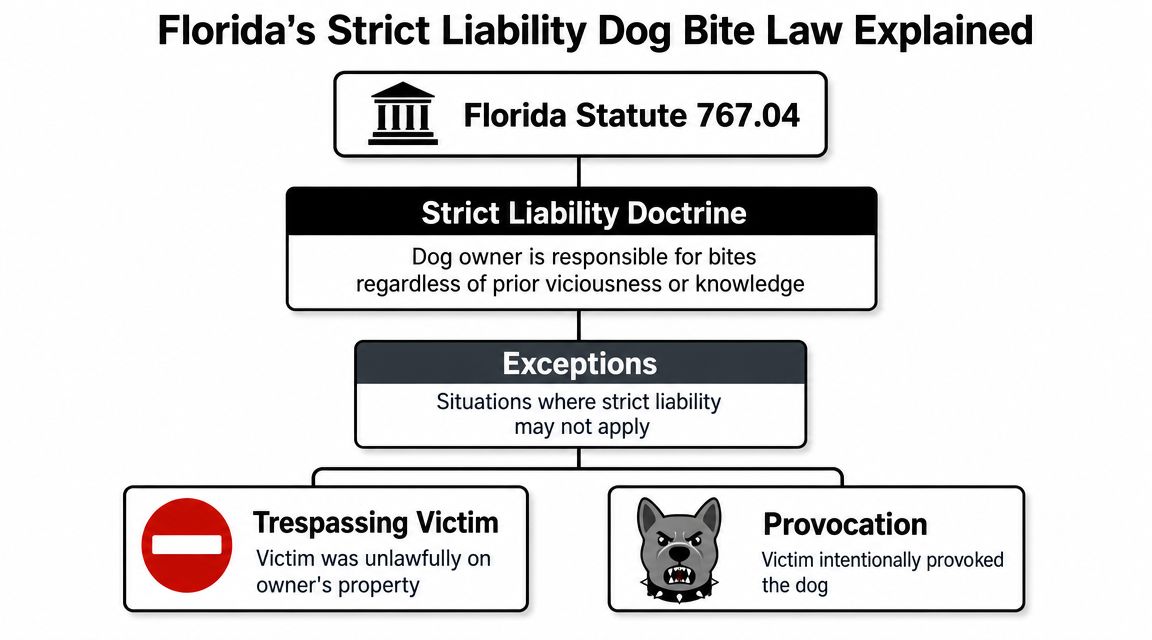
Florida uses a strict liability rule for many dog bite cases under Florida Statute 767.04. In plain English, that means the injured person usually doesn't have to prove the owner knew the dog was dangerous, and doesn't have to prove the dog had bitten someone before. The central question is usually whether the victim was in a public place or was lawfully on private property when the bite happened, as explained in this Florida dog bite law summary under Statute 767.04.
That changes the whole shape of a case.
What strict liability means in everyday terms
Think of it this way. In some injury cases, you must show someone acted carelessly. A dog bite claim under Florida's statute often works differently. The law starts from the bite itself and the circumstances around it.
If you were walking on a sidewalk and a dog rushed out and bit you, the case usually centers on ownership, lawful presence, and your injuries. If you were invited onto someone's property and their dog bit you, the same basic rule often applies.
You usually do not need to prove:
Prior aggression: You don't need evidence that the dog bit before.
Owner knowledge: You don't need to show the owner admitted the dog was dangerous.
Classic negligence: You may not need to build the whole case around careless conduct.
Where people get confused
A lot of people have heard of the “one-bite rule.” They assume an owner gets one free pass if the dog had never shown aggression before. That idea causes people to delay getting legal advice because they think they have no case.
In Florida, that assumption is often wrong.
The first attack can still lead to liability if the legal conditions are met.
That's why a dog bite attorney in Florida often investigates facts like these first:
Where did the bite happen
Were you lawfully there
Who owned or controlled the dog
What injuries followed the attack
The lawful presence issue
Determining the validity of many claims requires extensive factual detail. “Lawfully on private property” sounds simple, but people often need help proving it.
A few examples make it clearer:
Likely lawful presence: visiting a friend, delivering a package, walking through a common area where you're allowed to be
Potential dispute: entering a fenced area without permission, ignoring a direct instruction to stay out
Public place cases: sidewalks, streets, parks, and other public areas usually raise fewer questions about lawful presence
A careful lawyer doesn't assume this issue will sort itself out. They gather texts, doorbell footage, witness statements, and other proof that shows why you were there and what happened next.
First Steps to Protect Your Health and Your Claim
The first day matters. Not because you need to become your own lawyer, but because small decisions can protect both your recovery and your case. If you're hurt, focus on practical steps in order.
Start with medical care
Dog bites can look smaller than they are. Deep punctures, infection risk, tearing, nerve involvement, and later scarring may not be obvious at first. If you fell while escaping, the bite may not even be your only injury.
Get medical attention promptly and tell the provider exactly how the incident happened. If your wrist hurt because you hit the ground while backing away from the dog, say that. If your child seems unusually fearful after the attack, mention that too. Those details become part of the medical record.
Secure the basic facts before they disappear
People often think evidence means dramatic video footage. Usually, it starts with simple identification.
Try to gather:
The dog owner's name and contact information
The address where the attack happened
A photo of the dog, if it can be taken safely
Names and phone numbers for witnesses
Photos of wounds, torn clothing, blood, and the scene
If you're helping an injured child, photograph the injuries over time. Early swelling, bruising, stitches, and healing progress can all matter later.
Make an official report
Animal control reports are often important because they create a dated record of the event and may help confirm the dog's identity. They can also document location, owner information, and any follow-up about the animal.
Don't assume the owner will report it accurately for you. If you're physically able, make sure a report gets made.
A claim gets easier to prove when the event exists in more than one place. Your memory, your photos, your medical chart, and an official report should all point to the same story.
Be careful with insurance calls
If an adjuster contacts you quickly, that doesn't mean they're helping you build the claim. They're evaluating exposure. Even routine questions can shape later arguments about fault, timing, or the seriousness of the injury.
A safe approach is to avoid giving a recorded statement before you understand your injuries and have your records organized. If the case is more than minor, many people choose to let counsel handle those calls.
Keep a simple recovery file
You don't need anything fancy. A folder on your phone and a paper envelope are enough.
Keep:
| Item | Why it matters |
|---|---|
| Photos | Show how the injury looked before healing changed it |
| Bills and visit summaries | Tie treatment to the attack |
| Work notes | Help prove time missed or restrictions |
| Personal notes | Track pain, sleep problems, fear, and daily limitations |
That file often becomes the backbone of the case.
Related reading:
Injured at a Miami Hotel or Resort? Here Is What Florida Law Says You Are Owed
Contributory Negligence: What It Is and How It Affects Your Injury Claim
Premises Liability
Proving Your Case Evidence and Recoverable Damages
It is widely understood that a dog bite case needs proof of the bite. Fewer people understand how often the harder part is proving the full harm the attack caused. That's where claims are often undervalued.
Florida dog attack cases can involve much more than puncture wounds. Victims may suffer falls while trying to escape, infections, permanent scarring, and long-term psychological harm such as PTSD. A strong case documents those injuries through records, therapy notes, and other supporting proof, as discussed in this guide on complex dog attack injuries and documentation.
Evidence is more than a photograph of a wound
Photos matter, but they rarely carry a case by themselves. An attorney usually tries to build overlapping proof from different sources so the insurance company can't reduce everything to a minor bite narrative.
A useful evidence file often includes:
Official reports: animal control or police documentation can help fix the date, location, and dog identification
Medical records: urgent care, ER, primary care, specialist, and therapy records often tell the injury story over time
Witness accounts: a bystander may confirm the dog charged without warning, or that you were invited onto the property
Scene evidence: torn clothing, broken glasses, blood stains, and location photos can support how violent the event was
Non-bite injuries are often the most contested
A common insurance position is to narrow the claim. They may treat the case as “a bite that healed,” while ignoring the rest.
That's a mistake if the attack caused a chain of injuries.
Examples include:
| Injury type | How it happens | Helpful proof |
|---|---|---|
| Fall injuries | You trip or fall while backing away from the dog | ER notes, imaging, scene photos |
| Infection complications | A wound worsens after the initial bite | follow-up records, prescriptions, wound photos |
| Scarring and disfigurement | Tissue damage heals visibly | dated photographs, surgeon or specialist notes |
| Psychological trauma | Fear, nightmares, panic, avoidance after the attack | therapy records, journal notes, family observations |
Case-building insight: If an injury changed how you sleep, work, move, or interact with dogs, it deserves documentation even if it doesn't show up on an X-ray.
What damages may be recoverable
In practical terms, a claim often seeks payment for losses tied to the attack and its aftermath. Depending on the facts, that can include medical bills, lost income, rehabilitation, scarring, and pain-related losses. In stronger files, the evidence doesn't stop at invoices. It also shows what your life looked like before and after the attack.
A settlement discussion is usually stronger when the file shows both categories clearly:
Financial losses: treatment bills, medication, therapy, work loss, and other documented out-of-pocket costs
Human losses: pain, fear, scarring, reduced confidence, disrupted routines, and emotional strain
If you want a broader overview of how injury claims are valued, this personal injury settlement guide gives useful background on the factors lawyers often assess.
When evidence is limited
Some good claims start with imperfect proof. No eyewitness. No video. No immediate photo of the dog. That doesn't automatically end the case.
A lawyer may still work with:
Prompt treatment records that match the event
Consistent statements made to providers and reporting agencies
Physical evidence such as wound pattern, clothing damage, or location details
Follow-up documentation showing the injury developed in a medically predictable way
What hurts a case most isn't always the lack of one dramatic piece of evidence. It's inconsistency. If the records, photos, and statements fit together, even a difficult case can be proven.
The Legal Timeline and Common Defenses
The biggest mistake many injured people make is assuming they can deal with the legal side later, after life settles down. Dog bite cases don't work well that way. Delay creates two problems at once. Evidence fades, and the filing deadline keeps moving toward you.
For incidents on or after March 24, 2023, Florida's personal injury filing deadline is generally two years, and a late filing can permanently bar recovery, even when liability is otherwise strong, as explained in this Florida dog bite statute of limitations overview.
The timeline people should expect
Most claims do not start in court. They start with investigation. That includes collecting records, confirming ownership or control of the dog, reviewing photos, interviewing witnesses, and understanding the full medical picture.
A typical timeline often looks like this:
| Stage | What usually happens |
|---|---|
| Early intake | Facts are gathered, records requested, deadlines checked |
| Investigation | Evidence is organized and liability issues are tested |
| Demand phase | A settlement package goes to the insurer |
| Negotiation | Offers, counteroffers, and arguments over proof |
| Lawsuit if needed | Formal litigation begins if resolution fails |
Some readers worry that contacting a lawyer means they're committing to a lawsuit. Usually, it means the opposite. Early legal work often helps determine whether the claim can be resolved without filing one.
Common defenses and how they work
Dog owners and insurers often focus on a short list of defenses. The words may sound simple, but each one turns on facts.
Trespassing
If the defense claims you weren't allowed on the property, they may argue the strict liability statute doesn't apply. That's why details about invitations, deliveries, social visits, and access routes matter so much.
Useful proof may include text messages, witness statements, security footage, or evidence that you were performing a normal permitted activity.
Provocation
This defense argues the injured person caused the dog to react. Sometimes it's raised fairly. Sometimes it's stretched far beyond the actual facts.
Children's cases often become battlegrounds here because adults may reinterpret ordinary child behavior as provocation. A careful attorney looks closely at age, context, witness descriptions, and what the dog was doing before the bite.
Comparative negligence
Some cases involve arguments that the injured person's own actions contributed to the injury. Florida readers who want a plain-language primer on that concept can review this comparative negligence explanation.
Insurance defenses often sound stronger on the phone than they do under scrutiny. Once records, witness statements, and timelines are assembled, many broad blame-shifting arguments narrow quickly.
Why speed matters beyond the deadline
Waiting doesn't just risk a limitations problem. It also makes ordinary proof harder to obtain.
Witness memories fade
Photos get deleted
Doorbell footage may be overwritten
Visible injuries heal before they are documented
Informal conversations with insurers create avoidable inconsistencies
If you're searching for a dog bite attorney in Florida, one of the most important jobs is not dramatic courtroom work. It's preserving a clean, timely record before the defense shapes the story first.
How a Florida Dog Bite Attorney Manages Your Claim
From a client's perspective, a legal claim can feel like a pile of disconnected problems. There's medical care, insurance calls, paperwork, missed work, and uncertainty about what counts as evidence. From an attorney's perspective, the job is to turn that pile into a structured file with a clear theory of liability and a well-supported damages presentation.
What the lawyer does first
The first phase is usually quiet but important. The attorney reviews the incident date, confirms where the attack happened, identifies the dog owner or responsible party, and starts gathering records. If there are signs of a disputed issue, such as alleged trespassing or limited witness proof, that gets attention early.
This stage often includes:
Record collection: medical charts, bills, animal control reports, and any available photos
Fact testing: comparing your account with official reports and witness statements
Damage mapping: identifying not just the bite wound, but also scarring, therapy, lost income, and daily limitations
What changes once counsel is involved
One major benefit of representation is control over communication. Insurance adjusters often ask for statements before the full medical picture is known. An attorney can slow that down, organize the claim, and present it in a way that reflects the actual harm rather than the narrowest possible version of it.
A lawyer may also help clients avoid common mistakes, such as:
| Common issue | How counsel helps |
|---|---|
| Incomplete injury story | Connects treatment, symptoms, and later complications |
| Loose paperwork | Builds one organized claim file |
| Pressure from adjusters | Handles calls and written communications |
| Undervalued damages | Presents both financial and personal losses coherently |
The demand and negotiation phase
Once the evidence is assembled and treatment has progressed enough to understand the claim, the attorney typically sends a demand package. That package isn't just a bill total. It's a narrative supported by records.
A strong demand usually tries to answer the insurer's predictable questions before they ask them:
Why is the owner legally responsible
What injuries were caused by this attack
How do the records support those injuries
What losses should be paid
If negotiation stalls, the case may move into litigation. That doesn't mean trial is certain. It means the claim now enters a formal court process where both sides must exchange information.
Litigation if settlement doesn't happen
When a lawsuit is filed, the work becomes more structured. Written questions, document requests, depositions, and expert issues may follow. For the client, the key point is that the case keeps moving under formal rules rather than informal insurance discussion alone.
People looking for broader injury representation can review the firm's Florida personal injury services. The Law Office of John P. Sherman, PLLC handles personal injury matters in Florida, including cases where an injured person wants counsel to manage insurers and pursue compensation while the client focuses on treatment.
Good representation is often less about speaking the loudest and more about building the cleanest record.
Florida Dog Bite Claim FAQs and Your Next Steps
Some dog bite questions don't fit neatly into a checklist because real life is messy. The owner may be someone you know. The dog may not have bitten anyone before. The physical wound may heal while fear, sleep disruption, or visible scarring continue.
Across the United States, about 800,000 dog bites require medical treatment each year, but only about 16 result in death, which shows why these claims are usually about serious injury rather than fatality. Florida's strict liability framework gives many victims a clearer path than states that require proof of prior aggression, as discussed in this Florida Bar Journal article on dog bite law.
Common questions clients ask
What if the dog owner is my friend or relative
That concern is common. In many cases, the claim is handled through insurance rather than a direct personal demand against someone you care about. Even so, you should avoid making assumptions about coverage or responsibility before the facts are reviewed.
What if the dog never bit anyone before
That fact alone usually doesn't end a Florida claim. The old “one-bite” idea confuses many people, but Florida law is not built around proving a prior bite history in the way some other states are.
What if I wasn't bitten badly but I'm now afraid of dogs
Psychological harm can be real and disabling. If the attack changed how you sleep, walk in your neighborhood, let your child play outside, or respond around animals, that effect should be taken seriously and documented.
What if there were no witnesses
Lack of witnesses makes the case harder, not impossible. Prompt reporting, consistent medical history, scene photos, and physical evidence can still support a claim.
What if the attack caused a fall, not just a bite wound
Those cases often need more explanation because the insurer may try to isolate the bite itself. If the dog's actions caused you to fall and suffer additional injury, that sequence should be documented from the first medical visit forward.
What to do next if you're unsure
If you're still deciding whether to speak with counsel, do these four things today:
Save every photo and message connected to the event
Request or preserve treatment records from each provider you saw
Write down the timeline while it's still fresh
Stop guessing about fault until someone reviews the facts carefully
The right next step is usually a calm legal review, not a rushed decision. A dog bite attorney in Florida should be able to tell you what facts matter, what proof is missing, and what deadline controls your case.
If you or your child was injured in a dog attack, The Law Office of John P. Sherman, PLLC offers personal injury consultations for Florida cases. The firm serves South Florida from Coral Gables, provides bilingual service in English and Spanish, and handles injury claims on a no-fee-unless-there-is-a-recovery basis.