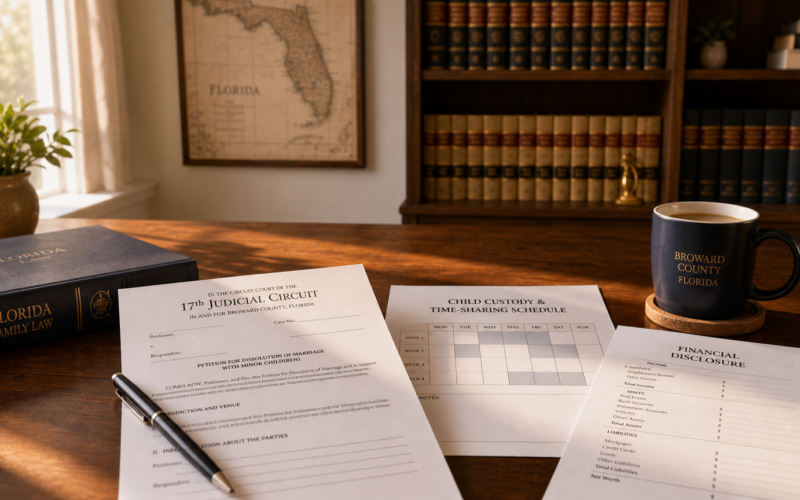

If you need a domestic violence injunction Florida order, move quickly. Florida law is designed for urgent protection, and the next 48 hours often matter more than a perfect explanation.
A domestic violence injunction is a civil court order that can immediately limit another person’s behavior once served. It can restrict contact, require someone to leave a shared home, and provide short-term protection until a judge hears both sides.
What a Domestic Violence Injunction Does in Florida
A domestic violence injunction creates enforceable rules law enforcement can act on if the respondent violates them. It can order no contact, remove someone from a shared residence, and set temporary terms that protect you until the final hearing.
Florida treats injunctions as one part of a broader response to abuse. The state reported 48,798 domestic violence injunction petitions in FY 2019-2020 and 44,584 petitions in FY 2020-2021, a decline of about 8.6% year over year, while survivors and their children spent 563,721 nights in emergency shelter in FY 2019-2020 (Florida Domestic Violence Annual Report 2019-2021).
Temporary protection versus final protection
A judge can act fast. Florida court guidance says a judge reviews the petition, may issue a temporary injunction, and then sets a hearing within 15 days (Florida Courts benchbook).
Temporary orders can take effect immediately after service. They may limit contact, change living arrangements, and affect parenting logistics before the final hearing.
A domestic violence injunction is different from a criminal no-contact order. A criminal order comes from a criminal case. This injunction comes from civil court and can still carry immediate consequences once served.
If you want a plain-English overview of how Florida handles domestic violence cases, start with this Florida family law resource.
Who Qualifies for a Domestic Violence Injunction Under Florida Law
Florida limits who can use this type of injunction. The relationship test controls, and filing under the wrong category can cost valuable time. Chapter 741 is the exclusive civil vehicle for domestic violence injunctions (Florida Statutes section 741.30).
If you need a plain-English overview of Florida domestic violence law, start with this Florida family law resource, then confirm that your relationship fits the statute before filing.
The relationship test in plain English
A domestic violence injunction is for family or household members. That includes current or former spouses, relatives by blood or marriage, people who live or used to live together as a family, and people who share a child.
Common examples:
- Former roommates who never dated usually do not qualify.
- Separated spouses living in the same home may qualify.
- Co-parents may qualify even if they never lived together.
- Extended family disputes may qualify if the statutory relationship test is met.
When the wrong petition type creates delays
Domestic violence injunctions are not the same as dating violence, repeat violence, or stalking injunctions. Each has its own legal test. Filing the wrong one can delay service or lead to denial.
If the relationship is unclear, start with one question: does it fit the family or household member requirement? If not, another injunction type may be the better path.
How to File and What Happens at Each Stage
You do not need a perfect life story. You need a clear, usable petition. Florida’s injunction process starts with the clerk of court, and the state’s courts allow filing in any Florida county.
What to include in the petition
Be specific. Include dates, times, locations, what was said, what was done, and why the danger is immediate. Florida’s Sixth District notes that petition quality can affect whether the judge grants short-term relief or waits for a hearing (Florida Sixth District injunction guidance).
If you have screenshots, photos, medical records, witness names, or prior police calls, list them and preserve them. Precision matters more than length.
What happens after filing
If the judge grants an ex parte temporary injunction, law enforcement serves the respondent, and the order becomes enforceable upon service. If the judge denies emergency relief, the court may still set a hearing. Florida guidance says the final hearing is set within 15 days.
Service is usually handled by the sheriff or another law-enforcement officer. If the address is wrong, service can stall.
If the judge denies temporary relief
A denial is not always the end. It may mean the petition lacked detail, missed the relationship test, or did not show immediate danger clearly enough. If so, fix the gaps, organize the evidence, and refile when the petition is stronger.
Emergency Ex Parte Orders and Immediate Remedies Available
An ex parte request lets a judge act before the other side is heard. If the petition shows immediate danger of domestic violence, the court can issue temporary protection quickly.
Temporary injunctions are enforceable across Florida, not just in the county where they were entered.
What the judge can order right away
Temporary relief can include removal from a shared home, no-contact provisions, temporary custody, and child-support-related relief. The order usually lasts until the final hearing unless extended (Florida Sixth District injunction guidance).
Strong petitions are organized and specific. Dates, threats, injuries, and concrete acts help justify immediate protection. Vague statements usually do not.
Why documentation changes the result
Florida courts do not need a criminal conviction to grant protection. They need facts showing immediate danger and a credible fear of continued abuse.
Give the judge enough reliable detail to act now. Add exhibits, not adjectives. If firearms are part of the risk, say so. Florida’s treatment of children and unsecured firearms also matters when kids are in the home (Florida Courts benchbook).
Life After the Injunction, Firearms, Custody, and Enforcement
Getting the injunction is the start, not the finish. The order can affect firearms, parenting time, child support, temporary support, counseling, and housing.
Florida’s judicial guidance says judges should explain orders clearly, may use video hearings, and should address compliance with surrender of weapons, firearms, and ammunition (Florida Courts best practices guide).
Firearms and ammunition
If the injunction includes firearm-related requirements, follow the order exactly. Timing and compliance matter. If the respondent is a law-enforcement officer, the issue may become more complex because job duties and possession rules can conflict.
Parenting and support consequences
A domestic violence injunction can affect temporary custody, visitation, child support, spousal support, and counseling conditions. It may also overlap with a divorce or paternity case.
For parents worried about unsecured firearms around children, see this Florida-focused firearms and child safety discussion for a deeper look at why courts pay attention to that issue.
Enforcement and modification
If the order is violated, contempt and criminal consequences can follow. Do not test the limits with casual texts, indirect messages, or informal child handoffs.
Modification is possible, but only through the court. Keep a copy of the order with you, and make sure relevant people, such as school staff, employers, and caregivers, know the rules.
When to File on Your Own and When to Hire an Attorney
Florida allows self-filing, and there is no filing fee and no minimum residency requirement under the statute and court guidance (Florida Statutes section 741.30). But low-cost access is not the same as low-risk strategy.
When self-filing makes sense
Self-filing can work when the relationship clearly fits the statute, the facts are straightforward, and the evidence is organized. If you need immediate protection, waiting for ideal circumstances can cost time.
When counsel changes the outcome
Hire an attorney when the case involves custody disputes, financial abuse, hidden assets, a related divorce, or a criminal investigation. What you say at the injunction hearing can affect other cases. A lawyer can refine the petition, prepare exhibits, organize witnesses, and handle cross-examination.
That is especially true if the other side already has counsel.
When language access matters
Spanish-speaking clients in South Florida often need more than translation. They need legal explanations that are clear in the moment. For families that want a local evaluation, The Law Office of John P. Sherman, PLLC is a Coral Gables-based option that handles family-law crises with a direct, practical approach.
Your Evidence and Safety Planning Checklist
The court filing is only part of the safety plan. If you are preparing a domestic violence injunction Florida petition, build your evidence and your safety plan at the same time.
If you need a more detailed breakdown of proof, review this evidence guide for Florida restraining orders after you have secured the basics.
Evidence to collect now
- Text messages and call logs: Save threats, stalking messages, and repeated contact attempts.
- Voicemails and screenshots: Keep originals when possible.
- Photos and medical records: Document injuries, property damage, and treatment.
- Police reports and witness names: Preserve this information immediately.
- Location and social media evidence: Capture posts, check-ins, and tracking behavior.
Keep the proof organized. Back it up, label files by date, and group them by event.
Safety steps that matter outside court
Change routines if the other person knows your habits. Tell your employer or your child’s school who may pick up the child. Set a code word with a trusted contact and identify a safe place you can reach quickly.
Also review digital safety. Turn off location sharing, secure accounts, and check shared device access.
Where to get help
If you are in immediate danger, call 911. For Florida domestic violence support, contact the Florida Domestic Violence Hotline through your local shelter network or court self-help resources.
The Law Office of John P. Sherman, PLLC helps Florida clients move quickly when family-law problems turn urgent, including domestic violence injunctions, custody issues, and related court disputes. If you need a calm, direct legal evaluation and a plan for the next 48 hours, visit The Law Office of John P. Sherman, PLLC to get help from a team that understands the stakes.