
Most people associate “negligence” with civil lawsuits, insurance claims, and personal injury disputes. In many situations, that is exactly where negligence belongs, because civil law is built to resolve private conflicts and compensate losses. Criminal negligence is different. It is the label people use when conduct is so dangerously careless, and so far outside accepted safety standards, that the government treats it as a crime rather than only a civil wrong.
In Florida, what people call “criminal negligence” is often discussed through the concept of “culpable negligence.” Florida’s standard criminal jury instructions describe culpable negligence as far beyond ordinary carelessness, using language that points to gross and flagrant conduct, reckless conduct, and a wanton disregard for human life or the safety of others.
If you are being investigated, questioned by law enforcement, or charged based on allegations of criminal negligence, your risk is not limited to an insurance dispute or a settlement number. Criminal exposure can involve incarceration, probation, court supervision, fines, and lasting legal consequences that affect work, licensing, future background checks, and your criminal record. If you are on the other side, meaning you believe someone’s extreme disregard for safety caused serious injury or death, it is still important to understand that the criminal system is not designed primarily to reimburse victims in the same way civil courts are.
This article explains what criminal negligence often means in Florida, the elements prosecutors typically must prove, how criminal negligence differs from civil negligence, real-world examples tied to Florida law, the penalties that may apply, and when it is time to speak with a criminal defense attorney. This is general information, not legal advice.
Elements of Criminal Negligence
“Criminal negligence” is not always a single stand-alone charge with one universal definition. In Florida, the concept people usually mean is often addressed through culpable negligence, a term that appears in statutes like Florida Statute 784.05 and is explained to jurors through standard criminal jury instructions. Those instructions matter because they are the lens jurors are asked to use when deciding whether conduct crosses the line from careless to criminal.
The first element is the required level of negligence itself. Ordinary negligence can be understood as a failure to use reasonable care, and in civil court that idea is framed around what a reasonably careful person would do in similar circumstances. Florida’s standard civil jury instructions describe negligence using that reasonable care standard, which is why most everyday “carelessness” claims stay in the civil arena.
Culpable negligence is a different threshold. Florida’s standard criminal jury instructions describe culpable negligence as gross and flagrant, showing reckless disregard for human life or for the safety of persons exposed to its dangerous effects, or an entire lack of care that suggests conscious indifference to consequences. The point is not that the outcome was terrible. The point is that the behavior itself is portrayed as an extreme departure from acceptable safety conduct, demonstrating a conscious choice to ignore obvious risks.
The next element depends on the specific statute a prosecutor chooses. Florida’s culpable negligence statute criminalizes exposing another person to personal injury through culpable negligence, and it separately criminalizes causing actual personal injury through culpable negligence. That difference matters because some charges focus on creating an unacceptable danger or placing someone in a zone of danger even if no injury occurred, while other charges focus on injury that allegedly resulted from the conduct.
In cases where harm is part of the charge, causation becomes essential. The State must connect the defendant’s conduct to the alleged injury in the way the statute requires, and the defense often tries to create doubt by pointing to intervening factors, missing links in the timeline, or alternative explanations for what caused the harm. When death is involved, prosecutors may consider manslaughter charges, and Florida’s manslaughter statute includes killings caused by culpable negligence as one way the offense can be committed.
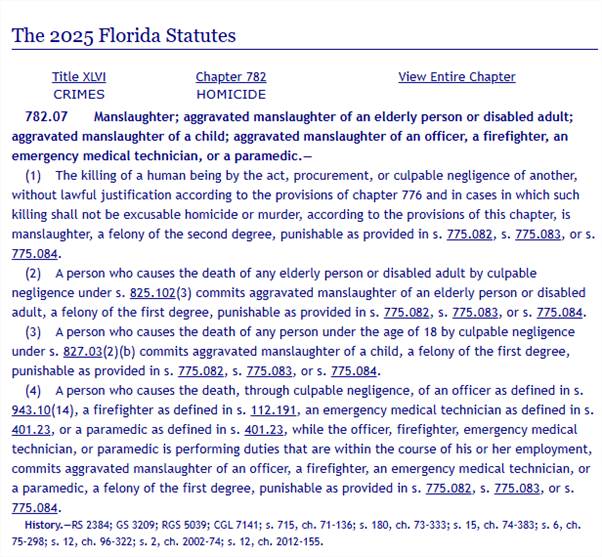
Taken from the Official Internet Site of the Florida Legislature
Because these are criminal charges, the burden of proof is part of the equation in every case. Florida’s standard instruction on reasonable doubt explains that the doubt must be reasonable, not imaginary, and focuses the jury on whether the evidence leaves them with an abiding conviction of guilt. That standard often shapes strategy more than people expect, because uncertainty that might be tolerable in civil court can be decisive in criminal court.
If you are trying to assess risk realistically, the most useful question is not whether something “looks bad.” The useful question is whether the State can prove each required element, including the elevated culpable negligence threshold, beyond a reasonable doubt with admissible evidence. That is where many cases are won or lost.
Criminal Negligence vs Civil Negligence
Criminal negligence and civil negligence can arise from the same incident, but they exist for different purposes and follow different rules. Civil negligence is focused on compensation. Criminal negligence is focused on punishment and public safety. Even when the same facts overlap, the legal system treats the two tracks differently because they serve different goals.
In civil negligence, the question is whether someone failed to use reasonable care and caused damages that can be proven and measured. Florida’s civil jury instructions describe negligence through the reasonable care standard, which is why most negligence disputes revolve around whether the conduct was unreasonable under the circumstances and whether it legally caused the harm.
In criminal negligence, the question is whether the conduct is so dangerous and so far outside accepted safety standards that it meets a criminal definition like culpable negligence. Florida’s standard criminal jury instructions frame culpable negligence as gross and flagrant, tied to reckless disregard for human life or safety, which is a higher bar than ordinary civil carelessness. The defendant must be shown to have acted culpably negligent, demonstrating reckless endangerment rather than mere carelessness.
Control of the case is also different. In a civil case, the injured person decides whether to file, settle, or dismiss, and the remedy is usually money compensation. In a criminal case, the State prosecutes, and the outcome is guilt or not guilty, along with criminal penalties. That difference matters for victims too, because criminal court is not primarily designed to pay medical bills or replace long term financial loss.
The burden of proof is another key separation. Criminal cases require proof beyond a reasonable doubt, and Florida’s standard instruction explains how jurors should think about that level of certainty. Civil cases generally use a lower burden, which is one reason it is possible for civil liability disputes to proceed even when criminal charges are not filed or when a conviction is not obtained.
Shared fault rules are also a point of confusion. Civil negligence disputes often involve comparative fault, and Florida’s comparative fault statute describes how responsibility can reduce damages and, in many cases to which the statute applies, bar recovery when a party is found to be greater than 50 percent at fault for their own harm. Criminal cases do not assign guilt in percentages, so “comparative negligence” concepts generally do not operate as a direct defense to criminal liability.
If you are caught between these two worlds, an early, clear assessment can prevent costly mistakes. A civil strategy and a criminal strategy can pull in different directions, and what you say or do on one side can sometimes echo into the other.
Criminal Negligence Examples
Criminal negligence cases tend to share a theme. The risk of serious injury is so obvious that ignoring it looks like indifference rather than a simple lapse in judgment. The law is not built to punish every bad outcome. It is built to punish conduct that fits a criminal statute and can be proven beyond a reasonable doubt.
Florida’s culpable negligence statute is a straightforward example of how extreme carelessness can be charged. It addresses exposing another person to personal injury through culpable negligence, and it also addresses situations where culpable negligence causes actual personal injury, creating a more serious classification when harm occurs.
Reckless driving behaviors represent a common category of criminal negligence cases. Examples include excessive speeding through residential areas, texting while driving in heavy traffic, drag racing on public roads, aggressive tailgating at high speeds, running stop signs in school zones, failure to yield causing collisions, and road rage incidents that create hazardous conditions for other motorists. These driving scenarios can escalate to criminal charges when the conduct demonstrates wanton disregard for the safety of others.
Workplace accidents can also trigger criminal negligence investigations when business operations ignore workplace safety regulations. Cases may involve employers or supervisors who knowingly expose workers to hazardous conditions without additional protection, fail to maintain equipment despite known dangers, or disregard mandatory safety protocols in construction, manufacturing, or industrial settings.
Healthcare provider cases represent another context where the standard of care becomes critical. While most medical malpractice claims remain civil, extreme departures from accepted medical care standards—such as performing procedures while impaired, ignoring life-threatening symptoms, or grossly inadequate medical care—can cross into criminal territory when the conduct shows conscious indifference to patient safety.
Florida law also addresses firearm incidents through separate and commonly discussed safety scenarios. Florida’s safe storage statute covers circumstances where a person stores or leaves a loaded firearm accessible within the reach or easy access of a minor. Cases involving negligent storage, unsecured firearms, and sport shooting accidents can result in criminal charges, particularly when improper supervision or child neglect contributes to injury or death. The statute outlines how liability and enhanced penalties can escalate when statutory conditions are met, while also providing exceptions and specific requirements that matter in real cases.
When death is involved, prosecutors may evaluate whether the facts fit manslaughter. Florida’s manslaughter statute includes killing by act, procurement, or culpable negligence, and it frames manslaughter as a killing without lawful justification and not excusable homicide or murder under Florida law. That statutory framing is why these cases often turn into disputes about classification, causation, and whether the evidence truly supports the criminal threshold. Special victims, such as children or vulnerable adults, may trigger additional protection provisions under Florida law.
In practice, prosecutors often emphasize warnings that existed, safety steps that were ignored, and how foreseeable the risk was. The defense often pushes the opposite direction, focusing on uncertainty, alternative causes, and whether the conduct is being overstated into “gross and flagrant” territory. Florida’s standard criminal jury instructions are the backbone of that dispute because they define what the jury must actually find, not what sounds emotionally persuasive.
If an incident could be characterized either as a tragic accident or as criminal-grade recklessness, the most important thing is to stop relying on assumptions. The facts, the elements, and the proof required will determine the direction, not the headline description.
Criminal Negligence Penalties and Sentencing Guidelines
Penalties in Florida depend on the specific charge, the offense degree, and the defendant’s history. Two cases that sound similar in conversation can carry very different exposure once charging decisions and sentencing structures are applied.
Florida’s culpable negligence statute classifies exposing another person to personal injury through culpable negligence as a second-degree misdemeanor, and causing actual personal injury through culpable negligence as a first-degree misdemeanor. In addition, certain firearm-related scenarios involving minors can involve felony exposure when the statutory conditions are met.
Florida’s general penalties statute sets maximum incarceration terms by offense degree, including maximum jail time for misdemeanors and maximum prison time for felonies. Those statutory maximums provide an outer boundary, but they are not the whole story, especially in felony cases where scoring and enhancements can shape what is realistically on the table. A jail sentence can range from months to years depending on the classification and circumstances.
Florida’s general fines statute also sets maximum fines by offense degree, including different caps for misdemeanor degrees and felony degrees. Monetary penalties can come alongside incarceration exposure, and they can also be paired with probation terms and court-ordered conditions that affect daily life long after the case is resolved.
When death is involved and manslaughter is charged, Florida’s manslaughter statute classifies manslaughter as a felony, and the statutory classification is part of why the stakes escalate dramatically in culpable negligence death investigations.
For felony sentencing, Florida uses the Criminal Punishment Code, a structured system that relies on worksheet scoring to calculate total sentence points. That framework can factor in offense severity rankings, additional offenses, victim injury scoring, and prior record, which is why it is dangerous to assume exposure based only on the name of the charge. Enhanced penalties may apply in cases involving special victims or aggravating factors.
If you want a practical takeaway, it is this. Early decisions matter. The first statements, the first evidence preservation steps, and the first strategic moves can influence how the case is charged and how it is later negotiated. Understanding mitigating factors and extenuating circumstances early can shape both charging decisions and sentencing outcomes.
How Criminal Negligence Is Proven in Court
To prove criminal negligence in Florida, prosecutors must show more than the fact that something went wrong. The State must present evidence that the defendant’s conduct meets the elevated culpable negligence threshold and that each element of the charged offense is proven beyond a reasonable doubt.
Many cases are built through a combination of witness testimony, physical evidence, digital records, and expert analysis. Witnesses may describe the conduct, the presence of warnings, the expected safety practices, and what was visible in the moment. Physical evidence may show dangerous conditions, missing safeguards, or the mechanism of injury. Digital evidence can establish a timeline and awareness. Experts may address risk recognition and whether the conduct represents a gross departure from acceptable safety conduct.
Even with strong evidence, the definition the jury must apply is the legal center of the case. Florida’s standard criminal jury instructions define culpable negligence as requiring gross and flagrant behavior showing reckless disregard for safety, not ordinary negligence. That is why trials often become battles over characterization, because the same facts can be argued as tragic carelessness on one side and criminal indifference on the other.
Reasonable doubt shapes every stage of a criminal case. Florida’s reasonable doubt instruction emphasizes that jurors must reach an abiding conviction of guilt, and it acknowledges that doubt can arise from conflicts in evidence or from lack of evidence. That is one reason evidence gaps can be more powerful in criminal court than in civil court, and why timelines and documentation can quietly decide outcomes.
If you are facing allegations, a smart approach is to ask what the State can actually prove, not what people assume happened. That shift in mindset often reveals where risk is truly concentrated and where the defense can create meaningful doubt.
Defenses to Criminal Negligence Charges
Defenses in criminal negligence cases are highly fact specific, but they often focus on a handful of pressure points. One common defense is that the conduct does not meet the culpable negligence threshold. The defense may argue the behavior was careless, a mistake, or ordinary negligence, but not the gross and flagrant, reckless disregard conduct required by Florida’s criminal jury instructions.
Causation is another major defense theme. Even if conduct was risky, the State must connect that conduct to the alleged injury or death. Intervening events, another person’s actions, or uncertainty in medical or timeline evidence can create reasonable doubt. In serious cases, causation disputes can become the hinge point, because a jury can dislike the conduct and still acquit if they are not convinced the conduct caused the harm in the way the charge requires.
Foreseeability and awareness often show up in these disputes. Prosecutors typically argue that the risk was obvious and should have been recognized, while the defense argues that the danger is being reconstructed with hindsight. The culpable negligence definition in Florida’s standard instructions is often where that argument lands, because the instruction frames culpable negligence as something more than a mistake and closer to conscious indifference or reckless disregard.
Mitigating factors and extenuating circumstances can also play a critical role in defense strategy. Evidence of reasonable force used in self-defense, lack of prior knowledge of dangerous conditions, or intervening factors that broke the chain of causation can all support the defense narrative. In some cases, demonstrating that the defendant’s actions were consistent with accepted practices in their field or that they took reasonable precautions can counter claims of gross negligence.
In death investigations where manslaughter is considered, statutory classification and legal framing can become the battlefield. Florida’s manslaughter statute includes the “without lawful justification” framing and distinguishes manslaughter from excusable homicide and murder under Florida law, which is why legal arguments can focus on what category the evidence truly supports.
If you are under investigation, one of the most common and most damaging mistakes is trying to “clear it up” through informal conversations with law enforcement. Even statements made in good faith can be misunderstood or later used as building blocks for the prosecution’s narrative. A deliberate strategy usually protects you better than confidence that things will “make sense” later.
When to Contact a Lawyer for Negligence Charges
If criminal negligence is on the table, the best time to speak with a Sarasota criminal defense attorney is early, before the narrative hardens. If law enforcement wants to interview you, if you learn you are being blamed for serious injury, or if a death occurred and investigators are asking questions, those are moments to slow down and protect your future.
Waiting until charges are filed can limit options. Once a case is formal, the process becomes more rigid, and early missteps can be difficult to undo. A focused case evaluation and case investigation can help you understand what the State must prove, what evidence exists, what evidence is missing, and how to avoid unforced errors that make the situation worse.
Experienced trial lawyers can provide custom defense strategies tailored to your specific circumstances, develop comprehensive legal support throughout the process, and guide legal strategy development from the initial investigation through trial if necessary. A thorough case evaluation allows your attorney to identify weaknesses in the prosecution’s case, preserve critical evidence, and build a defense that addresses both the legal elements and the factual narrative.
There is also another side to this topic. If you are the person harmed by someone else’s extreme disregard for safety, criminal court may not address the financial and personal fallout you are living with. Criminal proceedings are designed to determine guilt and impose penalties, not to fully reimburse losses the way civil remedies are designed to do.
If you want a calm, practical assessment of what your situation likely means and what your next step should be, The Law Office of John P. Sherman, PLLC can help you evaluate the facts before you make decisions that are hard to reverse. We offer a free consultation to discuss your case, review the evidence, and explain your options. Our approach combines thorough legal analysis with practical guidance, and our client testimonials reflect our commitment to protecting your rights and your future.