
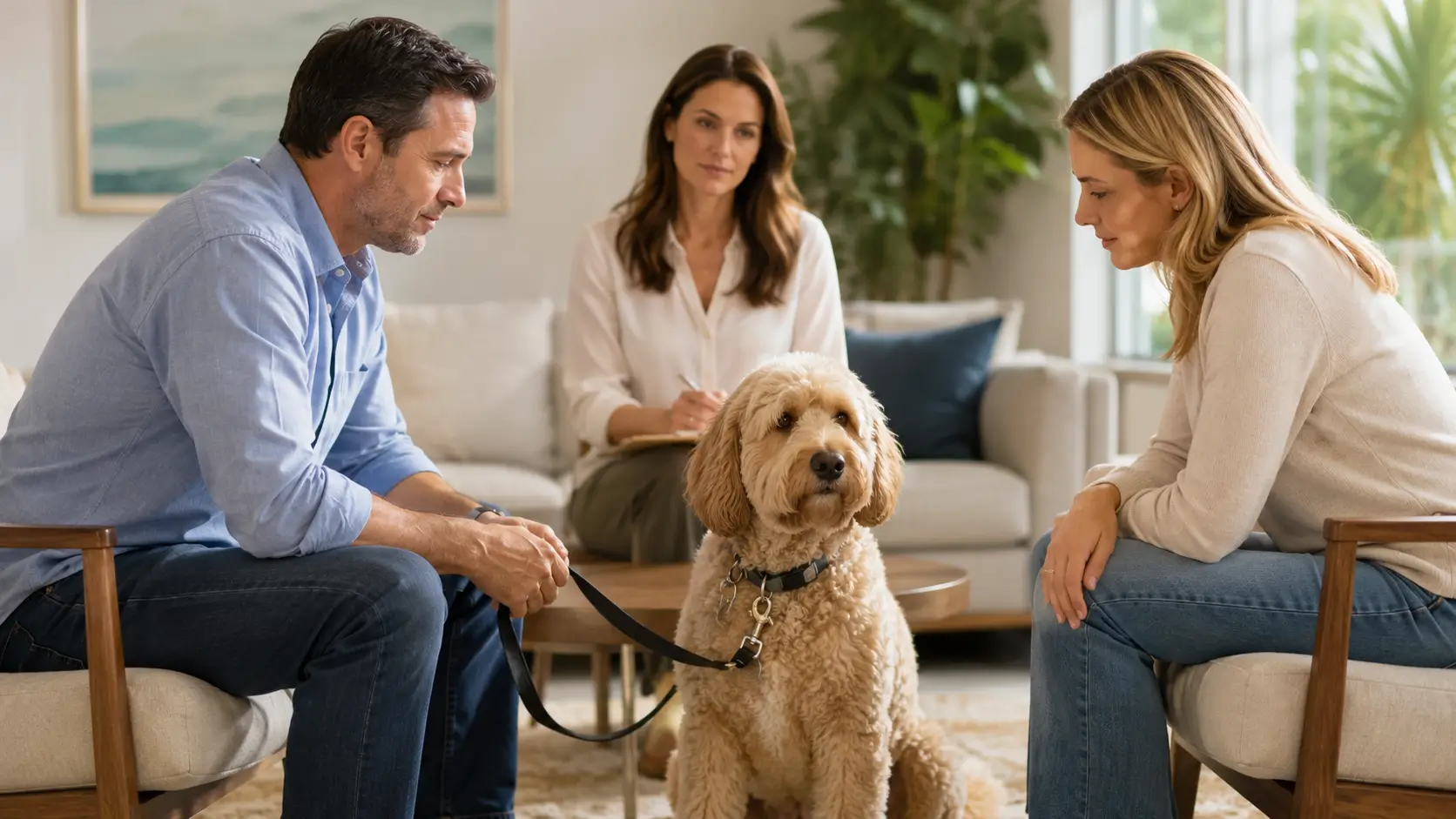
For millions of Florida families, a pet is not an asset. It is a daily presence, a source of comfort, and in many households, the one constant that made a difficult period of life more manageable. A dog who has been there for eight years. A cat who knows your routine better than anyone. An emotional support animal whose presence is not optional. The idea of losing that relationship as a line item in a property division agreement feels wrong in a way that is hard to articulate legally.
Florida law, however, does not have a framework built around that emotional reality. Under Florida’s equitable distribution statute, pets are classified as personal property. Courts award ownership to one spouse. There are no visitation orders. There is no shared custody schedule. The law hands a judge a financial framework designed for furniture and investment accounts, and asks them to apply it to a living relationship.
That is the legal starting point. But it is not the only option available to you. Understanding the full picture, including a meaningful 2025 Florida appellate decision and the practical paths most pet disputes actually take, gives you a much clearer position than the statute alone suggests.
What Florida Law Says About Pets in Divorce
• Florida classifies pets as personal property under Fla. Stat. §61.075, the equitable distribution statute
• Courts award ownership to ONE spouse. There is no legal framework for shared pet custody in Florida
• The court applies equitable distribution factors: who bought the pet, who provides daily care, the pet’s economic value
• October 2025: Kraushaar v. Kraushaar (3d DCA) clarified how a pet’s status as an emotional support animal factors into a distribution dispute, and what that claim can cost you in privacy
• Private agreements between spouses can create informal shared arrangements, though they are not enforceable the same way a custody order is
Losing a pet in a divorce is one of the outcomes people feel most deeply and plan for least. Speaking with a qualified family law attorney Miami residents rely on early in the process, before positions harden and disputes reach a hearing, gives you the most options and the most time to pursue the path most likely to protect your relationship with your animal.
How Florida Law Classifies Pets in a Divorce
The governing statute for property division in a Florida divorce is Fla. Stat. §61.075. It was written to address bank accounts, real estate, vehicles, and investments. Florida courts apply it to pet ownership disputes because the statute covers all personal property, and that is the legal category pets occupy under Florida law. This is not a gap in the law that courts have quietly worked around. Florida’s First District Court of Appeal addressed it directly in Bennett v. Bennett, 655 So. 2d 109 (Fla. 1st DCA 1995), holding that a trial court has no authority to order visitation with a dog because it is personal property, and that pet disputes belong in the equitable distribution process, not a custody framework.
Understanding the full scope of property division in divorce is important context here, because pets are evaluated within the same equitable distribution framework as every other marital asset. What this means in practice is that a judge approaching a pet dispute will use the same analytical framework they use for any other asset: which spouse has a stronger ownership claim, what is the economic value of the asset, and how does awarding it to one party fit into the overall fairness of the marital estate division?
Equitable Distribution Factor How It Applies to Pet Ownership
- Who purchased or adopted the pet: one of the strongest ownership signals. Original purchase contracts, adoption paperwork, and breeder receipts in one name carry significant weight
- Who serves as primary caregiver: demonstrated through vet appointment histories, grooming records, training participation, and daily feeding routines
- Economic value of the pet: pedigree animals, show dogs, and breeding animals carry measurable market value that factors into the distribution analysis
- Marital vs. separate property: a pet acquired before the marriage and maintained primarily by one spouse may qualify as separate property, removing it from equitable distribution entirely
- Connection to the children: when a pet is closely bonded to minor children in the household, courts sometimes factor that relationship into the ownership decision
One distinction worth understanding clearly: if a pet was yours before the marriage, and the circumstances support treating it as separate property, it may never be subject to equitable distribution at all. Just as there are certain categories of what money can’t be touched in a divorce, separately owned pre-marital property, including pets, can fall outside the marital estate entirely when properly documented. The burden is on the spouse asserting separate property status to establish it.
The Kraushaar v. Kraushaar Decision: What Florida’s 2025 Ruling Means for Your Case
In October 2025, Florida’s Third District Court of Appeal decided Kraushaar v. Kraushaar, Case No. 3D25-1706, and the case matters to anyone going through a divorce who relies on their pet in a therapeutic or emotional support capacity, though not in the simple, one-directional way it is sometimes described.
The case arose from a discovery dispute, not a final ruling on who kept the dog. One spouse claimed the family dog was his certified emotional support animal and sought its return, attaching letters from medical providers describing a long-standing anxiety condition the dog helped manage. The other spouse asked for access to those medical records to test whether the claim held up, and the trial court blocked that request. The Third DCA was asked to decide whether blocking that discovery was correct, and its answer draws an important line that shapes how these claims should be handled going forward.
The court held that Fla. Stat. §61.075 already allows a judge to weigh the sentimental value attached to a piece of property, including a pet, as one factor in the distribution analysis. If a spouse wants to use an emotional support animal’s status simply to show that sentimental bond, the court can consider that without requiring any medical records at all. But if that same spouse instead argues that the animal’s status as an emotional support animal creates a special need or special circumstance that should tip the distribution in their favor, that is a stronger and more consequential claim, and the court held that it opens the door to discovery of the medical records supporting it, subject to protective safeguards like an in-camera review.
In practical terms, Kraushaar gives spouses a real choice, not a guaranteed advantage. Documenting a pet’s role as an emotional support animal can support a straightforward sentimental-value argument without exposing private medical information. Turning that same documentation into a stronger special-circumstances argument can work, but it comes with a real privacy tradeoff, since the other side may then be entitled to your underlying medical records. Deciding which route serves your case, and how to frame it, is exactly the kind of judgment call a qualified family law attorney should walk you through before you file anything.
Related reading:
Who Is Responsible for Debt After a Florida Divorce? The Complete Guide to Marital Liability
Key Components of a Marital Settlement Agreement
Divorce & Separation
How to Strengthen Your Claim to the Family Pet in a Florida Divorce
Ownership claims in pet disputes are built on documentation. The spouse who can present a clearer, more comprehensive record of their connection to and ongoing responsibility for the animal has a significantly stronger position. If your divorce is pending or approaching, gathering the following evidence should begin immediately.
• Purchase or adoption records in your name. This includes the original purchase contract, breeder documentation, adoption paperwork from a shelter, or any written agreement establishing you as the owner at the time of acquisition.
• Veterinary records showing you as the primary contact and owner of record. The full clinic file matters here, including appointment histories, emergency contact designations, and records of who attended visits.
• Microchip registration in your name. This is frequently overlooked and is one of the clearest ownership indicators available.
• Licensing and vaccination records listing your home address.
• Photographs and timestamped social media posts from before the divorce showing your day-to-day caregiving role. Feeding, walking, grooming, training, vet visits. The routine documented over time.
• Written communications with veterinarians, groomers, trainers, or boarding facilities that show consistent involvement and decision-making authority on your part.
• If your pet is an emotional support animal: formal documentation from a licensed mental health provider establishing the therapeutic relationship and its significance to your functioning. Under Kraushaar, this documentation can support a sentimental-value argument on its own, or a stronger special-circumstances argument if you are prepared for the medical records exposure that comes with it. A family law attorney can help you decide which framing fits your situation.
Not all of this evidence carries equal weight in every case, and presenting it effectively in a divorce proceeding requires knowing which arguments to lead with and how to frame them within the equitable distribution analysis. A qualified family law attorney can help you identify what you have, what is missing, and how to build the strongest possible ownership argument before the case reaches a hearing.
Private Pet Agreements: The Practical Path Most Pet Disputes Actually Take
Here is something the statute does not tell you: most pet disputes never reach a judge. They are resolved through mediation or direct negotiation between the spouses, and that is almost always the better outcome for both parties and for the animal.
Collaborative divorce is one of the most effective frameworks for resolving pet disputes without adversarial litigation. It gives both spouses the space to explain what the animal means to them and to reach an arrangement that a judge applying equitable distribution factors simply would not have the authority to create. Because Florida courts cannot order a shared pet arrangement, the only way to achieve one is through a private agreement incorporated into the marital settlement agreement. When properly drafted and included in the MSA, this agreement creates enforceable terms for how the pet’s life is structured after the divorce.
A well-constructed pet agreement can address:
• Which spouse is the primary owner and where the pet primarily lives
• A schedule for the other spouse to spend time with the animal
• How veterinary costs, food, grooming, and routine care are shared
• Who has decision-making authority in a medical emergency
• What happens if the primary owner’s life circumstances change significantly
What You Need to Know About Private Pet Agreements
• A pet agreement is a contract between spouses, not a court order. Its enforceability depends on how well it is drafted
• If the primary owner violates the agreement, your remedies are more limited than they would be in a child custody violation
• The most enforceable approach is a carefully worded clause within the marital settlement agreement, reviewed by a qualified attorney
• Mediation and collaborative divorce are the ideal settings for pet disputes. Less adversarial, more flexible, and significantly less expensive than litigation
Can a Prenuptial or Postnuptial Agreement Protect Your Pet?
Yes, and this is the most legally reliable option for anyone who has not yet reached the point of a divorce but wants to protect a pet they care about.
There is a lot that what most couples don’t know about prenuptial agreements covers, and pet ownership is one of the more overlooked provisions. Florida couples can specifically designate pet ownership in a prenuptial or postnuptial agreement, establishing which spouse owns the animal as separate property and how care responsibilities would be handled in the event of a separation. Once a pet is designated as separate property in a valid agreement, it is removed from the equitable distribution analysis entirely. There is nothing for a court to decide because the agreement has already decided it.
If you are currently married and want to establish this protection now, a postnuptial agreement lawyer can help you create the same result after the wedding. Florida courts recognize postnuptial agreements that meet the requirements for validity, and pet ownership is a legitimate provision to include. The conversation is easier to have before a crisis than during one, and the legal protection it provides is far more certain than litigating ownership in a divorce proceeding.
Whether you are in the middle of a Miami-area divorce and fighting for a pet you love, or you want to plan ahead before a dispute arises, the Law Office of John P. Sherman can help you understand which path gives you the best chance of protecting that relationship under Florida law. Consultations are free and cover your specific situation.
Frequently Asked Questions
Who gets the dog in a Florida divorce? Florida law classifies pets as personal property subject to equitable distribution under Fla. Stat. §61.075. Courts award ownership to one spouse based on factors like who purchased the pet, who serves as primary caregiver, and the pet’s economic value. There is no legal framework for shared pet custody in Florida.
Can I get visitation rights for my pet after a Florida divorce? Florida courts do not issue pet visitation orders. However, divorcing spouses can negotiate a private pet agreement through mediation or direct negotiation, which can be incorporated into the marital settlement agreement. These agreements are contracts, not court orders, so enforcement is limited.
Does it matter who paid for the pet in a Florida divorce? Yes. Evidence of who purchased or adopted the pet, including receipts, adoption contracts, and breeder documentation, is persuasive evidence in an equitable distribution dispute. However, courts also weigh who provided primary daily care, whose name appears on vet records, and other caregiving factors.
Can a prenuptial agreement protect who gets the dog in a divorce? Yes. Florida couples can designate pet ownership in a prenuptial or postnuptial agreement, removing the pet from equitable distribution. This is the most legally reliable way to protect your bond with a pet, far more effective than litigating ownership during a divorce.