What happens in Vegas stays in Vegas. What happens at a Miami hotel can follow you home in the form of medical bills, lost income, lasting physical pain, and a set of legal rights that nobody at the front desk is going to volunteer to explain. Miami is one of the top tourist destinations in the United States. Its hotels range from budget properties near Miami International Airport to five-star towers on Brickell Bay and oceanfront resorts along Collins Avenue in Miami Beach. The size and rating of the property does not change the legal obligation. Every hotel in Florida owes every guest the same duty of care under Florida premises liability law, and when they fail to meet it, injured guests have rights worth understanding before they accept anything the hotel offers.
This article covers the most common hotel injury scenarios in Miami, what Florida law specifically requires hotels to do, the critical steps to take in the first hours after an injury, and what claims are realistically worth in South Florida. The same legal framework applies to vacation rentals listed on Airbnb and VRBO, which have become a major part of Miami’s accommodation market and a growing source of premises liability claims.
Florida Hotels Are Legally Required to Keep Guests Safe
• Hotels owe guests a duty of reasonable care under Florida premises liability law
• This duty covers rooms, hallways, lobbies, pools, fitness centers, restaurants, parking structures, and all guest-accessible common areas
• Hotels must warn guests of known hazards and correct dangerous conditions within a reasonable time
• Failure to meet this duty is negligence, and that negligence can support a personal injury claim
• The same legal duties apply to vacation rentals including Airbnb and VRBO properties under Florida premises liability principles
Miami hotel legal teams and their insurance companies respond to guest injuries within hours. They begin documenting, investigating, and building their defense while you are still in the property. If you were hurt at a Miami hotel, resort, or vacation rental, speaking with a qualified personal injury attorney before you leave the state is the single most protective step you can take.
What Types of Hotel and Resort Injuries Happen Most Often in Miami?
Miami’s specific hospitality environment creates injury scenarios that are distinct from other markets. High-rise hotels with aging infrastructure, rooftop pools with elevated risk profiles, crowded tourist corridors, and a hospitality industry that moves fast and cleans up faster: all of these conditions shape the claims that arise most frequently in South Florida.
Slip and Fall Injuries in Lobbies, Bathrooms, and Pool Areas
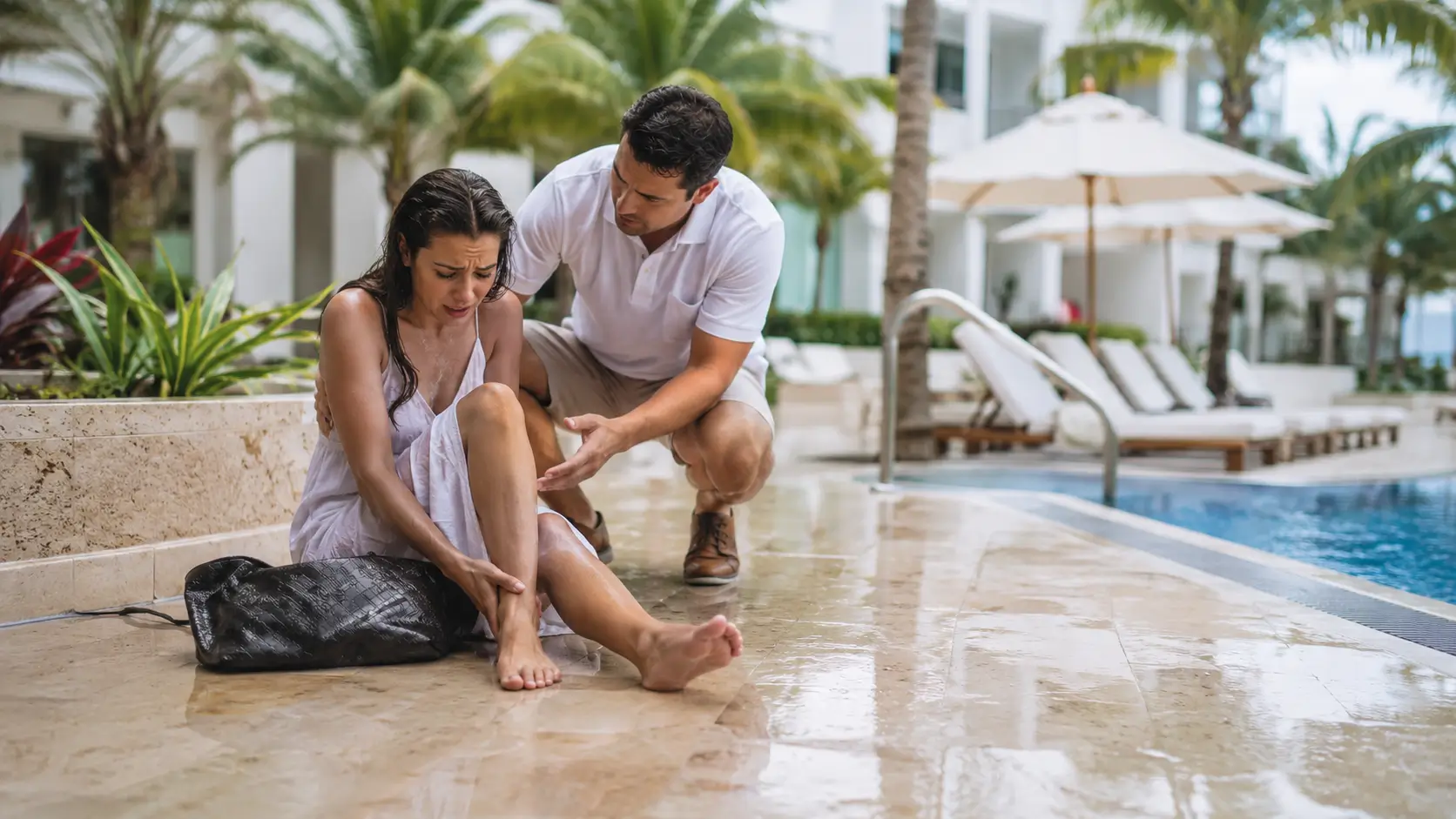
Wet marble lobbies, pool decks without adequate non-slip surface treatment, and poorly maintained bathroom tile are the most common sources of hotel injuries in Miami. A qualified slip and fall attorney will look immediately at the maintenance logs, staff communications, and prior complaint records to establish what the hotel knew and when they knew it.
These cases turn on whether the hotel knew or should have known about the dangerous condition and whether they acted on it within a reasonable time. Understanding the general range of outcomes in slip and fall injury cases in Florida can help set realistic expectations for what your specific claim might be worth, which varies significantly based on the severity of injury and the quality of evidence.
Swimming Pool and Waterpark Accidents
Florida hotels with pools carry legal obligations regarding barriers and fencing, posted depth markers, water quality standards, and appropriate warning signage. Contrary to a common assumption, Florida law does not generally require hotels to staff lifeguards at their pools. That requirement applies to public pools with general public access, such as municipal pools and water parks, not to the limited-access pools found at hotels. What the law does require is that a hotel without a lifeguard post clearly visible signage stating that no lifeguard is on duty and that guests swim at their own risk.
When a pool accident happens, liability typically comes from missing or inadequate barriers, absent depth markers, poor water quality, missing required signage, or a hotel’s own decision to advertise supervised swimming without actually providing it, not from the mere absence of a lifeguard by itself. Drownings, near-drownings, and diving injuries at hotel pools in Miami Beach are documented claims, particularly at rooftop and infinity pools where design features can obscure depth cues.
Balcony and Elevator Accidents
Balcony railing failures and elevator malfunctions are recurring claims in Miami’s older hotel inventory, where deferred maintenance is a consistent issue. These two categories are actually governed by different rules, and knowing the difference matters. Elevators are regulated statewide under Florida Statutes Chapter 399: every elevator must be inspected annually by a state-certified elevator inspector and must carry a current Certificate of Operation issued by the Department of Business and Professional Regulation.
A hotel running an elevator without a valid, current certificate has already violated state law before any accident happens. Balconies and other structural elements are handled differently. Florida’s statewide “milestone inspection” law, passed after the Surfside condominium collapse, applies specifically to condominium and cooperative buildings and does not cover standalone hotels. What does apply to hotels in Miami-Dade and Broward County are those counties’ own building recertification ordinances, which require structural and electrical recertification once a building reaches a certain age, regardless of how it is owned. A hotel that cannot produce current elevator inspection records or building recertification documents for a system that failed has already made a significant portion of your case for you.
Negligent Security and Assault in Hotel Common Areas
Miami’s geography places some hotels in close proximity to neighborhoods with documented crime histories. Parking garages, stairwells, and hotel lobbies in these areas create foreseeable security risks that the property is legally required to address. Negligent security cases in Miami follow a clear legal standard: if a hotel was aware of prior criminal incidents on or near the property and failed to implement proportionate security measures, including adequate lighting, functioning locks, camera coverage, and trained personnel, it can be held liable for assaults that occur because of those gaps.
One 2023 change is worth knowing about: under Florida Statutes Section 768.0701, when a case like this goes to a jury, the jury must now divide fault among everyone who contributed to the injury, including the person who actually committed the assault, not just the property owner. That can reduce a hotel’s share of financial responsibility even in a case where its security failures are well documented, which makes building a thorough record of what the hotel knew and failed to do even more important. If you were assaulted on hotel property and believe the attack was foreseeable, speaking with an attorney who handles Miami premises liability cases is the right first step.
Food Poisoning and Illness from Hotel Restaurants
Hotel restaurants and room service operations are licensed and regulated by the Florida Department of Business and Professional Regulation’s Division of Hotels and Restaurants, the same agency that oversees any licensed food service establishment in the state.
A documented food poisoning case tied to a specific hotel property, supported by medical records and corroborated by reports from other guests who ate the same meal during the same period, can establish negligence. Hotels that operate third-party restaurants on their premises are not automatically insulated from liability if they control the space and the vendor relationship.
Vacation Rental Injuries in Miami
Miami’s short-term rental market has expanded significantly over the past several years, and Florida courts have increasingly applied standard premises liability principles to Airbnb and VRBO hosts when unsafe conditions cause guest injuries. Florida does not have a law written specifically for short-term rental platforms, so these cases are evaluated under the same general negligence principles that apply to any property owner: the host owes guests a duty to inspect the property, correct known hazards, and warn guests of dangers that cannot be immediately addressed. Platform insurance programs may provide an additional avenue for recovery depending on the specific circumstances of the injury.
What Florida Law Requires Hotels to Do to Protect Guests
Hotel guests are classified as invitees under Florida premises liability law. Invitees receive the highest duty of care that property law recognizes. This is not the same standard that applies to trespassers or to social guests. It is an active, ongoing obligation to inspect the property, find hazards, fix them, and warn guests of dangers that cannot be immediately resolved.
Hotel Legal Duty What It Means in Practice
Regular and proactive inspection Hotels must inspect all guest-accessible areas on an ongoing basis, not only after a complaint is filed
Fix or warn of known hazards Once a dangerous condition is identified or should have been found, the hotel must repair it or clearly warn guests before they encounter it
Security proportionate to foreseeable risk In high-crime areas, security measures must match the documented threat level: cameras, lighting, personnel, access controls. Fault for an assault is now divided among all responsible parties, including the attacker, under Florida Statutes Section 768.0701
Pool safety compliance Florida does not require hotels to staff lifeguards. It does require compliant barriers, posted depth markers, regular water quality and chemical testing, and a visible “No Lifeguard on Duty” warning if none is present
Elevator maintenance Annual inspection by a state-certified elevator inspector and a current Certificate of Operation under Florida Statutes Chapter 399
Structural and building recertification Local county recertification ordinances (Miami-Dade and Broward) require structural and electrical recertification of aging buildings, including hotels, at set intervals
Food service safety standards Full compliance with DBPR Division of Hotels and Restaurants licensing and food handling requirements at all hotel food service operations
The “knew or should have known” standard is where most hotel negligence cases turn on the specific facts. A hotel that received a written maintenance request about a broken handrail three days before a guest fell while gripping it is in a fundamentally different legal position than a hotel with no prior notice of the defect. That difference comes from documentation, and finding it requires a legal investigation that begins immediately after the incident.
What to Do in the First Hours After a Hotel Injury in Miami
The first hours after a hotel injury are the most legally consequential. Evidence disappears. Hotel staff document the scene in their favor. Witnesses check out. The gap between what actually happened and what the hotel’s incident report says happened grows quickly. The following steps protect your ability to tell the true story of what occurred.
- Step 1. Report the injury to hotel management immediately and request a written incident report. Do not leave the property without getting the report number and a copy if possible. This creates an official record that the hotel cannot later deny.
- Step 2. Photograph everything before the hotel cleans or repairs anything. The hazard itself, its location, the surrounding area, any warning signs that were or were not present, and your visible injuries. Take photographs from multiple angles and distances.
- Step 3. Get the names and contact information of every witness, including other guests and any hotel employees who were present at the scene or responded to the incident.
- Step 4. Seek medical attention promptly and follow through with any care your provider recommends. Florida does not impose the kind of strict treatment deadline on premises liability injuries that it does on certain auto accident claims, but gaps in treatment are one of the first things an insurance adjuster will use to argue that your injury was minor, unrelated to the incident, or exaggerated. Medical records created close in time to the incident are the strongest evidence connecting the hotel’s negligence to your injury.
- Step 5. Do not sign anything the hotel or its representatives put in front of you. Do not accept any compensation, including gift cards, room credits, meal vouchers, or cash payments, without speaking with a qualified personal injury attorney first. Accepting these offers can waive your right to pursue a full claim.
- Step 6. Contact a personal injury attorney before you leave Miami if at all possible. The sooner a legal investigation begins, the more evidence is available and the stronger your position.
What Hotel Staff Will Try to Do in the First Hour After Your Injury
• Offer goodwill compensation in the form of gift cards, room upgrades, or complimentary services. Accepting these can waive your legal rights
• Have you sign an incident report that frames the accident as your fault or as a minor, unavoidable event
• Clean up or repair the hazard before you or any third party can document its condition
• Direct you to their insurance company, whose job is to minimize the claim, not to fairly compensate you
• Express sympathy in ways designed to de-escalate the situation while their legal team begins building a defense
The time between a hotel injury and the start of a legal investigation is where claims are won or lost. Evidence that exists in hour one is often gone by hour six. If you were injured at a Miami hotel and want to protect your claim, speaking with a qualified personal injury attorney before you leave the property, or at minimum before you leave the state, is the most important call you can make.
How Much Is a Miami Hotel Injury Claim Worth?
The value of a hotel injury claim depends on the severity of the injury, the economic losses it has caused, the strength of the evidence establishing the hotel’s negligence, and the resources of the defendant. Miami’s hotel market includes some of the largest hospitality corporations in the world, many of which carry commercial general liability policies with substantial limits. That can mean higher potential settlements, but it also means more experienced, better-funded defense teams on the other side.
Injury Type Illustrative Range in Miami, Florida
- Soft tissue injuries from a minor slip and fall requiring no surgery $15,000 to $75,000 depending on treatment duration, documentation, and lost income
- Broken bones requiring surgical intervention $75,000 to $250,000 or more depending on the severity of the fracture and recovery timeline
- Pool accident or near-drowning with neurological involvement $100,000 to $500,000 or more depending on the extent of long-term impact
- Balcony fall or structural failure causing catastrophic injury $300,000 to several million in cases involving permanent disability or significant life alteration
- Assault resulting from negligent security failures $100,000 to $1 million or more depending on the severity of harm and the hotel’s documented knowledge of risk
- Wrongful death occurring at a hotel or resort $500,000 to several million depending on the decedent’s age, income, and number of dependents, calculated under Florida’s Wrongful Death Act
These figures are general illustrations of how case value tends to scale with injury severity and evidence quality. They are not a prediction, promise, or guarantee of any outcome. Results in individual cases are based on the unique facts of each case, and no prior or hypothetical result guarantees a similar result in your case.
In the most tragic cases where a family member did not survive an incident at a hotel, the path forward involves a wrongful death lawsuit with its own set of rules, eligible parties, and recoverable damages under Florida law that require specific legal guidance.
Out-of-state and international guests should note that Miami hotels are often defended by experienced legal teams who are aware that injured tourists are less likely to pursue a claim once they return home. This is precisely why taking action before leaving the state matters.
The 2-Year Deadline That Most Tourists Do Not Know About
Under Florida Statutes Section 95.11, as amended by HB 837, hotel injury victims whose accidents occurred on or after March 24, 2023 have exactly two years from the date of injury to file a personal injury lawsuit in Florida. That deadline does not care where you live. It does not pause because you returned to your home state, finished treatment, or were unaware that it existed.
Florida courts decide which state’s law applies to an injury using what is called the significant relationship test, weighing factors like where the injury occurred, where the hotel’s conduct took place, and where the parties are located, rather than automatically applying the law of wherever the guest happens to live. In practice, for a physical injury that happens inside a hotel located in Miami, Florida is almost always the state with the most significant connection to the case, which means Florida’s two-year deadline governs in the vast majority of these claims regardless of where the injured guest resides.
Most out-of-state visitors who are injured in Miami hotels discover Florida’s 2-year personal injury deadline only after they have been home for months, in a conversation with an attorney who has to explain that Florida law governed their injury, not the law of their home state. Some discover it after the deadline has already passed. If you were injured at a hotel in Miami, Florida’s two-year statute of limitations very likely applies to you, whether you live in New York, Texas, Brazil, or anywhere else. The clock started on the day of your injury and it does not stop.
If you were injured at a Miami hotel or resort and you are not a Florida resident, the most important thing you can do is contact the Law Office of John P. Sherman before you assume you understand how much time you have. A free consultation takes 30 minutes and tells you exactly where you stand under Florida law, from wherever you are.
Frequently Asked Questions
Can I sue a hotel for my injury in Miami? Yes. Florida premises liability law allows hotel guests who are injured due to the hotel’s negligence to sue for compensation. Hotels owe guests a duty of reasonable care, including maintaining safe conditions, warning of known hazards, and providing adequate security. If the hotel’s failure caused your injury, you may be entitled to compensation.
How long do I have to file a hotel injury claim in Florida? For injuries occurring on or after March 24, 2023, Florida Statutes Section 95.11, as amended by HB 837, gives you 2 years from the date of your injury to file a personal injury lawsuit. This generally applies to out-of-state visitors injured at Miami hotels as well. Missing this deadline permanently eliminates your right to sue in the vast majority of cases.
What should I do if I am injured at a Miami hotel? Report the injury to hotel management and request a written incident report. Photograph the hazard and your injuries. Get witness contact information. Seek medical care promptly. Do not sign anything or accept compensation from the hotel without first consulting a personal injury attorney.
Are Airbnb and VRBO hosts liable for guest injuries in Miami? Yes, generally. Florida does not have a law written specifically for short-term rental platforms, so these claims are evaluated under the same general premises liability principles that apply to any property owner. If an Airbnb or VRBO host’s negligence, including unsafe conditions, failure to warn of hazards, or inadequate maintenance, caused your injury, you may have a claim against the host and potentially against the platform, depending on the circumstances.