Family Law
How Can Unmarried Fathers Legally Establish Paternity?
•
5 min
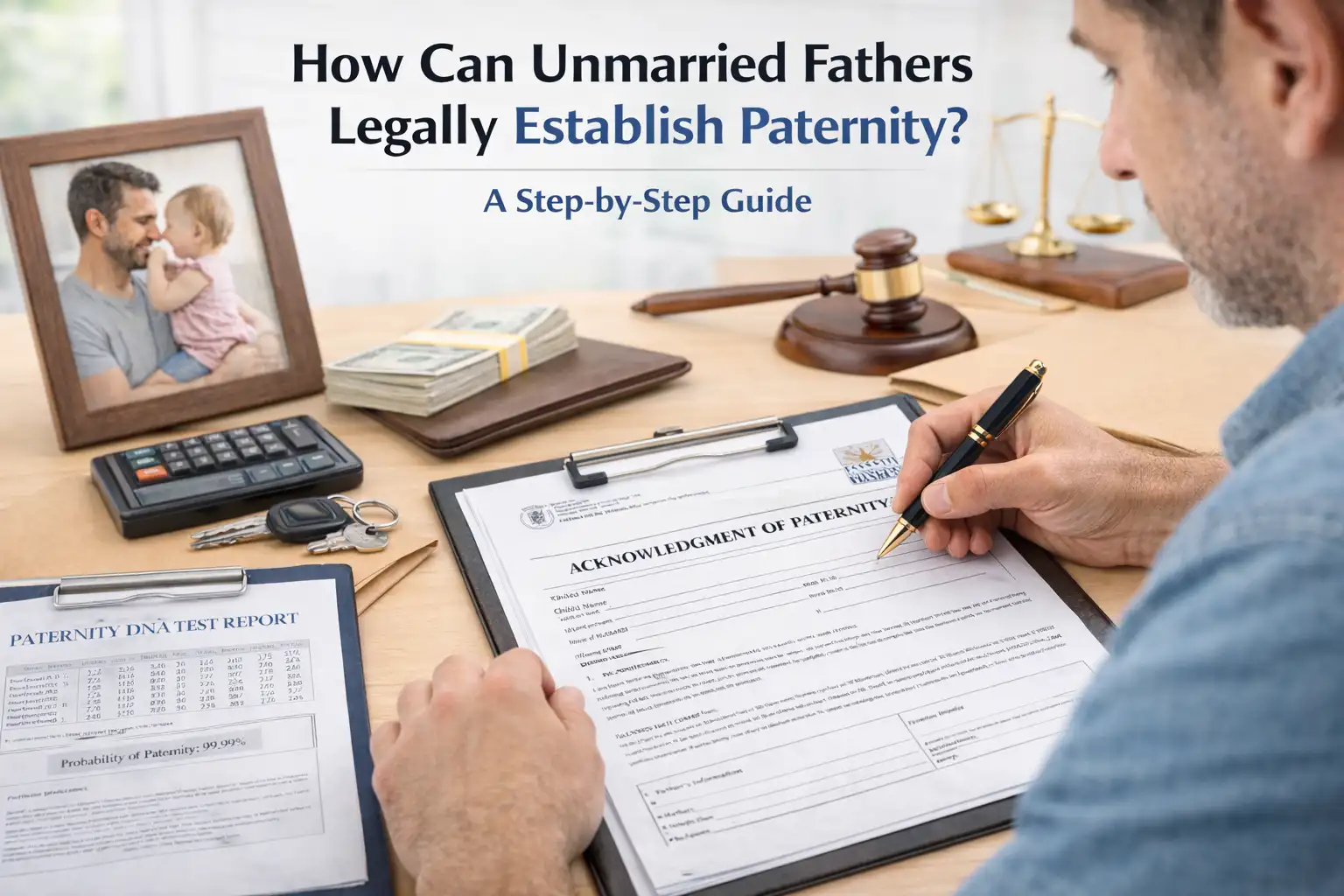
If you are an unmarried father, you might feel stuck in a strange in-between place. You know you are your child’s dad. You may already be changing diapers, doing school drop-offs or sending money, but on paper you are not recognized as the legal father. That gap between your real life and your legal status can be frightening. You may lie awake wondering what happens if the relationship with the child’s mother breaks down, if she moves away, or if you suddenly find yourself shut out of decisions about school, health care or even basic contact.
Legal paternity is what turns “everyone knows I am the dad” into enforceable rights and responsibilities in the eyes of the law. The good news is that unmarried fathers usually have several ways to establish paternity, from signing a voluntary acknowledgment to going through an administrative or court process. The hard part is understanding which method fits your situation, what it actually gives you and what it does not. Many fathers worry that one wrong signature will lock them into a lifetime of payments without time with their child, or that refusing to sign will destroy their chances of ever being involved.
If you are in Florida and feel anxious about paternity forms, genetic tests or court papers you do not fully understand, you do not have to guess your way through this. Before you sign an acknowledgment of paternity, agree to testing or file a petition, you can speak with the Law Office of John P. Sherman to review your options, understand your risks and build a strategy that protects both your relationship with your child and your long-term legal position.
What Is Legal Paternity and Why Does It Matter?
Legal paternity is the formal recognition, under state law, that a man is the legal father of a child. It is different from simply being the biological father or from helping raise the child informally. Once paternity is legally established, the father’s name can usually be added to the birth certificate, and the law treats the father and child as having a recognized parent-child relationship. In many states, including Florida, when a child is born to a married couple, the husband is automatically presumed to be the legal father. When parents are not married, there is no automatic presumption, so paternity must be established through a voluntary acknowledgment, an administrative process or a court order.
For the child, legal paternity opens the door to a long list of rights and benefits. These can include the right to financial support from both parents, access to the father’s health insurance and life insurance, eligibility for certain Social Security or veterans’ benefits through the father, inheritance rights and access to important family medical history. It also reinforces the emotional bond by giving the father a recognized place in the child’s legal identity and family tree. Federal child support guidance emphasizes that children tend to be better off, both materially and emotionally, when paternity is established and fathers are legally connected to their children.
For the father, legal paternity is usually the first step before a court will even consider issues like time-sharing and parental responsibility. Without legal paternity, you may have no enforceable right to see your child, no say in where the child lives or goes to school and no standing to object if the mother decides to relocate. At the same time, legal paternity also creates responsibilities. Once you are the legal father, a court can order you to pay child support and share in certain expenses. Many fathers feel nervous about this, but it is important to understand that child support and parenting rights are part of the same legal framework. Establishing paternity is what gives you a seat at the table when decisions about your child’s future are made.
Methods for Unmarried Fathers to Establish Paternity
Unmarried fathers typically have more than one option to establish legal paternity. The exact names of forms and agencies vary from state to state, but the main methods are similar across the United States. Most fathers will use one of three paths:
● Voluntary acknowledgment of paternity
● Court-ordered paternity case with genetic testing
● Administrative paternity proceeding through the child support agency
In Florida, for example, both the circuit courts and the Department of Revenue’s Child Support Program can be involved in establishing paternity. Each method has different advantages, limitations and timelines. A voluntary acknowledgment is usually the fastest and simplest when both parents agree. A court-ordered case is more formal and is often used when there is disagreement or when one parent refuses to cooperate. An administrative process can sometimes establish paternity without a full courtroom trial, especially when the state is setting up child support.
You can think of the main methods this way:
Method | When It Is Usually Used | Main Advantages | Main Limitations |
Voluntary acknowledgment | Both parents agree who the father is and will sign | Fast, simple, low cost, often done at birth | Hard to undo after a short rescission period; does not create a Parenting Plan by itself |
Court-ordered paternity case | There is a dispute or doubt about paternity | Court order provides clear legal status | More formal and often more expensive; can take longer |
Administrative paternity case | Child support agency is involved or assistance is used | Less formal than a full trial; often streamlined | Focuses on support; usually does not address time-sharing or parental responsibility in detail |
A father who understands how these methods differ is less likely to be surprised by what a particular form or test actually does. In the next sections, we will look at each option in more detail so you can see what it involves and what it can (and cannot) do for you as an unmarried father.
Voluntary Acknowledgment of Paternity
A voluntary acknowledgment of paternity is a form that both parents sign to state that a particular man is the child’s legal father. This option is usually used when there is no real dispute about who the father is and both parents are willing to put it in writing. In many states, including Florida, unmarried parents can sign a paternity acknowledgment form at the hospital when the child is born, or later through the vital statistics office or another authorized agency. Both parents sign in front of a notary or authorized witness, and the father’s name can then be added to the birth certificate. For many families, this is the quickest and least complicated way to establish paternity.
However, a voluntary acknowledgment is still a serious legal document, not just routine hospital paperwork. Most states allow only a short window to rescind or challenge the acknowledgment, often around sixty days, and even then, usually only on narrow grounds such as fraud, duress or a material mistake of fact. Once that period passes, it can be very difficult to undo the acknowledgment, even if later genetic testing raises questions. Because of that, you should be absolutely sure about paternity before signing and you should read the form carefully, so you understand what rights and responsibilities it creates in your state.
Many fathers are surprised to learn that signing a voluntary acknowledgment and being listed on the birth certificate does not automatically give them a court-ordered time-sharing schedule or parental responsibility. It does establish paternity, which is the foundation for those rights, but you may still need to file a separate case or obtain a court-approved Parenting Plan to get a clear, enforceable schedule. If you want to be more than just a name on a birth certificate and hope to have regular, predictable time with your child, it is wise to talk with a family law attorney about the next legal steps after paternity is established.
Court-Ordered Paternity Testing
Court-ordered paternity testing usually comes into play when there is a dispute or uncertainty about who the father is. Either the mother, the alleged father or sometimes the state, through a child support agency, can file a petition asking a court to determine paternity. In Florida, for example, a man who believes he is the father, the mother or the child can bring a proceeding in circuit court under the paternity statutes to establish parentage and related rights and responsibilities.
If the court finds that there is a legitimate question about paternity, it can order genetic testing. Modern DNA tests are usually done using cheek swabs and are highly accurate, often showing more than ninety-nine percent probability of paternity or completely excluding a man as the biological father. State child support programs often coordinate these tests, and in some cases the cost may be covered or deferred when the case is part of a public child support action. Once the results are in, a very high probability of paternity typically creates a legal presumption that the tested man is the father. The court can then use that presumption to issue an order establishing paternity and, if requested, order child support and other relief.
Court-ordered testing can feel intimidating, especially if you fear being forced into a lifetime of child support or if you are currently being denied contact with the child. It helps to remember that the purpose of a paternity case is to clarify legal relationships, not to punish either parent. If testing shows that you are not the biological father, the paternity petition may be denied. If testing confirms that you are the father, you will then have an opportunity to ask the court not only to address support, but also to create or enforce a parenting plan, depending on your state’s procedures. Because court orders are powerful and long-lasting, it is a good idea to seek legal advice before agreeing to or refusing a court-ordered test so you understand the consequences in your specific situation.
Administrative Paternity Process
In many states, including Florida, there is also an administrative process to establish paternity, often connected to the state’s child support agency. Rather than going straight to a full courtroom trial, the agency can open a case, send notices to the parents and, if necessary, arrange for genetic testing. Under Florida law, for example, the Department of Revenue can begin an administrative proceeding to establish paternity or to establish both paternity and child support. If the parents cooperate with genetic testing and the results support paternity, the agency can issue an administrative order that has legal effect similar to a court order for those issues.
The administrative process is often used when one parent applies for child support services or when public assistance is involved. It is designed to be faster and less formal than a full court case, but the decisions it produces are still legally binding. Parents usually receive formal notices explaining their rights, their obligation to appear or cooperate with testing and the consequences of ignoring the process. If genetic testing confirms paternity or if there is no timely contest, the agency can issue an order establishing paternity and setting a support amount based on state guidelines.
One important limitation is that administrative paternity and support orders often do not fully address parenting time or decision-making. In many jurisdictions, including Florida, time-sharing and parental responsibility are handled through family court orders and Parenting Plans, not through the child support agency. That means that even if paternity and support are established administratively, an unmarried father who wants a clear schedule with his child will often still need to go to court to request a Parenting Plan. If you are participating in an administrative process and you want more than just a support order, it is wise to talk with a family law attorney about how to coordinate administrative and judicial steps so your rights and responsibilities stay balanced.
Rights Unmarried Fathers Gain Through Established Paternity
When paternity is legally established, an unmarried father moves from having no recognized legal status to having a defined set of rights and responsibilities. These rights vary somewhat by state, but the core themes are similar. Legal paternity is the gateway to being more than a visitor in your child’s life.
Some of the key rights that usually follow established paternity include:
● The ability to ask a court for a Parenting Plan or time-sharing schedule.
● The right to seek shared parental responsibility or decision-making authority.
● The right to receive information about the child’s schooling, medical care and general welfare.
● The right, in some situations, to be notified of and object to certain legal actions involving the child, such as adoption, if allowed by state law.
For the child, established paternity brings rights such as financial support from both parents, eligibility for the father’s health and life insurance benefits, potential Social Security or veterans’ benefits, inheritance rights and access to family medical history. Federal guidance on paternity establishment highlights that these legal, emotional and practical benefits help children feel more secure and connected to both sides of their family.
It is important to understand that establishing paternity does not automatically guarantee any particular custody outcome. Courts will still look at the best interests of the child when deciding time-sharing and parental responsibility, taking into account each parent’s involvement, the child’s needs and many other factors. However, without legal paternity, you may not even be allowed to bring those issues before the court. Establishing paternity is therefore best seen as the first step that allows you to request fair time with your child and a meaningful role in major decisions.
Step-by-Step Process to Establish Paternity as an Unmarried Father
Although every family situation is unique, many unmarried fathers follow a similar path when they decide to establish legal paternity. The steps below are written with Florida in mind, but the same overall logic applies in many states. Always check your state’s specific rules or talk with a local attorney before making decisions.
A simple way to think about the process is as a series of stages:
Clarify your goals and your relationship with the child.
Choose the method that fits your situation.
Complete the required forms or petitions correctly.
Participate fully in testing or hearings if needed.
Follow through with parenting and support orders.
First, take time to clarify your goals. Are you only trying to be legally recognized as the father, or do you also want a detailed time-sharing schedule and shared decision-making authority? Are you already involved in day-to-day care, or are you trying to build a relationship that is currently limited or blocked? Understanding your priorities will help you decide whether a simple acknowledgment is sufficient or whether you should plan for a more comprehensive court case that includes parenting issues. It will also help you explain your goals clearly to the child’s mother, to the child support agency or to any attorney you consult.
Second, select the method that fits your situation. If both parents agree and are willing to sign, a voluntary acknowledgment at the hospital or through vital records may be the best path. If there is disagreement or serious doubt about paternity, a court petition with genetic testing is often more appropriate. If the state child support agency is already involved or public assistance is in play, an administrative process may start automatically. In Florida, for instance, parents who apply for child support services can be guided into an administrative paternity and support proceeding that includes notices and genetic testing. Choosing the right method early can save you time, money and a lot of frustration.
Third, complete the required forms or petitions carefully and on time. For a voluntary acknowledgment, that means reading the form, signing in front of the required witness or notary and confirming that all information is accurate. For a court case, it means filing a petition that cites the correct paternity statutes, properly serving the other parent and following local court rules. For an administrative proceeding, it means responding to notices, attending appointments and providing the requested information. Missing deadlines or ignoring paperwork can slow your case down or even cause it to be dismissed, which can be very discouraging if you are already fighting to be involved.
Fourth, if genetic testing or hearings are required, cooperate fully and keep good records. Attend all scheduled appointments for check-swab collection, bring any requested identification and keep copies of test results or orders you receive. If there are hearings, arrive early, dress respectfully and stay focused on your child’s needs rather than on personal attacks against the other parent. Courts take paternity matters seriously, and your reliability and demeanor can influence how judges view your later requests for time-sharing and parental responsibility.
Finally, once paternity is established, follow through with the next legal steps. If your case includes a child support order, make sure you understand how payments must be made and keep proof of every payment. Establishing paternity is a major milestone, but it is often just the first chapter. To turn legal fatherhood into lasting protection for your relationship with your child, you typically need both support orders and parenting orders that reflect your daily-life situation. If you want to combine paternity establishment with a clear long-term parenting strategy, the Law Office of John P. Sherman can help you plan both steps together instead of fighting separate, confusing battles.
Paternity Establishment When the Mother Disagrees
One of the hardest situations unmarried fathers face is when the child’s mother does not agree with establishing paternity or does not cooperate with the process. She might deny that you are the father, refuse to sign any forms, avoid contact with the child support agency or oppose your involvement with the child. This can be emotionally devastating, especially if you already feel bonded to your child and shut out of their life. It is important to know that in most states, including Florida, a mother’s refusal to sign a voluntary acknowledgment does not give her the final word on paternity. Courts and child support agencies can still move forward with a case to determine who the legal father is.
If the mother disputes that you are the father, the typical path is to file a paternity petition in court or to cooperate with an administrative case that includes genetic testing. The court or agency will order DNA testing, and if the results show a very high probability that you are the biological father, they can issue an order establishing paternity even without the mother’s agreement. That order can then be used as the foundation for child support and for future requests for time-sharing and decision-making rights. It may feel painful and unfair to have to fight just to confirm what you already know in your heart, but a clear paternity order is often the only way to gain enforceable rights when cooperation is not possible.
There are also cases where the mother may not oppose your status as a father but resists giving you structured time with the child. She might say you can see the child “whenever it works” while repeatedly canceling visits, or she may block your involvement when conflicts arise between the two of you. In these situations, establishing paternity is still the necessary first step, but you will likely need to follow it with a formal request for a Parenting Plan and time-sharing schedule. While it may feel unfair that you have to go to court to see your own child, having clear orders can protect your relationship over the long term and reduce the power of emotional conflict to cut off your contact. An experienced attorney can help you decide when to push forward, how to document missed visits and how to present your concerns to the court in a way that keeps the focus on the child’s best interests.
State-Specific Paternity Laws and Requirements
Although the broad concepts around paternity are similar across the United States, the details of how paternity is established and what forms are used are governed by state law. Some states have adopted versions of the Uniform Parentage Act, which sets out model rules for establishing parentage in various situations, while others follow their own statutes. Florida, for example, handles paternity for children born out of wedlock primarily through the Determination of Parentage statutes in Chapter 742 and uses additional provisions in Chapter 409 for administrative child support and paternity proceedings.
Key differences between states can include:
● How long a parent has to rescind a voluntary acknowledgment of paternity.
● What specific language must appear on acknowledgment forms and notices.
● Whether a notarized acknowledgment alone is enough to create a legal presumption of paternity.
● Which agency runs administrative paternity programs and how they operate.
● How paternity rules interact with same-sex parenting, assisted reproduction and multiple-parent claims.
Because of these variations, online information from another state or from a national article may not match the rules where your child lives. Even within a single state, local courts may have different forms or procedures. That is why it is crucial to look at your state’s official court and child support websites or to talk with a local attorney before assuming that a particular method, deadline or form applies to you. In Florida, for instance, understanding how judicial paternity proceedings and administrative paternity and support proceedings fit together can prevent confusion about what issues are resolved in each process.
If your case involves more than one state, things can become even more complex. Questions of jurisdiction, “home state” for the child and full faith and credit for existing paternity and support orders all come into play. Trying to navigate those rules on your own can be overwhelming. In multi-state situations, getting legal advice is especially important to avoid conflicting orders, missed deadlines or lost rights that could affect your relationship with your child for years.
Costs and Timeline for Establishing Paternity
Unmarried fathers often worry not only about rights, but also about how much establishing paternity will cost and how long the process will take. The honest answer is that both cost and timeline vary based on several factors, including:
● The method used (voluntary acknowledgment, court case or administrative case).
● Whether there is disagreement about paternity.
● How busy your local court or child support agency is.
● Whether you hire a private attorney or rely solely on agency processes.
● Whether your case also involves time-sharing, relocation or interstate issues.
Voluntary acknowledgment is usually the least expensive and fastest option. Signing the hospital form at birth or a later acknowledgment form through vital records may involve little or no direct cost for the father beyond basic administrative fees, especially if both parents agree and sign promptly. When a state child support agency coordinates paternity establishment, the agency may cover or reduce certain costs as part of its services. In Florida, for example, genetic testing coordinated through the Child Support Program is often done using cheek swabs at contracted labs, which can streamline both cost and timing for the parents.
Court cases and contested paternity matters tend to cost more and take longer. Filing fees, process service, attorney’s fees and the cost of private genetic tests can add up, especially if hearings are continued, if one party does not cooperate or if the case involves complex issues such as multiple potential fathers or interstate questions. Timelines can range from a few months in a straightforward case to much longer if there are serious disputes or logistical problems. Administrative cases through a state child support agency often fall somewhere in the middle. They can be faster than a full court trial, but they still require time for notices, appointments, testing and issuing final administrative orders.
From a planning perspective, it is helpful to think not just in terms of money and time, but also in terms of long-term value. Establishing paternity and obtaining clear orders about support and parenting can protect your relationship with your child, your financial stability and your ability to participate in major decisions for years to come. When you are weighing costs, it can be useful to compare them to the emotional and financial price of remaining in a legal gray area where you have no enforceable rights and no clear obligations. If you are unsure how to balance these factors or what a realistic cost range might be for your situation in Miami or elsewhere in Florida, speaking with an experienced paternity attorney can give you a more accurate picture of likely timelines and expenses.
FAQS


