Family Law
Can a Judge Deny an Uncontested Divorce in Florida?
•
5 min
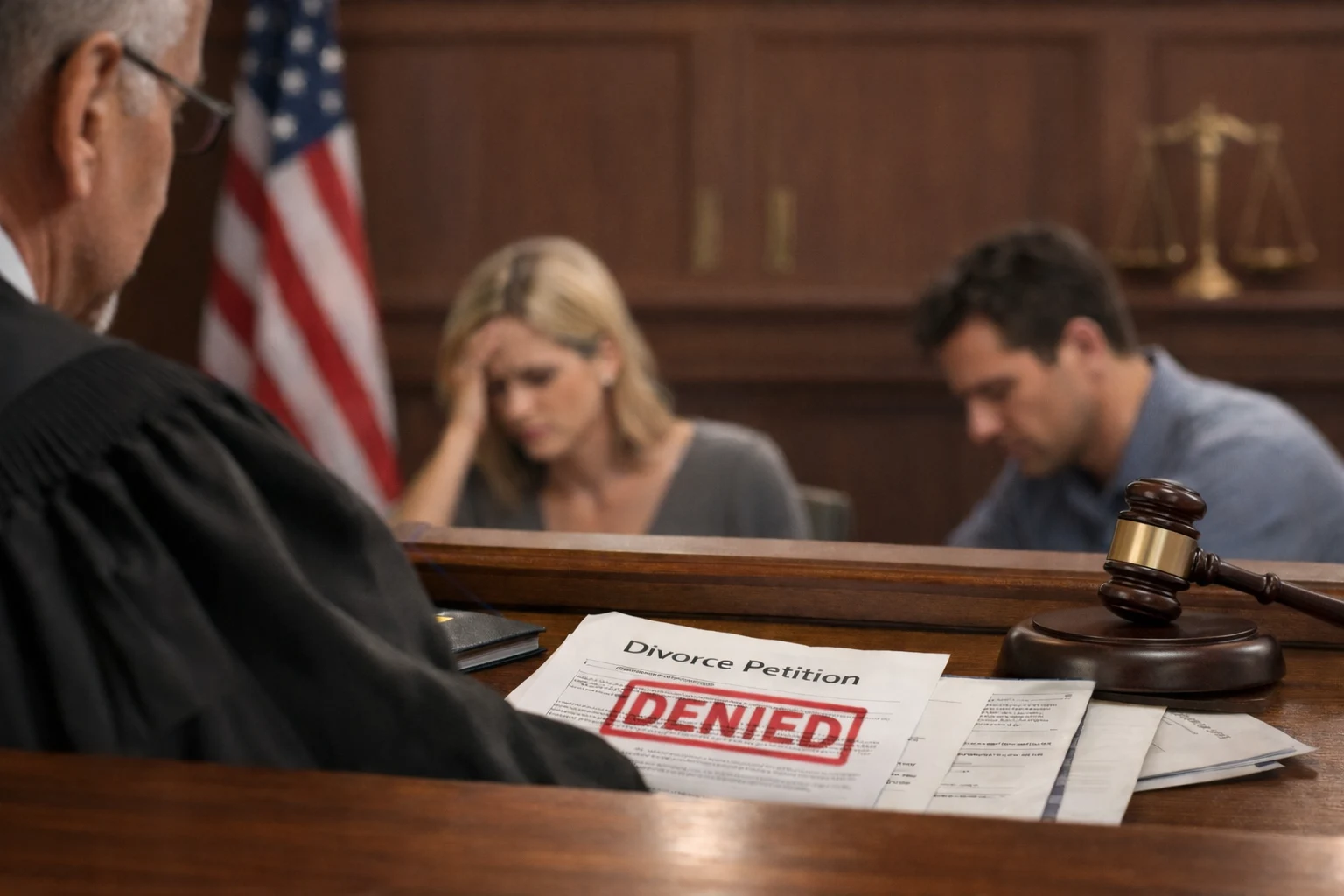
A judge can deny an uncontested divorce in Florida if certain legal and procedural requirements are not met, even when both spouses agree on everything.
When you and your spouse have done the hard work of reaching an agreement, an uncontested divorce can feel like the light at the end of the tunnel. You have talked through property, debts, and if you have children, you have likely had some of the toughest parenting conversations of your lives. At that point, many people assume that the judge will simply “rubber stamp” the paperwork. In reality, the court still has a legal duty to review your case, which means a judge can deny an uncontested divorce if something is not right under the law or if the agreements do not properly protect children or either spouse’s rights.
In Florida, including Miami and the surrounding counties, divorce is handled under a no-fault system, which means you do not have to prove wrongdoing like adultery or abandonment in order to end your marriage. You only have to show that the marriage is irretrievably broken and that basic legal requirements, such as residency, are met. However, even in these seemingly straightforward cases, judges must make sure the case is filed correctly, the court has jurisdiction, and any agreements involving children, support, and property are fair and lawful before they sign a Final Judgment of Dissolution of Marriage.
For many couples, the fear is simple. They worry a judge might refuse to finalize the divorce and send them back to square one, or worse, that a technical mistake in their paperwork will expose them to unnecessary delay, extra hearings, or even a contested case. These concerns are understandable. Divorce is already stressful, and the idea of “getting it wrong” at the last step can feel overwhelming, especially if you are trying to keep costs low and avoid conflict.
If you are unsure whether your uncontested divorce paperwork will meet the court’s expectations, you do not have to guess. Instead of hoping the judge signs off, you can have the Law Office of John P. Sherman carefully review your forms, flag weak spots, and correct them before you file, so your uncontested divorce is as “judge-ready” as possible from the very beginning.
Judge's Role in an Uncontested Divorce
Even in an uncontested divorce, the judge is more than a formality. They still have several specific legal responsibilities that go beyond simply signing off on your agreement.
Understanding what the judge actually looks for can turn a scary, unpredictable step into something you can prepare for.
Key Responsibilities in an Uncontested Divorce include:
● Confirming the court’s power to hear your case (jurisdiction).
The judge must make sure the court has the authority to decide your divorce. In Miami-Dade and across Florida, this includes verifying that at least one spouse has lived in the state for six months before filing for divorce and that the case is properly filed in a Florida court.
● Ensuring the legal grounds for divorce are met.
Florida law requires that the marriage is either irretrievably broken or that one spouse has been mentally incapacitated for at least three years. If the judge is not satisfied that these basic standards are met, they must decline to enter a final judgment rather than simply approving it because both spouses agree.
● Reviewing all documents for completeness and accuracy.
The judge makes sure your forms are complete, legible, properly signed, and that the file contains everything the court needs to enter a valid final judgment. In Florida, divorcing spouses have financial disclosure obligations and must submit standardized forms approved by the Florida Supreme Court.
● Checking that financial disclosure and required forms are legally sufficient.
If required forms are missing, inconsistent, or not signed under oath, the judge may not be able to enter a final judgment. Instead, the court may issue a deficiency notice, reset the hearing, or in some cases delay entry of the final judgment until the errors are corrected.
● Protecting the best interests of minor children.
When there are minor children, the judge’s role becomes even more protective. The court must review parenting plans, child support calculations, and any shared parental responsibility arrangements to ensure they meet Florida’s “best interests of the child” standard.
● Evaluating time-sharing and child support arrangements.
Even if both parents believe their agreement is fair, the judge must check that time-sharing is realistic and safe, that child support follows state guidelines unless a justified deviation is explained, and that major decisions about education, healthcare, and religion are clearly addressed.
● Refusing to approve unsafe or unlawful agreements.
The judge does not try to micromanage your family, but the court cannot approve an agreement that fails to protect a child’s well-being or that conflicts with Florida law. If something is not legally acceptable, the judge may delay entering the final judgment until it is corrected.
Reasons for a Judge to Deny a Divorce Petition
Even in a cooperative, low-conflict divorce, there are several situations where a judge may deny or delay approval of your petition. Many of these reasons are not about punishing either spouse. Instead, they are about enforcing legal requirements or protecting children and vulnerable spouses. Understanding these reasons can help you avoid common mistakes and prepare stronger paperwork before your hearing or submission.
The table below breaks down the most common issues that can lead a judge to deny an uncontested divorce petition. By seeing how judges analyze these cases, you can better understand what they look for, why certain details matter, and how to protect yourself from avoidable setbacks in your divorce process.
If you understand these red flags before you file, you can fix most of them in advance and avoid walking into court with paperwork that almost invites a denial.
Type of Issue | What It Involves | Why It Can Lead to Denial |
Technical problems with paperwork | Incomplete forms, missing pages, illegible information, incorrect case numbers, or missing signatures and notarizations. | The court cannot enter a valid final judgment if the file is not complete. Judges may deny or delay the case until the errors are corrected and all forms are in order, which means more time, more hearings, and more stress for both spouses. |
Conflicts with Florida law or residency rules | Not meeting the six-month residency requirement, failing to state proper legal grounds, or using agreements that contradict Florida statutes or rules. | Judges are bound by Florida law. If jurisdiction, grounds, or required legal standards are not satisfied, the court has no authority to grant the divorce. |
Child custody, support, or welfare concerns | Parenting plans that are unsafe, unrealistic, or unclear; child support that ignores guideline amounts without explanation; vague decision-making terms. | Courts must protect the best interests of the child. If an agreement does not safeguard the child’s welfare, the judge may refuse to approve it as an uncontested case and require additional hearings, evaluations, or mediation. |
Unfair or incomplete financial arrangements | Extremely one-sided property or debt division, missing assets or debts, or financial affidavits that appear inconsistent or incomplete. | Judges worry that a spouse may not understand what they are giving up or that disclosure is incomplete. They may postpone granting the divorce until a fair, informed deal is shown. |
Questions about mental capacity, duress, or coercion
| A spouse who seems confused, heavily pressured, or unable to understand the agreement; signs of threats or improper pressure to sign. | An uncontested divorce must be voluntary and informed. If consent is not truly free and knowing, the judge is likely to deny or pause the case for further protection. |
Evidence of bad faith or conflicting statements
| Contradictions between sworn forms and testimony, inconsistent dates, or statements that do not match financial documents or prior filings. | Courts rely on honest, consistent information. When records conflict, judges may doubt reliability and be unwilling to finalize the divorce until the inconsistencies are fixed. |
Issues with Incomplete or Incorrect Divorce Paperwork
One of the most common reasons a judge denies or delays an uncontested divorce is simple: the paperwork is incomplete, inconsistent, or not prepared in the way the court requires. Florida divorce forms need to be filed in the correct version, in the right sequence, and with all necessary attachments, such as financial affidavits and marital settlement agreements. If something is missing, if names do not match across documents, or if the case number is wrong, the court’s staff may flag the file. The judge may refuse to sign a final judgment until the errors are corrected, which can add weeks or months to what should have been a straightforward process.
Mistakes on financial disclosure are particularly sensitive. Florida requires divorcing spouses to exchange and file financial affidavits in most cases, even when the divorce is uncontested. If income, assets, or debts are left out or appear inconsistent with other documents, the judge may question whether the agreement is truly fair and fully informed. In severe cases, incomplete disclosure can lead to future legal challenges, where one spouse asks to reopen the case because they believe important information was concealed. A judge who suspects that the paperwork does not accurately reflect the real financial picture may be hesitant to approve the divorce quickly.
There are also format and procedure rules that matter. Some forms have to be notarized. Others must be signed under penalty of perjury. Certain counties require additional local forms, cover sheets, or checklists before the court will schedule a final hearing. Self-represented spouses can easily miss one of these steps when using online resources or trying to interpret instructions on their own. When the file reaches the judge, they may see missing signatures, incorrect notarization, or absent attachments and decide that the case is not ready for final judgment, which effectively denies or postpones the uncontested divorce until everything is put in order.
One of the simplest ways to avoid this type of denial is to have a family law attorney review your forms before you submit them. That can catch missing signatures, outdated forms, or local requirements you might not even know exist, so your paperwork moves through the clerk’s office and onto the judge’s desk without unnecessary delays.
Violations of State Law or Residency Requirements
Many spouses are surprised to learn that a judge can deny an uncontested divorce in Florida even when there is no conflict between them, simply because a basic residency or legal requirement is not met.
Even when both spouses are completely on the same page, the judge must make sure your divorce follows Florida law. One key requirement is residency. Florida Statutes require that at least one spouse has lived in Florida for six months before filing for dissolution of marriage. This residency must be proven with acceptable evidence in the court file. If the court does not see clear proof of residency, a judge can deny an uncontested divorce or ask, in effect, “Have you really lived in Florida long enough for this court to end your marriage?”
Requirement | What Florida law requires | How you can show it |
Residency | At least one spouse must have lived in Florida for 6 months before filing for divorce. | Florida driver’s license, state ID, voter registration, lease, utility bills, witness affidavit. |
Legal grounds | The petition must state that the marriage is irretrievably broken or that one spouse has been mentally incapacitated for 3+ years. | Using the correct language in the petition and giving consistent testimony at the final hearing. |
Proper venue | The case should be filed in a county that has a real connection to the spouses or the marriage. | Filing in the county where one or both spouses live, or where the marriage last existed as a couple. |
Compliance with statutes and rules | Agreements and forms must follow Florida statutes and court rules, especially when children are involved. | Parenting plans, child support terms, and required classes that match Florida law and local rules. |
Legal grounds for divorce also matter. Florida is a no-fault state, but the statute still requires that the petitioner allege that the marriage is irretrievably broken or that one spouse has been mentally incapacitated for at least three years. If the petition fails to state an acceptable ground or if the wording in your pleadings is inconsistent, the judge might not have legal authority to grant the divorce. For example, if your petition says the marriage is irretrievably broken but testimony at the hearing suggests that counseling or reconciliation is still realistically expected, the judge may continue the case, order counseling, or in rare situations decline to grant the divorce if they find the marriage is not irretrievably broken.
There are also rules about where to file the case. While filing in the wrong county does not always lead to a denial, it can cause delays and extra motions. Judges may ask whether the chosen court has a proper connection to the parties and the marriage. When documents conflict with state law, such as parenting plans that ignore required parenting classes or agreements that attempt to waive child support completely without justification, the judge must follow the law rather than simply honoring the spouses’ preferences. In these situations, the court may decline to sign the final judgment until the agreements are corrected to comply with Florida statutes and rules.
If you recently moved to Miami or another part of Florida, it can be smart to have a family law attorney confirm that you meet the residency and filing rules before you submit your paperwork, so you do not lose time finding out at the hearing that the court cannot yet grant your divorce.
Disputes Over Child Custody, Support, or Welfare Agreements
An uncontested divorce stops being genuinely cooperative the moment there is a genuine dispute about children. Many parents worry, “What if the judge doesn’t accept the parenting plan we worked so hard to agree on?” and that is a very real concern. Florida courts prioritize the best interests of the child, which means that a judge will not grant a divorce based on a parenting plan that looks unsafe, unstable, or unrealistic. If your documents reveal disagreements about time-sharing, decision-making, or school choices, the judge may determine that the case is in fact contested and requires more hearings, mediation, or even a trial. In that scenario, the judge can take your case off the uncontested track and treat it as a contested matter going forward.
Child support is another area where judges pay close attention. Florida uses guidelines to calculate support based on each parent’s income, the number of overnights with each parent, and certain child-related expenses. If your child support figure is far below the guideline amount and there is no clear, legally acceptable reason to deviate, the judge may view the agreement as unfair to the child. The court may deny the proposed final judgment or require you to modify your child support provisions to align with state guidelines before it approves the divorce. Even when both parents are trying to help each other financially, the judge must still make sure the child support amount is high enough to protect the child.
Judges are also sensitive to situations where one parent appears to be giving up important parental rights or time-sharing without a clear explanation. If a parenting plan gives one parent almost no contact with the child, or if there is evidence of safety concerns that the agreement fails to address, the judge may decline to approve the plan as written. The court can order changes to the plan, require more detailed provisions, or direct the parties into mediation. Until those concerns are resolved, the judge may decline to finalize the uncontested divorce.
If you and your co-parent want to keep your divorce uncontested, it can be very helpful to have a lawyer review your parenting plan and child support numbers before you file, so small drafting issues do not push your case into a contested track with more hearings and more conflict.
Concerns About Mental Capacity to Consent
For some spouses, the hardest part of divorce is not the paperwork, but worrying whether a judge will believe their husband or wife truly understands what they are signing.
For a divorce to be uncontested, both spouses must not only agree, they must understand what they are agreeing to. Judges sometimes delay or even refuse to finalize a divorce if they have serious concerns about a spouse’s mental capacity to consent. Florida law recognizes mental incapacity as a separate ground for divorce, which involves specific requirements and at least three years of documented incapacity. If a judge believes a spouse may not fully understand the rights they are giving up, including rights to property or support, the court may decide that more evaluation or legal representation is needed before granting the divorce.
This concern can arise in several ways. A spouse may appear confused at the hearing, give inconsistent answers when questioned, or reveal during testimony that they have not had a chance to review the agreement carefully. In extreme situations, there may be evidence of cognitive decline, untreated mental illness, or medication side effects that significantly affect judgment. When judges see these warning signs, their responsibility is to slow the process down, not to rush it. They might require that the spouse obtain independent legal counsel or that additional medical information be provided before any final decision is made. For example, an older spouse on heavy medication or a partner with a long history of psychiatric hospitalizations may raise additional questions for the court.
Mental capacity is not about punishing people with health challenges. It is about ensuring that no one is taken advantage of in a moment of vulnerability. An uncontested divorce agreement is a binding contract that affects property, support, and parental rights. If there is any serious doubt that a spouse truly understands that contract, judges are likely to put the petition on hold or refuse to accept the agreement in its current form. Protecting vulnerable parties is one of the core reasons courts exist.
If you know that mental health or cognitive issues are part of your marriage, getting advice from a lawyer before you file can help you structure the process in a way that protects your spouse, respects the law, and still allows you to move forward with your life.
Evidence Suggesting Bad Faith or Conflicting Statements
Judges expect honesty and consistency from both spouses in an uncontested divorce. Many people are surprised to learn how quickly small inconsistencies in their paperwork can make a judge question whether everything is being disclosed. If a judge sees information in the paperwork that does not match up, such as different dates of separation, inconsistent descriptions of assets, or contradictions between sworn affidavits and hearing testimony, they may suspect that something is wrong. In these situations, the judge may question both parties more carefully and, if not satisfied, postpone granting the divorce until those inconsistencies are resolved. Courts rely heavily on sworn documents, so contradictions raise red flags about reliability and good faith.
Bad faith can also appear when one spouse seems to be rushing the other or when agreements are structured in an unusually one-sided way without explanation. For example, if one spouse waives all rights to property or support while the other keeps nearly everything, the judge may question whether there has been full disclosure and fair negotiation. Although Florida law allows spouses to make generous concessions, the court still has an interest in preventing agreements that look like they were obtained through manipulation or incomplete information. If the judge believes more investigation is required, they can refuse to approve the final judgment.
Conflicting statements can also affect jurisdictional questions. If one document suggests that neither spouse has lived in Florida long enough to meet the residency requirement while another document claims the opposite, the judge cannot simply ignore the contradiction. The court may require additional evidence, like testimony from a corroborating witness or documents proving residency, before moving forward. Until the facts are clear and consistent, the judge may postpone granting the divorce or reset the hearing, which can be frustrating for spouses who thought everything was settled.
Before you submit your forms, it can be worth having a family law attorney look for inconsistencies or missing details, so you do not find out in front of the judge that something in your story or your documents does not add up.
Signs of Duress or Coercion in the Divorce Process
An uncontested divorce must be truly voluntary. If you feel like you are being pushed into signing paperwork just to “get it over with,” you are not alone, and judges pay close attention to those situations. If a judge suspects that one spouse has been pressured, threatened, or forced into signing the agreement, the court can and should decline to approve the divorce. Duress or coercion can show up in subtle ways, such as a spouse appearing fearful in court, hesitating before answering questions, or repeatedly looking to the other spouse for approval before speaking. Judges are trained to notice these cues, and they may ask more direct questions to confirm that each spouse is signing the agreement freely and without pressure.
A common red flag is when one spouse reveals that they signed the documents only because they felt they had “no choice” or because the other spouse threatened to cut off financial support, access to children, or immigration help. While it is normal to feel emotional pressure during a divorce, legal duress involves more serious improper threats that undermine a person’s free will. If a judge hears testimony suggesting this type of pressure, they may decline to accept the agreement, require separate legal counsel, or shift the case out of uncontested status. A spouse might say, for example, that they signed only because they were told they would never see the children again or that they would be cut off financially if they refused.
Courts also consider whether both spouses had a reasonable opportunity to review the agreement, ask questions, and consider alternatives. If the judge learns that one spouse was rushed into signing complex documents they did not understand, perhaps on the same day as the hearing, the court may not feel comfortable approving the divorce. The law favors voluntary, informed agreements. When that standard is doubtful, the judge’s safest choice is to put the case on hold and delay entry of the final judgment until the parties can engage in a more balanced process.
If you feel you are being pressured or threatened into signing divorce papers, speaking with a family law attorney before your final hearing can help you understand your options and show the court that your agreement is not truly voluntary. They can review your situation confidentially and help you plan how to raise these concerns safely.
Marital Assets
Judges also look closely at how marital assets and debts are being divided in a low-conflict divorce.
Many spouses are willing to accept an uneven split of property just to move on, but judges still have to make sure the agreement is not so unfair that it raises questions about disclosure or pressure. Florida follows a principle called equitable distribution, which means marital property is divided in a way that is fair, although not necessarily perfectly equal. When both spouses agree on a property division plan, the judge usually respects their choices, as long as the plan appears reasonable and each spouse has disclosed their finances. However, if the distribution seems extremely lopsided without explanation, or if there are signs that significant assets are missing from the paperwork, the court may decide not to enter the final judgment.
Problems can arise when spouses forget to list certain assets, such as retirement accounts, stock options, or real estate in another county or state. Judges rely on the documents in front of them, so if something important is left out, the court may not have authority to divide it or to confirm that both parties have agreed to its allocation. If the judge suspects that not all marital assets or debts are addressed, they may ask questions, request more documentation, or delay entry of the final judgment until a more complete settlement agreement is submitted. This protects both spouses from later disputes over property that was never clearly divided. In some cases, what looks like a simple oversight may cause the court to wonder whether assets are being hidden on purpose.
Debt allocation is just as important as asset division. If the agreement assigns a large amount of marital debt to one spouse with no clear reason, the judge may wonder whether the spouse truly understands the long-term consequences. While courts do not rewrite every agreement, they are cautious when one party appears to bear most of the financial burden without receiving any offsetting benefit. To avoid a denial or delay, it is critical to prepare a detailed, honest list of all assets and debts and to explain any unusual or unbalanced terms in your marital settlement agreement.
Before you file an uncontested divorce, it is wise to sit down with a lawyer and review a complete list of your assets and debts, so your marital settlement agreement is both fair on paper and acceptable to the court. They can help you spot unusual or risky terms before a judge does.
Steps to Take if Your Uncontested Divorce Is Denied by a Judge
Having a judge deny or delay your uncontested divorce can feel discouraging, especially if you thought everything was finished. For many people, it feels like the floor has dropped out from under them just when they were expecting closure. The most important thing to remember is that a denial is usually not the end of the road. In many cases, the judge is pointing out specific issues that must be fixed before the court can grant your divorce.
The first step is to carefully review any written order or explanation the judge provides. Courts often issue a notice or minute entry that explains what is missing, such as:
● Financial affidavits
● Parenting class certificates
● Proof of residency
Understanding the exact reason for the denial helps you respond efficiently rather than guessing.
Once you know what went wrong, you can gather the necessary documents, correct the forms, or clarify the terms of your agreement. For example, if the judge was concerned about child support calculations, you may need to recalculate the support based on guideline worksheets and make sure all income and overnights are accurately listed. If the issue was incomplete financial disclosure, you may need to prepare updated financial affidavits and exchange them with your spouse. In many cases, the next step involves one or more of the following:
● Correcting or updating financial disclosure forms
● Completing a required parenting course and filing the certificate
● Providing additional documents that prove residency or income
While this extra work can be frustrating, resolving the specific problem usually puts your case back on track and can prevent more serious issues down the line.
When you are not sure how to fix the problem, this is an important moment to consider legal advice. Many people try to handle an uncontested divorce on their own to save money, but a judge’s denial often reveals that professional guidance is needed, at least for the more technical steps. A family law attorney can review your court order, identify what went wrong, and help you prepare amended documents that meet the court’s expectations. This can be especially valuable if the denial involved sensitive issues like parenting, support, or possible coercion. Having someone familiar with local court practices can turn a confusing setback into a structured plan with clear next steps.
Uncontested Divorce Lawyer
An uncontested divorce may sound simple on paper, but as you have seen, judges can and do deny petitions for a variety of reasons. An experienced uncontested divorce lawyer helps you avoid these pitfalls from the beginning by spotting issues that might never be obvious to someone filling out forms for the first time. The right attorney will start by listening to your goals, reviewing your existing agreements, and confirming that an uncontested approach is truly appropriate for your situation. If it is, they will guide you through the specific Florida requirements that apply to your case, including residency, parenting plans, financial disclosure, and local court procedures that can differ from one county to another.
At the Law Office of John P. Sherman, the focus is on keeping the process efficient, respectful, and affordable while still protecting your long-term interests. That means preparing clear, detailed settlement agreements, accurate financial affidavits, and parenting plans that reflect real life, not just ideal schedules on paper. It also means catching problems early, such as missing assets, unrealistic time-sharing schedules, or child support figures that do not match the guidelines, and helping you fix them before a judge ever raises them in court. Because the firm regularly handles uncontested divorces in Miami-Dade and throughout Florida, it is familiar with what local judges expect to see in the file and how to present your agreement in a way that is more likely to be approved the first time.
A skilled uncontested divorce lawyer does more than complete forms; they help you think through the long-term impact of the choices you are making now. Decisions about property, debt, support, and parenting will shape your financial stability and your family’s daily life for years to come. Having guidance from someone who understands both the law and the practical realities of Florida family courts can make the process feel less overwhelming and more predictable. This proactive, detail-focused approach saves you time, reduces stress, and minimizes the risk that your low-conflict case will escalate into a contested one, so you can move forward with greater confidence into the next chapter of your life.
Final Thoughts
Divorce is never easy, but an uncontested divorce handled correctly can give you closure without unnecessary conflict or delay. When you work with a lawyer who understands Florida’s family law system and who regularly handles uncontested cases, you gain more than paperwork preparation. You gain a guide through one of the most important legal transitions of your life. If you are ready to move toward a smoother, judge-ready uncontested divorce in Florida, reach out to the Law Office of John P. Sherman to schedule a consultation and put a knowledgeable advocate on your side from start to finish.
FAQS


