
The adjuster has called twice. The repair estimate is sitting in your inbox. A release form is attached, and the message sounds simple: sign, return it, and the check goes out.
That moment feels like the end of the claim. In Florida, it can also be the moment you accidentally give up far more than you intended.
An auto accident settlement agreement template can help, but only if it's built and edited for the kind of claim you have. A generic form pulled from the internet often treats every crash the same. Florida claims usually aren't that neat. Property damage, bodily injury, PIP, health insurance payments, provider balances, and possible lien issues all need to be handled with care if you want to close the claim cleanly.
Why You Need More Than a Generic Settlement Template
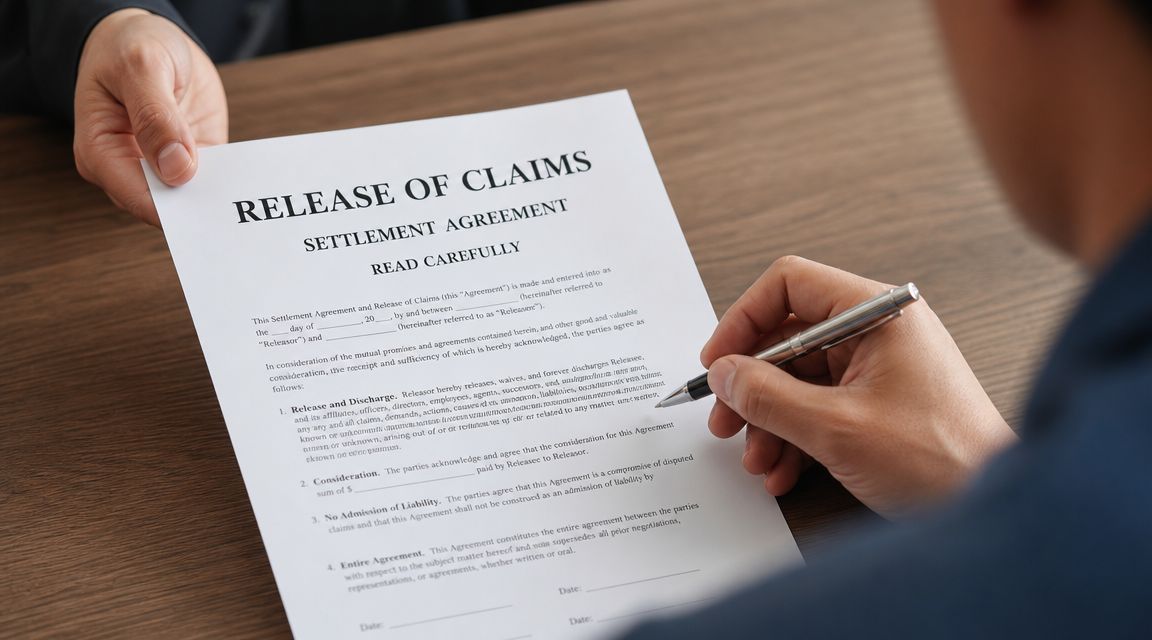
A settlement agreement isn't just paperwork. It is the document that ends your claim. Once you sign it, the insurer will treat the case as finished.
That matters because even “ordinary” car accident claims can involve real money. A widely cited 2022 benchmark put bodily-injury auto claims at $24,211 per liability claim and property-damage claims at $5,313, while broader personal-injury data reported that about two-thirds of plaintiffs recover compensation and only 15% of successful claimants receive more than $75,000 according to USClaims' summary of car accident settlement data. Those figures don't tell you what your case is worth, but they do show why the language in a release deserves close attention.
Generic forms miss the real risk
When someone searches for an auto accident settlement agreement template, they are typically trying to solve one immediate problem. They want the insurer to pay. That makes sense. The car needs repair, medical bills are arriving, and time off work creates pressure.
The problem is that a generic release often goes much further than the issue you think you're resolving. It may say you release all claims, known or unknown, arising from the crash. If you intended only to settle the vehicle damage, that wording can create a serious problem later if neck pain, back pain, or another injury becomes clearer after the fact.
Practical rule: If the insurer is paying only for the car, the release should usually say only that.
What the template should do for you
A good template is a starting point, not a shortcut. It should help you slow down and confirm four things before you sign:
Who is being released: The legal names of the driver, owner, insurer, and any other party should be accurate.
What claim is being resolved: Property damage only, bodily injury only, or a global settlement.
What payment is being made: The amount, timing, and any conditions need to be unmistakable.
What rights you keep: Individuals often make costly errors regarding the rights they retain.
Many clients first want to know whether they even need a lawyer for this stage. If you want a clear overview of what counsel does in a claim, this guide on what a personal injury lawyer does is a useful companion.
Why the fine print matters in Florida
Florida cases often involve overlapping insurance issues. Your own PIP coverage may have paid part of your medical treatment. A health insurer may have paid another portion. A provider may still claim a balance. None of that is fixed by signing a broad release with the other driver's insurer.
A strong auto accident settlement agreement template protects you by forcing precision. If the form is vague, the insurer benefits from the vagueness, not you.
The Anatomy of a Florida Auto Accident Settlement Agreement
A settlement agreement works best when every clause has a job. If a sentence doesn't clearly define rights, payment, timing, or scope, it usually creates room for argument later.
The cleanest forms are direct. They identify the parties, describe the crash, state the amount being paid, and say whether the payment is a full and final settlement. A model settlement agreement also shows that payment can be made in installments and may include a default clause if a payment is missed, as reflected in the Legal Aid NSW sample terms of settlement for car accidents.
Start with the identity and accident facts
The first part should sound basic, but it matters. Names, dates, and locations anchor the contract to one event and one set of claims.
If the document misidentifies a party or describes the wrong accident date, the insurer may later argue about scope, or a court may have to sort out ambiguity that should have been avoided from the start.
Key Clauses in Your Settlement Agreement
| Clause Name | Purpose and What to Look For |
|---|---|
| Parties | Identify every person or entity entering the agreement. Check legal names, insurer names, and whether anyone else is included by broad catch-all language. |
| Accident Description | Ties the release to a specific crash by date and location. This should be accurate and narrow. |
| Settlement Amount | States what will be paid. It should match the negotiated figure exactly and say whether payment is lump sum or installments. |
| Full and Final Settlement | Says whether the agreement resolves all claims or only selected claims. This clause needs the most attention. |
| Release Language | Defines who is released and from what. Watch for broad wording that includes unknown claims, future claims, or unrelated parties. |
| No Admission of Liability | Clarifies that payment doesn't mean the other side admits fault. This is standard and usually not the clause to fight over. |
| Payment Timing | States when payment is due after signing. If there are installments, include dates and consequences for missed payments. |
| Default Clause | If payments are structured, this clause should explain what happens if a payment isn't made. |
| Governing Law | States which law applies to interpret the agreement. For a Florida claim, this should align with Florida law. |
| Signatures | Confirms that the parties agreed voluntarily and intentionally. Dates matter. So does signing capacity if someone signs for an entity or estate. |
The release clause is where most trouble starts
The release language does the heavy lifting. It tells everyone what is over and what is not.
A broad release might discharge the driver, owner, insurer, related entities, heirs, successors, and others from every claim connected to the crash. Sometimes that's appropriate. Sometimes it's far too broad. If your goal is only to resolve one piece of the case, the release should say so plainly.
Read the release as if you were the insurance company looking for the broadest possible protection. That's usually how it will be enforced.
Payment terms should be boring
This is one area where boring is good. The amount should be exact. The payee should be clear. If the check is going to your attorney's trust account, the agreement should allow that. If there's an installment arrangement, list due dates and spell out the consequence of default.
When clients review a template, they often focus on the number and skim the mechanics. That's backwards. A settlement you can't enforce cleanly is not a good settlement.
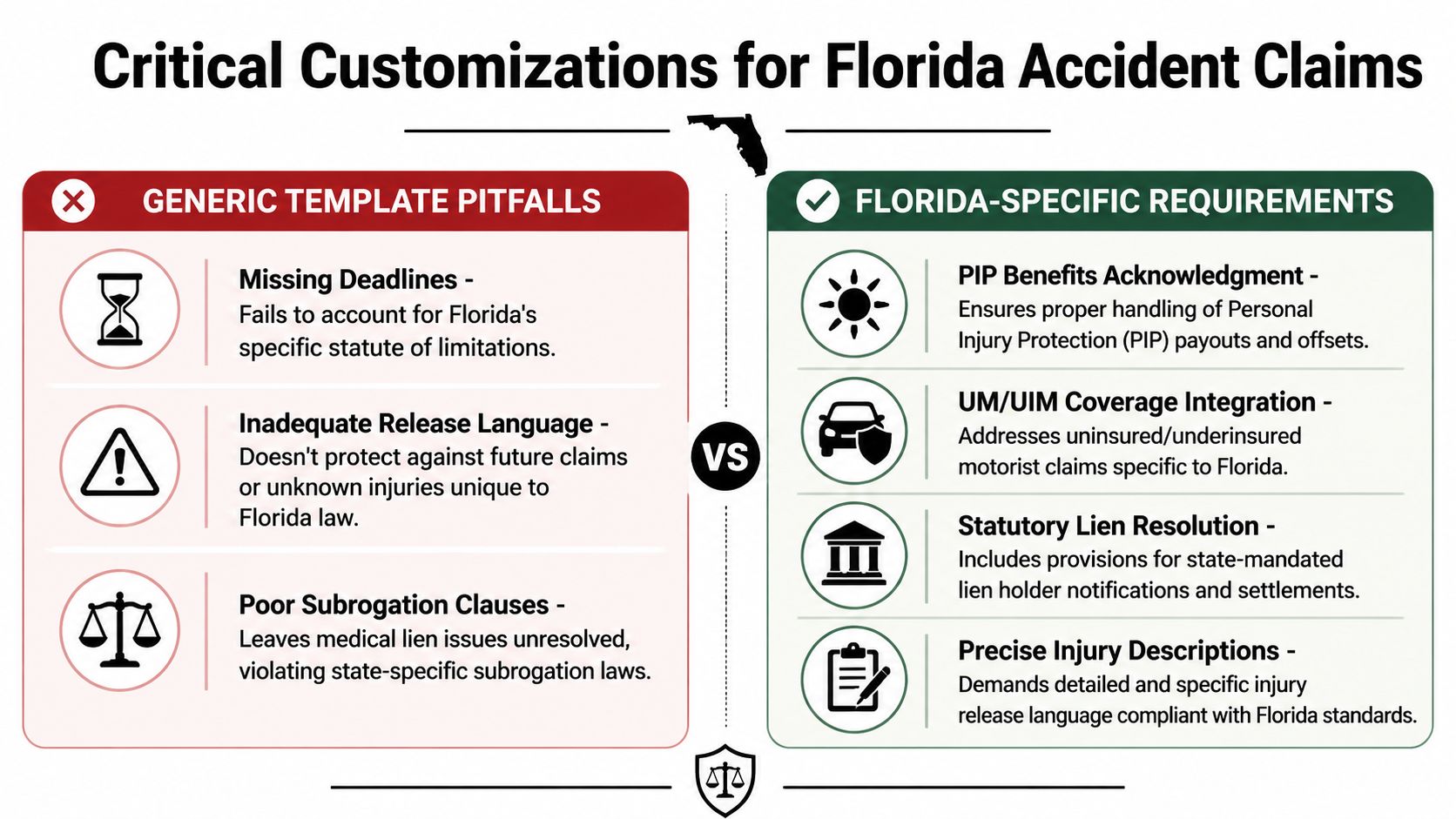
Critical Customizations for Florida Accident Claims
The biggest mistake I see with online forms is the assumption that one release works for every Florida crash. It doesn't.
Florida claims often need narrower drafting because the practical question isn't just “Are you settling?” It's “What exactly are you settling, and what are you intentionally leaving open?” That distinction can preserve a valid injury claim or destroy it.
Property damage isn't the same as bodily injury
A major weakness in many templates is that they fail to distinguish a vehicle-damage-only settlement from a full personal-injury release. The wrong wording can unintentionally bar later claims for medical treatment or pain and suffering, a risk highlighted in Genie AI's discussion of private car accident settlement agreements.
This matters in Florida because some injuries don't present fully on day one. Soft-tissue complaints may look minor right after the crash and become more serious as treatment develops.
What a Florida property-damage-only release should accomplish
A narrow release should make clear that:
The payment resolves only vehicle loss: The agreement should refer specifically to repair costs, total-loss value, towing, storage, or related property items.
Injury claims are preserved: The document should say bodily injury, medical expense, pain and suffering, and other personal injury claims are not being released.
No accidental global waiver sneaks in: Avoid catch-all language releasing “all claims of every kind” unless you mean it.
A short phrase can make a major difference. “This release applies only to property damage arising from the accident” is very different from “full and final settlement of any and all claims.”
PIP and related Florida issues need deliberate wording
Florida drivers also need to think about PIP, because it sits in the background of many injury claims. A generic template may say nothing about benefits already paid, possible offsets, or whether the settlement amount is meant to include categories that were handled elsewhere.
That doesn't mean every agreement needs a long insurance treatise. It does mean the document should be consistent with how the claim was handled. If your own coverage paid part of the medical loss, the release shouldn't carelessly create confusion about what was included in the third-party settlement.
Don't ignore fault allocation issues
Florida claims also raise settlement decisions tied to responsibility. If there's any argument that you share blame, release language and negotiation posture need to account for it. A broad overview of that issue is available in this explanation of comparative negligence in Florida.
A generic form treats your case like paperwork. A customized Florida release treats it like a legal decision.
Watch for overbroad party definitions
Another common drafting problem is releasing people or entities that were never part of the negotiation. Some forms try to sweep in affiliates, agents, unknown persons, manufacturers, or other third parties.
That may be harmless in some cases. In others, it can cut off claims you didn't intend to waive. If there is any possibility that another party contributed to the crash or the injuries, broad release definitions deserve a very careful edit.
Related reading:
Is Your Auto Accident Settlement Taxable? a Florida Guide
How Much Can Someone Sue for a Car Accident
Auto & Rideshare Accidents
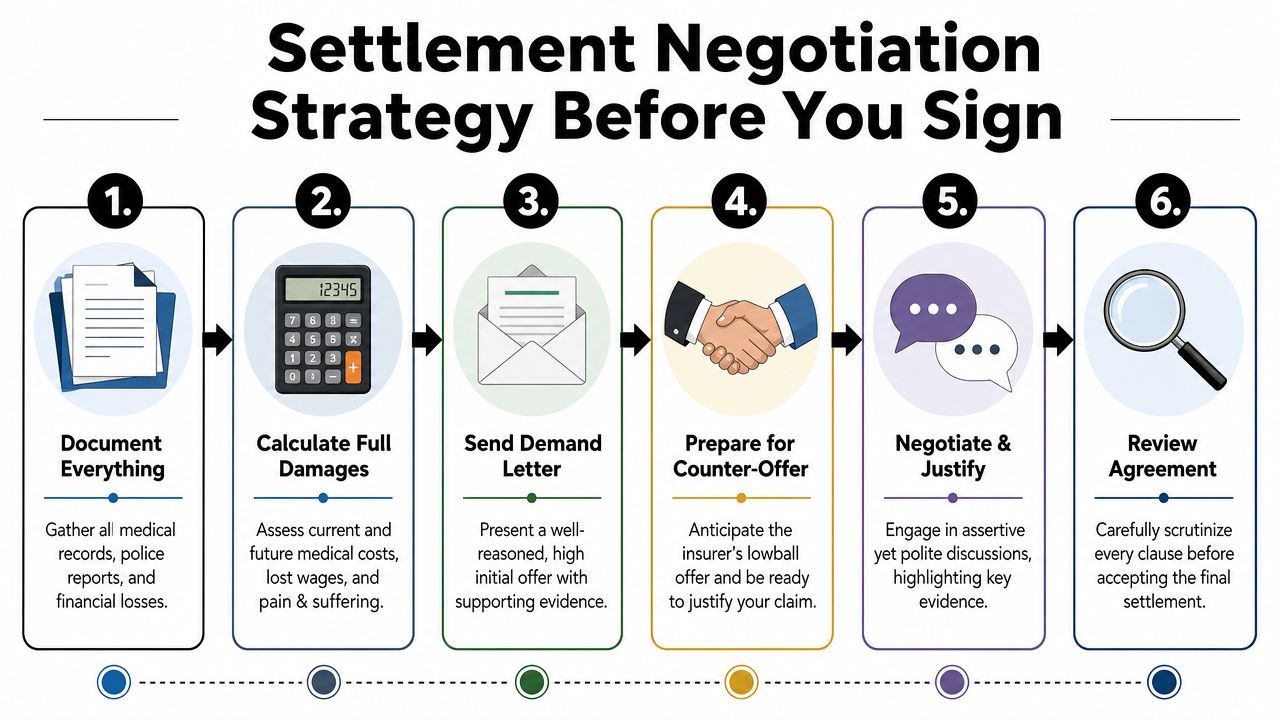
Settlement Negotiation Strategy Before You Sign
By the time a release lands in your email, most of the meaningful work should already be done. The strength of the final agreement depends on what you gathered, documented, and argued before anyone drafted the closing papers.
The best workflow is straightforward: gather evidence, quantify damages, send a demand letter, and finalize the release only after maximum medical improvement and updated medical records are clear. The process takes slightly less than one year on average, with a typical range from a few months to two years, according to The Law Dictionary's overview of the auto accident settlement process.
Build the claim before you discuss the release
A release should be the last document, not the first priority. If you settle before you have the medical records, billing support, lost-income proof, and a stable treatment picture, you're negotiating in the dark.
That's why early low offers are dangerous. They often arrive before the paper trail is complete and before your body has told the full story.
A practical pre-sign checklist
Collect the records
Get the crash report, photos, repair documents, medical records, billing statements, and proof of missed work.Separate paid bills from unpaid balances
This sounds small, but it matters later when liens, reimbursements, and net recovery are calculated.Prepare a demand package
A good demand letter doesn't just ask for money. It connects the crash, the injuries, the treatment, and the losses in a way the adjuster can evaluate.Wait for a reliable medical picture
If treatment is still changing, the value picture is unstable too.Negotiate the amount first
Don't let the insurer shift the conversation too quickly to signatures and forms.Review the release against the deal
The final document should match the negotiated scope exactly.
What works better than arguing with the adjuster
Many people think negotiation means aggressive phone calls. Usually it doesn't. The better approach is organized proof.
Use records. Use chronology. Use billing support. Use a concise explanation of how the crash affected work and treatment. When the adjuster sees a well-supported file, the conversation changes from dismissal to evaluation.
The strongest settlement leverage usually comes from documentation, not volume.
Don't confuse speed with progress
Some claims settle quickly because the injuries are clear and limited. Others take longer because treatment is ongoing, records are incomplete, or the insurer is testing whether you'll accept less out of frustration.
A rushed signature can wipe out the upside of careful treatment and documentation. If the claim isn't ready, the release isn't ready either.
Managing Medical Liens and Subrogation After a Settlement
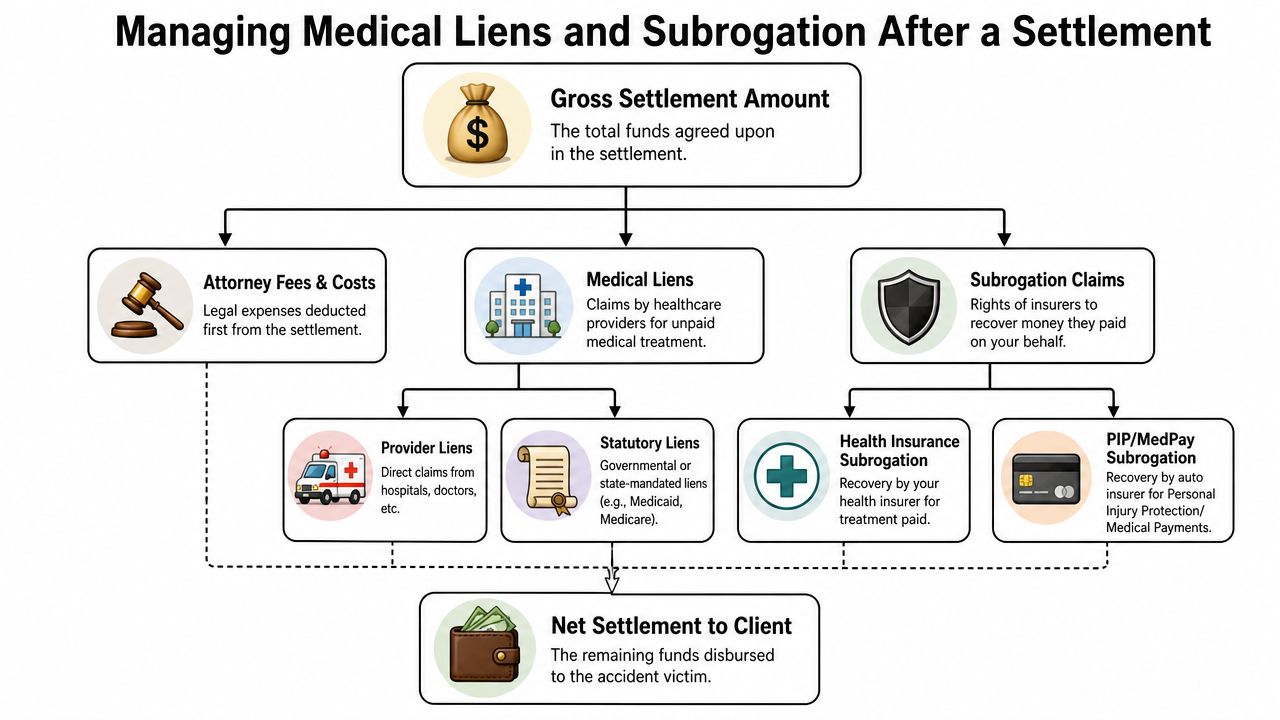
A settlement number is not the same thing as the amount you put in your pocket. After a Florida accident claim resolves, several parties may still have a claim on those funds.
Clients often feel blindsided at this point. They hear the gross settlement amount and assume that's the recovery. Then they learn that fees, costs, unpaid treatment balances, lien claims, and insurance reimbursement issues all have to be addressed before the final disbursement.
What liens and subrogation really mean
A medical lien is a claim that a provider or other legally recognized party has against your settlement because treatment was provided and remains payable from the recovery.
Subrogation usually refers to the right of an insurer or benefit payer to seek reimbursement for money it paid on your behalf.
These issues are easy to underestimate because they often aren't fully visible when the insurer first offers settlement.
Why this affects your net recovery
Settlement agreements are final, insurers commonly issue payment within two to four weeks after the release is signed, and attorney contingency fees are often 33% to 40% of the settlement before medical liens and expenses are deducted, according to Beck & Beck Missouri car accident settlement guidance.
That's why lien review isn't cleanup work. It's part of settlement strategy.
Questions to answer before the check arrives
Who paid for treatment already: Your PIP carrier, health insurer, a provider working under a letter of protection, or a government program may each have different rights.
What balances remain open: Some providers have not been paid at all and expect payment from the settlement.
What must be resolved before disbursement: If a valid claim exists, ignoring it can create future trouble.
Whether reductions are possible: Many lien and balance issues can be negotiated, but only if someone identifies them early.
The release should not create a new problem
A settlement agreement sometimes includes indemnity language requiring the injured person to protect the insurer from later medical claims tied to the accident. That language needs close review.
If the insurer insists on broad protection, you need to know what unresolved claims exist before you accept that burden. Otherwise, you may sign an agreement that shifts avoidable risk onto you.
Client-side focus: Don't ask only, “What is the settlement amount?” Ask, “What gets paid from it, and what remains my responsibility?”
A better way to handle the post-settlement phase
The cleanest process usually looks like this:
Identify every payer early: Don't wait until the release is signed.
Confirm balances in writing: Estimate is not enough. Get payoff information where possible.
Review statutory or government-related obligations carefully: Those need special attention.
Negotiate before final disbursement: Once numbers are fixed and the file is closing, the bargaining position changes.
Document the final distribution: You should be able to see where every dollar goes.
Clients are often relieved once they understand this part of the claim. The issue isn't that money is “disappearing.” The issue is that settlement funds must be distributed in the right order and with full visibility.
Finalizing Your Settlement Agreement and Getting Paid
The last stage should feel administrative, but don't switch to autopilot. Here, the settlement becomes binding.
Read the final release line by line. Confirm the names, accident date, payment amount, and scope of the release. If the settlement is limited to property damage or another narrow category, make sure the final document still says that. Insurers sometimes send standard forms that are broader than the negotiated deal.
Final signing checklist
Confirm the document matches the agreement
Before signing, verify:
The amount is correct: It should match the negotiated figure exactly.
The release scope is correct: Global settlement and partial settlement are not the same thing.
The payee details are correct: Especially if payment is going through counsel's trust account.
There are no surprise add-ons: Watch for confidentiality clauses, indemnity language, or party definitions that weren't discussed.
Handle execution carefully
Some releases require signatures from all claimants. Others may need witness or notary formalities depending on the form used and the parties involved. Follow the instructions exactly and keep a complete copy of what you signed.
Return the executed agreement in a way you can track. Email is common, but keep the sent copy, attachments, and any confirmation from the adjuster or defense representative.
What happens after signing
Once the release is accepted, payment usually follows the insurer's internal processing steps. If you're represented, the check often goes to the attorney trust account, where fees, costs, and approved lien payments are handled before the net funds are disbursed.
If you want a broader overview of the closing stages of a claim, this car accident settlement guide is helpful.
One last caution
Don't treat an auto accident settlement agreement template like a fill-in-the-blank form you can complete without judgment. The template is only as good as the edits made to fit your claim.
In Florida, the most common bad result isn't that the agreement fails. It's that it works exactly as written, after the injured person signs language they didn't fully understand.
If you're dealing with a Florida car accident claim and aren't sure whether the release in front of you is limited, fair, or dangerously broad, The Law Office of John P. Sherman, PLLC can help you review the agreement, protect injury-related rights, and make sure liens, PIP issues, and settlement terms are handled strategically before you sign.